EIGHTEEN years ago, Hannah Bhagwandeen captured the hearts of citizens locally and abroad, as the baby girl born with a rare liver disease struggling to hold on to life.By her first birthday, she had undergone a Kasai operation and two liver transplants. But the little girl persevered.She went on to write the Secondary Entrance Assessment (SEA) examination and reached a remarkable milestone last month when she graduated from secondary school.
A LIFE FULL OF PROMISE: Hannah Bhagwandeen, left, with her parents,Joshua and Thalia Bhagwandeen, and sister, Leah.
CelebratING Resilience: Hannah Bhagwandeen at her martial arts class.
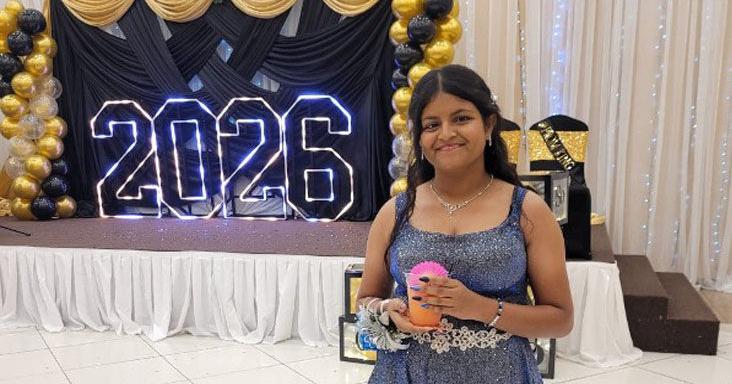
Last week The Express reached out to Hannah, who is hearing impaired.She said: “I feel proud and happy that I finally finished school and I am glad I got through in school even with my ups and downs such as homework, assignments and SBAs.”Hannah thanked her parents and younger sister for their support.“I managed it with time and effort also with my supportive parents. Being disabled doesn’t means you can’t do things you want to do, there are ways you can enjoy life”, she said.But for Hannah’s parents, Joshua and Thalia Bhagwandeen, watching their little girl cross the stage on graduation day was so much more than an academic achievement.“It was a testament to her resilience, perseverance, and unwavering determination in overcoming the many challenges she has faced throughout her life,” her mother said.She said Hannah wrote the SEA examination during the Covid-19 pandemic, a challenging period for all students. But for Hannah, it was extremely difficult because of her hearing impairment.“Like many children, she had to adapt to disruptions in learning, online classes, and uncertainty surrounding examinations. And throughout her five years at secondary school, Hannah continued to face challenges because of her hearing impairment. She required classroom support from an aide who assisted with instruction and ensured she could fully participate in lessons. There were times when she struggled to keep up when aides were not available,” her mother said.Hannah continued to thrive, she said, with patience and understanding from her teachers. And she excelled academically.Outside of the classroom, Thalia Bhagwandeen said, her daughter enjoyed martial arts, and recently participated in the Pan-Caribbean Martial Arts Tournament, earning two medals. “She loves art and craft, especially creating stretch beaded hand-bands,” she said.But her most precious moments, the mother said, was spending time with her younger sister, Leah. “The sisters share a very close bond and enjoy training in martial arts together. Leah also enjoys playing cricket, giving her a passion for sports, and the two sisters are always encouraging one another in their different pursuits. They look out for each other every day—Leah is always willing to help Hannah whenever she needs support, while Hannah is equally caring and protective of Leah. Their relationship is built on love, mutual encouragement, and unwavering support,” she said.Joshua Bhagwandeen, who gave part of his own liver to save his little girl, added that with Hannah’s medical condition learning became a family effort. The family incorporated various styles of learning—charts, flash cards, YouTube videos—and remained in contact with her teachers to get assignments done, he said.And in June, Hannah completed her CSEC examination and was part of the school’s graduating class, an emotional and joyful celebration for her family.Graduation—amoment of hope, faith and perseveranceJoshua Bhagwandeen said, “Watching her walk across the stage to receive her certificate was a moment that represented years of hope, faith, and perseverance. It was not just the end of secondary school—it was a celebration of overcoming extraordinary challenges. It brought tears to my eyes, seeing how much she has struggled, but made it through. We are very proud of Hannah.”Hannah even got dressed up and attended her graduation ball, creating lasting memories with her friends.Her parents say they would support whatever Hannah wants to pursue. But right now, the young lady plans to spend her free time making bracelets and practicing her martial arts.Joshua Bhagwandeen said his daughter continues to receive specialist medical care, with regular clinic appointments and blood tests to ensure her transplanted liver continues to function well.“She takes lifelong anti-rejection medication every day, which is essential to protect her transplanted liver. And because these medications suppress her immune system, she must also be careful to avoid infections and maintain a healthy lifestyle. While there will always be ongoing medical monitoring, Hannah is able to enjoy many of the activities of a typical young adult,” he said.For Thalia Bhagwandeen, her greatest wish is for her daughter to be happy and to never feel restricted because of her disabilities. “We want her to continue to be the loving, kind, caring and wonderful person she already is,” she said.To parents caring for children with disabilities, the mother said, “My advice to parents is never lose hope. There will be difficult days, moments of uncertainty, and times when you feel overwhelmed, but don’t give up. Ask questions, advocate for your child, and celebrate every small victory.”She said it was important to have a strong support system and to always let the child know that they are capable of achieving their dreams despite the obstacles they may face.“We are fortunate that God has blessed us immensely with Hannah and her journey has taught us that resilience, love, determination, and hope can carry a family through even the most challenging circumstances,” she said.About HannahIn December 2007, when the Claxton Bay couple welcomed their first-born child, she was given a clean bill of health and allowed to go home.However, six weeks later baby Hannah was diagnosed with biliary atresia, a rare liver disease which affects one in every 20,000 babies.Before her first birthday, Baby Hannah underwent a Kasai operation, followed by a liver transplant.Her father, Joshua Bhagwandeen, gave a piece of his liver to save the life of his little girl.A second liver transplant was done three months later from an unknown cadaveric donor.The surgeries were performed at the Johns Hopkins Medicine International in Baltimore, Maryland, USA.The child’s plight was highlighted in the Express and readers—locally and abroad—made contributions towards her million-dollar medical expenses.The anti-rejection medication, however, caused Hannah to lose hearing in both ears.In 2010, she received a cochlear implant in her left ear at The Hospital for Sick Children (Sick Kids) in Toronto, Canada.A cochlear implant is a surgically implanted device that helps overcome problems in the inner ear, or cochlea.The cochlea is a snail-shaped, curled tube located in the area of the ear where nerves are contained.Its function is to gather electrical signals from sound vibrations and transmit them to the auditory nerve (hearing nerve).The hearing nerve then sends these signals to the brain, where they are translated into recognisable sounds.By age five, Hannah had faced more challenges than many people do in a lifetime.She had undergone nine major surgeries and her struggles were far from over.But somehow, Hannah continued to beat the odds and inspire doctors and patients at medical institutions locally and abroad.Hannah endured major setbacks, her parents said, weight loss, hair loss and acute renal failure.But that little girl never gave up and she thrived.