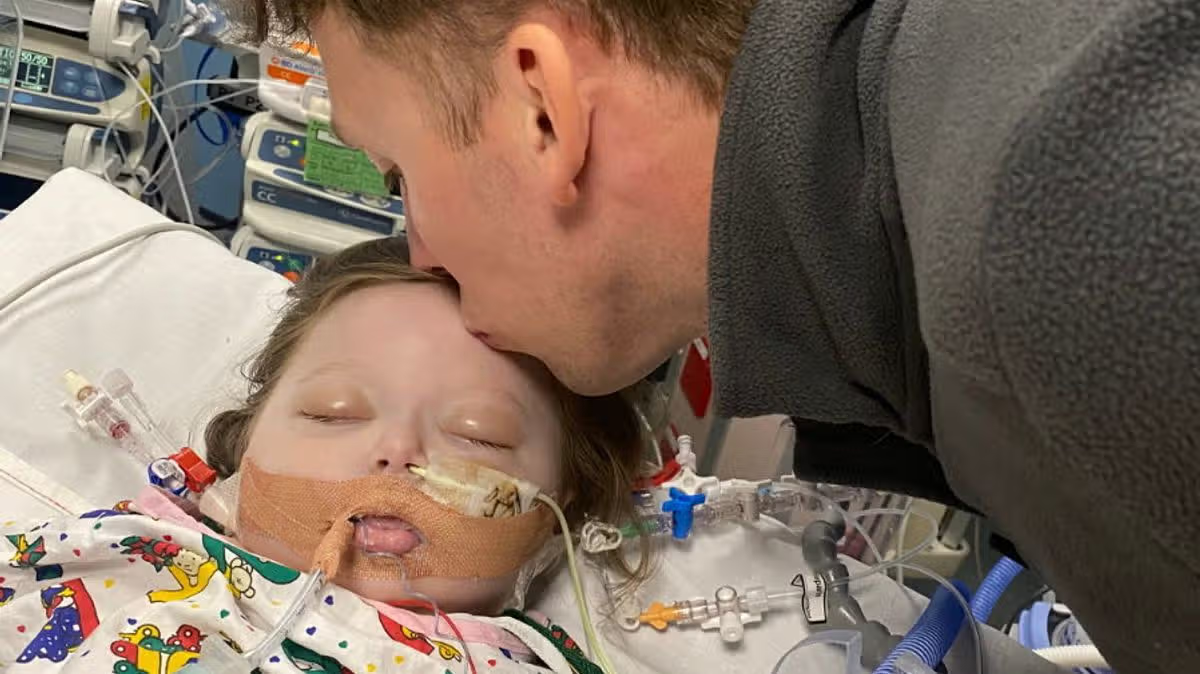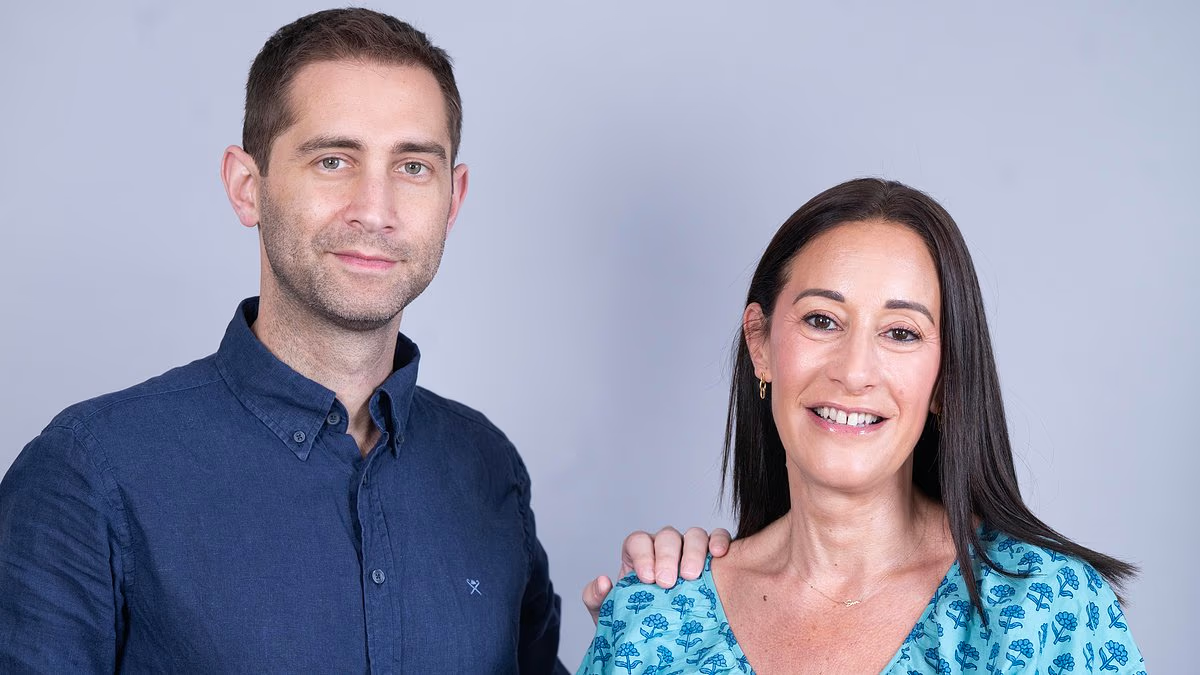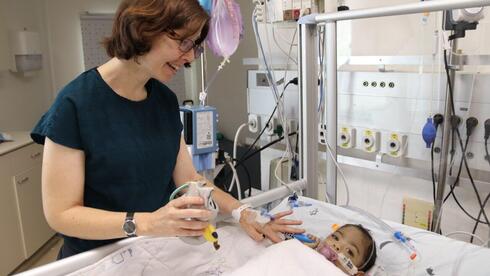
Twenty-two years after her father died of liver disease waiting for a donor, Dr. Talya Eden fulfilled a dream, donating part of her liver to Bissan, an 8-month-old Jerusalem baby: 'I think Dad would be proud of me'When Dr. Talya Eden, 39, a lecturer and researcher in computer science at Bar-Ilan University, was 17, her father died. He had been waiting for a liver transplant that never came. A week and a half ago, at age 39, she donated a liver lobe to 8-month-old Bissan from Jerusalem, saving her life."Seeing the girl recover after the surgery and knowing I had a part in it — there is no better feeling. Truly, whoever saves one life, it is as if they saved an entire world," Eden says.3 View gallery Donor Talya Eden with baby Bissan (Photo: Schneider spokesperson’s office)"It burned inside me all these years, the feeling that I could not save him, but maybe I could do it for someone else. It is an incredible sense of fulfillment, a full-circle moment. A transition from the helplessness I felt then as a teenager to a sense of control. At the same time, there is a deep longing for my father, but that will always be there," she said.Talya’s father, the late Sorin Abram, was diagnosed with hepatitis C, a chronic liver disease caused by the HCV virus, when she was a toddler. Over the years, his condition deteriorated. He suffered from cirrhosis, was in life-threatening condition and needed a transplant."Throughout high school, we knew it would either come down to a donation or he would be sentenced to death," she says. "At the time, altruistic liver lobe donation was not accepted practice, and we depended on people signing an Adi donor card for deceased donation. It was a very difficult experience of helplessness, growing up with a father who needed a liver transplant and having no ability to influence that."Since her father died 22 years ago, Eden had carried with her the desire to donate a liver lobe altruistically. In her 20s, she first contacted the National Transplant Center and asked to donate part of her liver to a stranger, but was told she was too young and should first complete her pregnancies."Since then, it stayed in my mind," she says. "I have a doctorate in computer science, we are on a very demanding life track, but I always knew it would happen. I waited for the children to grow enough and for life to stabilize a little."Last September, Eden decided to try again. She contacted the National Transplant Center and began a screening and testing process. Several attempts almost went ahead but were canceled at the last minute, until about two weeks ago, the call came.3 View gallery From right: nurse Aya Nasser of Schneider’s intensive care unit; liver lobe donor Dr. Talya Eden; baby Bissan; Dr. Michael Gurevich, director of the Liver Transplant Unit; Dr. Yael Mozer-Glassberg, director of the Liver Transplant Recipients Unit; and Prof. Orit Weisbord-Zinman, director of the Liver Disease Service (Photo: Schneider spokesperson’s office)"The transplant coordinator called and told me there was an Arab girl who needed a liver transplant. It was already the third time I had received such a call, and I told myself I was not going to prepare myself emotionally again, and when it happened, it would happen. Then, a few days later, they were already talking to me about a date, and I realized it was really happening," Talya says.The baby, Bissan, 8 months old and a resident of Jerusalem, was born with a rare liver defect. In recent months, her condition deteriorated and reached life-threatening liver failure. She urgently needed a transplant, but her close relatives were found unsuitable to donate."After it turned out that my husband and I were not suitable donors for her, I had many fears," says her mother, Omaima. "I was afraid to see my daughter suffering before my eyes without being able to help her. When I received the news that a suitable donor had been found, I felt enormous relief and great joy. There was a feeling of hope after a very difficult period. Suddenly, I felt there was a real chance my daughter would receive the treatment she needed."The transplant was originally scheduled to take place today, but Bissan’s condition deteriorated and doctors determined that without an immediate transplant, she would not survive. Talya first heard about it while on her way to Ben-Gurion Airport for a work trip."I called to get an update on the date of the surgery, and then they told me they were not sure when the transplant would be and that they were trying to move it up because the girl’s condition was not good," she says. "I asked what would have happened if I were not traveling, and then they said they would have performed the transplant within a day or two."At that moment, Eden decided to cancel the trip."I could not travel after hearing the girl was in that condition," she says. "I knew I would not endanger her condition for a work trip, that it could not be a consideration at all, only what was best for her medically."After the trip was canceled, the transplant took place about a week and a half ago."I was not afraid of the surgery. I was a little afraid of the recovery and of the week after the surgery, when you are helpless and dependent on people," Talya says. She says that despite the concerns, her family supported the decision."My husband knew even before we got married that this was one of the things on my list. It was hard for him because he was really worried, but he is sweet and supportive and there is no one more wonderful than him. We told our children, ages 8 and 10, only right before the surgery. We did not want them to worry. My younger son was very excited and really wanted to hear about all the medicine behind it."The surgery, which lasted about six hours, was successful, and last week Talya met Bissan and her family for the first time."It was very moving. The girl looked like everything would be OK with her. I have no way to describe it. This whole week was a wave of overwhelming excitement," she says.At the beginning of the week, Talya was discharged home to continue her recovery."The first week was a little difficult. It is abdominal surgery, after all, but the staff was amazing, and so were my family and friends. I was surrounded on all sides, and now I feel really fine," she says.3 View gallery Dr. Talya Eden and her father, the late Sorin Abram, who died when she was 17 (Photo: Family album)"Few people know that altruistic liver donation is even possible — that one can donate a liver lobe and continue living a full and healthy life, because it is a unique organ that can regenerate and grow back," says Dr. Michael Gurevich, director of the Liver Transplant Unit at Schneider Children’s Medical Center, part of Clalit Health Services."Although a period of recovery and recuperation is required, in the long term, the health risk to the donor is very low," he says. "Right now, on the eve of Shavuot, we performed another altruistic liver transplant for another girl, the second in just five days. This is an unusual and exceptional event, since these transplants are rare, certainly in such close succession. We are closely monitoring both girls and very much hope for their continued good recovery.""Knowing I had a part in this — there is no better feeling," Talya adds. "Even someone who cannot donate altruistically can sign an Adi donor card. It is so important. People do not always understand what it means for others. It is something I would expect everyone to do."And how does she sum up the experience? "I think my father would have been proud of me."
Woman whose father died waiting for liver donor gives part of her liver to baby she never met
Twenty-two years after her father died of liver disease waiting for a donor, Dr. Talya Eden fulfilled a dream, donating part of her liver to Bissan, an 8-month-old Jerusalem baby: 'I think Dad would be proud of me'
1,325 words~6 min read