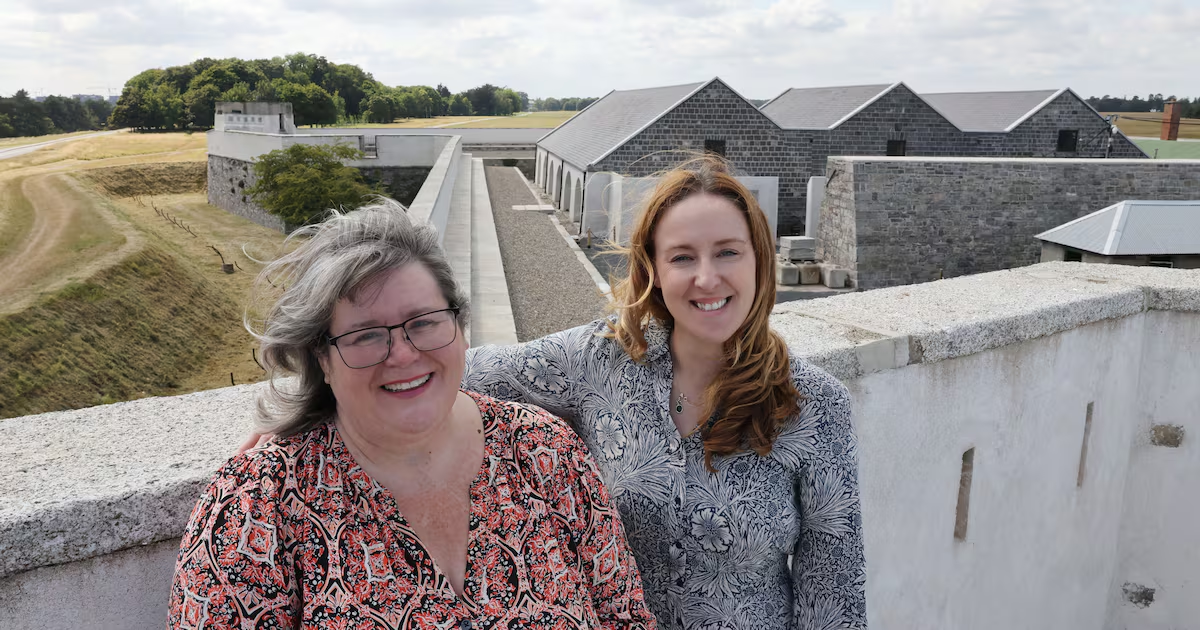
The first shots of the 1916 Rising were fired at the fort on Easter Monday when it was raided for arms by Na FiannaMagazine Fort: The ‘newest’ 400-year-old visitor attraction in Dublin’s Pheonix Park Video: Alan Betson Mon Jul 27 2026 - 06:00 • 4 MIN READThe historic Magazine Fort in Dublin’s Phoenix Park, once one of the most important military sites in the city, is finally open to the public following a €5 million repair and conservation project.The fort was built in 1736 on the orders of the duke of Dorset, then lord lieutenant of Ireland, to store gunpowder and ammunition that had until then been kept at Dublin Castle, perilously close to the heart of the city. The chosen site in the Phoenix Park was a high spot on its southern side with commanding views over the river Liffey and the Dublin mountains, a prime location for a military fortification. Unfortunately, it was already occupied by Phoenix House, a Jacobean mansion built the previous century and once home to Henry Cromwell, son of Oliver, but such was the importance of the site from a strategic vantage, that the house was razed. The fort was expanded between 1739 and 1801, with work to raise its parapets and widen its ramparts to accommodate gun emplacements and four corner “cavaliers”, or firing platforms. In 1801 a “ravelin”, a triangular outer defence protecting the gateway, was added, providing accommodation for officers, soldiers and their families. This additional structure gave the fort its star shape, and by this point it was second only to Dublin Castle in importance as a military facility.The first shots of the 1916 Rising were fired at the fort on Easter Monday when it was raided for arms by Na Fianna. George Playfair, son of the fort commander, went to raise the alarm and was shot dead leaving the park.Magazine Fort in Dublin’s Phoenix Park. Photograph: Alan Betson/The Irish Times The fort was under British control until 1922 when it was handed over to the Irish Army. It continued to be used as an ammunition store into the mid-20th century and remained under the management of the Defence Forces until 1988, when it was decommissioned and transferred to the Office of Public Works (OPW).It later fell into increasing dereliction, and was prey to vandalism and the theft of lead from the roofs of its principal buildings: the three vaulted gunpowder stores measuring up to 30.5m in length.The buildings underwent some repairs to allow the fort to be opened to limited tours for the centenary of the Rising, but largely it remained unused for almost 40 years. The OPW in 2021 announced a major conservation and redevelopment project to open it to the public. Work began in 2023 and the restoration has now been completed, allowing it to be opened for daily tours.“We knew from the start the site needed key fabric repairs and structural repairs and that informed the scope of what we could do,” says Audrey Farrell, senior conservation architect with the OPW.The renovated exterior walls of the Magazine Fort. Photograph: Alan Betson/The Irish Times Restoration and reconstruction work at the fort began in 2023. Photograph: Alan Betson/The Irish Times “Primarily, that was the structural stabilisation and repairs of the original 1736 rampart wall, we repointed and rendered basically half a mile of walls. Then there was the restoration of the three magazine buildings themselves, that’s the three arched vaults where the gunpowder was stored. They needed repairs to the exterior, the roof and the walls to make sure they were watertight.”One of the most visually arresting elements, and a project which took some considerable detective work, was the reconstruction of the original arched entrance, known as the Duke of Dorset Gate, which had been dismantled by the Army in the 1970s to provide vehicular access.[ Frank McNally on the ups and downs of Phoenix Park historyOpens in new window ]“Even though it was only the 1970s when they were taken down, we had no records of what it looked like, no historic drawings or plans. Then research by John McCullen [former chief park superintendent] turned up a single photo, of Peggy, the daughter of the fort caretaker Larry Cunningham, on her wedding day in 1969 coming through the arch, and from that we were able to piece it back together.”The work was undertaken by a master stonemason and apprentices, who used the few remaining original stones and carved new ones to rebuild the gate.In addition to restoration and reconstruction work, the project also unearthed a wealth of artefacts, Farrell says.“We found quite a few detonator tops, but thankfully nothing explosive attached to them; an Irish Republican Brotherhood button, that probably came off in one of the raids; and plenty of clay pipes, even though they shouldn’t have been smoking anywhere near here. We did then find what we thought was a timber post, but it was actually a degraded explosive that had been missed by housekeeping, so we did have to have the bomb squad out for that one.”The reinstated Duke of Dorset Gate at the Magazine Fort. Photograph: Alan Betson/The Irish Times The interior of the gunpowder stores in the Magazine Fort. Photograph: Alan Betson/The Irish Times The gunpowder stores and the blast wall at the Magazine Fort. Photograph: Alan Betson/The Irish Times The fort is now accessible through free guided tours, seven days a week, but the project is continuing to evolve, says chief park superintendent Margaret Gormley.“What we’ve done is phase one, the fort is stabilised and we can bring people in to showcase the conservation work that has been done to date. You’re coming into a raw industrial site, and getting the military, social and architectural history of the fort.”[ Donal Fallon: The story of Ireland is there in the Phoenix ParkOpens in new window ]The next phase will involve visitor facilities, a coffee dock and a base for the guides.“This has the potential to be a huge tourist attraction, not just for the park, but for Dublin. There is no other fort in Dublin,” Gormley says. “The OPW is keen to progress this project. So much has been achieved, but we are ambitious to take it to the next level.”Guided tours can be booked at phoenixpark.ie IN THIS SECTION
Phoenix Park’s Magazine Fort opens to visitors with guided tours available
The first shots of the 1916 Rising were fired at the fort on Easter Monday when it was raided for arms by Na Fianna
1,047 words~5 min read