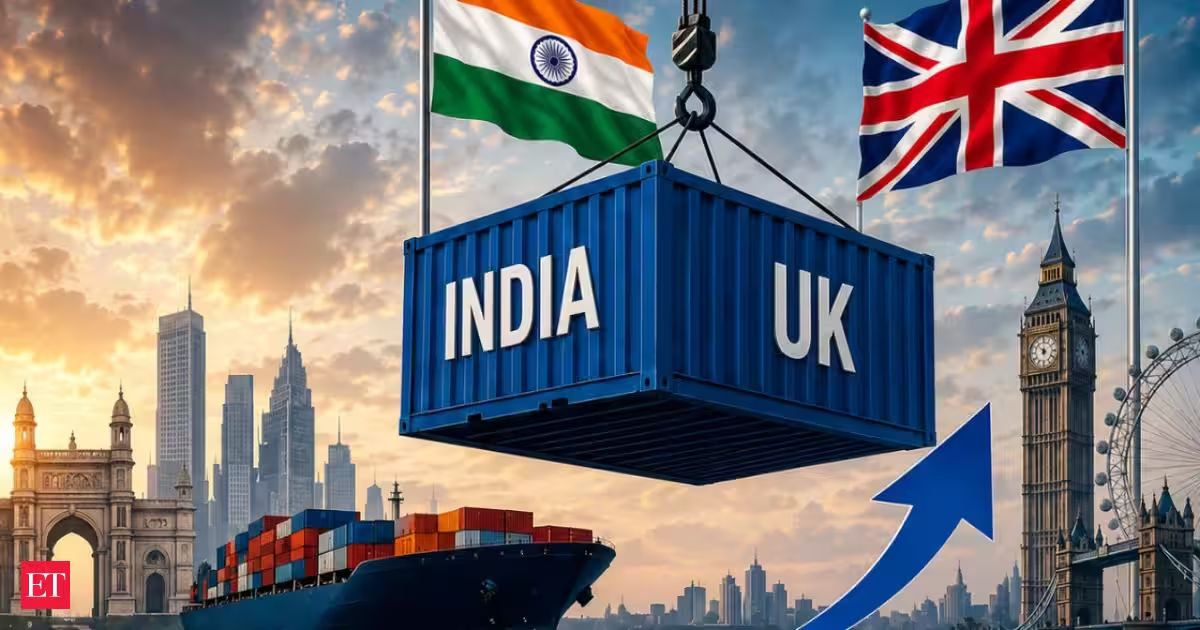
The India-UK CETA is far more than a trade agreement. It provides the foundation for a deeper manufacturing partnership
| Photo Credit:
On July 15, 2026, as the India-UK Comprehensive Economic and Trade Agreement (CETA) came into effect, the Government of India flagged off one of the first export consignments under the Agreement. The consignment was from Brakes India, an Indian automotive components manufacturer.There could scarcely have been a more appropriate symbol. It underscored the growing stature of India’s automotive components industry and the confidence that Indian companies have earned in global markets through decades of investment in quality, technology and engineering excellence.In many ways, that first shipment marked the beginning of a new chapter, one in which India is increasingly recognised not merely as a competitive manufacturing destination, but as a trusted partner in shaping the future of global mobility.More than a trade pactThe India-UK CETA is far more than a trade agreement. It provides the foundation for a deeper manufacturing partnership that combines India’s scale and manufacturing competitiveness with the UK’s strengths in advanced engineering, innovation and technology. The timing is significant. As the global automotive industry navigates geopolitical uncertainty, supply chain realignments and rapid technological change, trusted partnerships have become as important as competitive costs.India’s automotive components industry enters this new phase from a position of strength. Today, it is a $86 billion industry with exports of $24 billion, reflecting decades of investment in engineering capability, quality systems and manufacturing excellence.The UK is already an important partner. Automotive components export to the UK grew by nearly 11 per cent during FY26 to $801 million, highlighting the complementarity between the two industries. India has emerged as a globally competitive supplier across a broad spectrum of automotive products, while the UK remains a leader in advanced engineering, research, testing, design and next-generation mobility technologies. Together, these strengths create opportunities far beyond bilateral trade. As the industry transitions towards electric, connected and software-defined vehicles, the partnership can accelerate innovation, attract investment and strengthen resilient global supply chains.For India’s MSMEs, the agreement offers an opportunity to deepen technology partnerships, upgrade capabilities and integrate more closely with global value chains. Ultimately, the success of the India-UK CETA will be measured not by tariff reductions alone, but by the supplier relationships, technologies, investments and globally competitive products it helps create.The first consignment under the Agreement may have carried automotive components, but it also carried the confidence, capability and global aspirations of India’s automotive components industry.The writer is President ACMA and Vice Chairman and MD, JK Fenner (India) LtdPublished on July 27, 2026