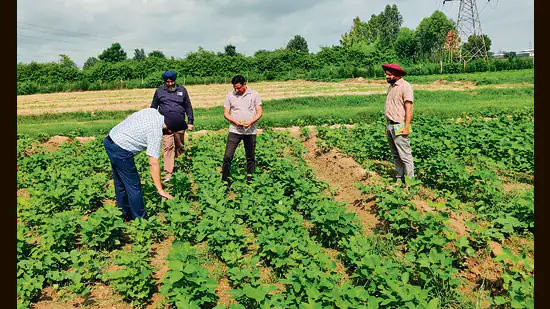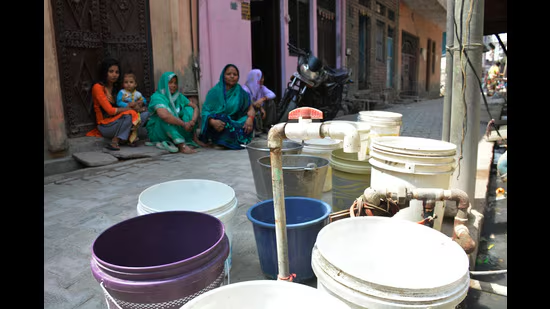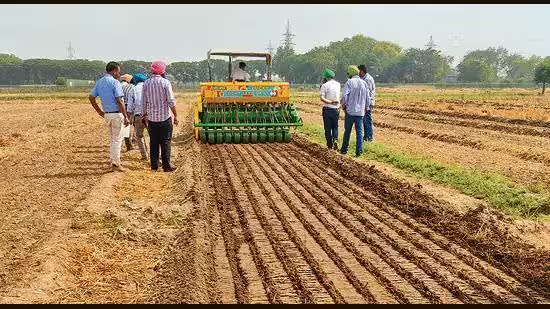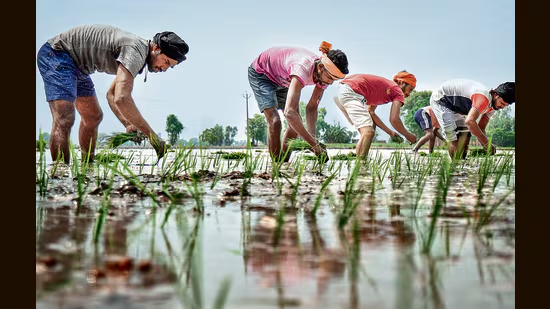
It is a welcome development for food security. Punjab farmers, who were charged with the reckless exploitation of natural resources in a quest to produce more from less, have started turning the tide in favor of environmental sustainability while maintaining productivity levels.Punjab contributes about 31 per cent of its rice produce to the national food grain basket. This helps feed 80 crore Indians under the National Food Security Scheme.Rice has never been a native crop of Punjab, as it is generally grown in regions where annual rainfall is more than 1,500 mm. Punjab receives only 550 mm of average annual rainfall. Since rice is a water-guzzling crop, Punjab meets the demand for additional water by drawing it from its subsurface aquifers. Needless to say, the underground water reservoirs, which were replenished over centuries through natural percolation, have been depleted over the last 50 years. The Central Ground Water Board has declared that if the current trend continues, subsurface water in all three aquifers of Punjab, up to a depth of 1,000 feet, will completely vanish by 2039, which is just 4,700 days away. In addition, methane, a greenhouse gas produced through oxidation-reduction chemical processes during rice cultivation in the standing water of puddled fields, is a major source of air pollution during the summers.Danger signs of overexploitation of natural resourcesYears of continuous warnings by scientists and environmentalists about the looming danger of a receding water table have now started showing positive impact on the thought process of farmers and policy planners. This change of mindset has also been triggered by the steeply falling water table. The water table, which was 40 feet deep in the year 2000, has now gone down to 400 ft. This sharp decline has not only deepened the lines of worries on the foreheads of farmers but has also prompted them to reset their farm production systems. Now, continuous and sustained farm production mechanism has gained precedence over an exploitative farming system.New practicesThe production process, or agronomy, of rice cultivation was developed in agro-climatic regions with excessive rainfall. Therefore, all factors related to rice production, including weed control, fertilizer application, insect control and nursery sowing, were developed for standing water conditions. The fact that rice can also grow in the absence of standing water was ignored. It is only during the last decade that scientists and farm practitioners realised through experimentation that rice can also be grown under Alternate Wetting and Drying (AWD) conditions.The Direct Seeding of Rice (DSR), without resorting to nursery sowing and transplantation in a pool of water, helped change the strategy of rice cultivation, reducing the water required for rice production by 30 per cent. The methodology of Seeding of Rice on Beds (SRB) added another layer of water conservation without adversely affecting productivity. Under this technique, water savings of upto 60 per cent are achieved.The changed landscapeThe area under direct seeding of rice, including SRB, has increased by 36 per cent to 4 lakh acres this kharif compared to last year, the government announced recently. This does not include the area brought under AWD and short-duration rice varieties. It is a welcome sign with positive portends.The author is a leading authority on sustainable agricultural practices and a former IAS officer, is currently heading Roundglass Foundation’s Regenerative Agriculture programmePublished on July 26, 2026
Farmers begin sustainable rice cultivation in punjab - although late, not too late
Punjab farmers embrace sustainable rice cultivation, adopting innovative practices to conserve water and enhance food security amidst environmental challenges.
551 words~3 min read