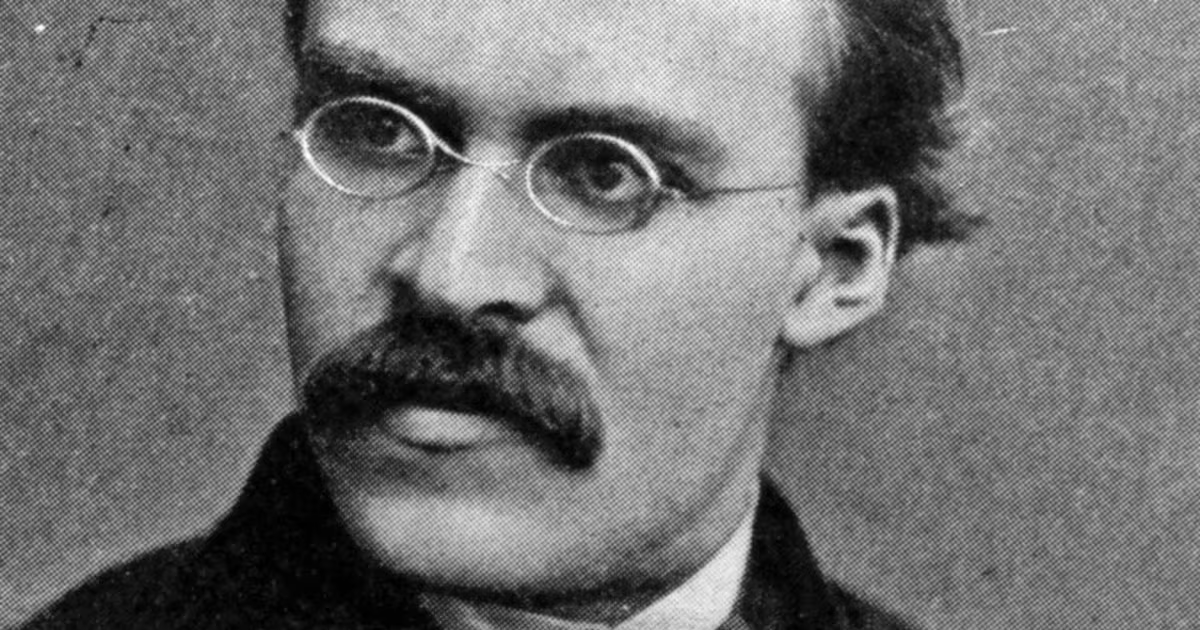
In approaching the great questions, one thing everyone can surely agree on is that no one is responsible for their own birth. In that sense, no one will ever be able to know for sure why they find themselves in the world, however fervently they may believe or wish to believe that their existence has been orchestrated by a benign power traditionally called “God”.This fact does not prevent people from raising questions about the meaning of life. It may, however, prevent them from answering them. If the ultimate origin of life is hidden from the human mind, how can the meaning of life not be hidden as well?It may have been some such calculation that led Friedrich Nietzsche to claim, albeit somewhat histrionically, in Twilight of the Idols (1888) that it was impossible, even stupid, to make value judgments on life, either for or against. As a party to the dispute, he argued, no one could at the same time be its judge.While the “value of life” may not exactly be the same thing as the “meaning of life”, the two notions have some overlap. The concepts of both meaning and value entail some sense of order, as opposed to chaos: a world without order is almost by definition a world without meaning or value. Not surprisingly, then, in the same work Nietzsche lamented: “I’m afraid we’ll never get rid of God, because we still believe in grammar.”Thus, even the notion of meaninglessness seems literally unthinkable without a belief in an ordered world. Like nihilism, meaninglessness cannot be conceived of without contradiction, since any proposed definition must assume that words have meaning independently of what any Humpty Dumpty might choose them to mean. Simply put: to say there is no truth is impossible, for at least that assertion has to be true.Yet such knock-down arguments against meaninglessness or nihilism tend to come across as quibbles or wordplay with little or no existential or emotional substance.Enter Emil Cioran (1911–1995), the Romanian-French aphorist who helpfully suggested that: “The fact that life has no meaning is a reason for living; what’s more, it’s the only one.” This gnomic utterance intimates that the only possible reason for finding life worth living is the realisation that it has no intrinsic meaning compelling recognition, and so people are free simply to decree life worth living. This approach to the question of the meaning of life is close to Nietzsche’s idea that, in the absence of any transcendent God guaranteeing meaning in the world, one is free, if one so chooses, to affirm life, warts and all. Such a choice is a kind of human “creation out of nothing” in the face of reality. There is no need to justify it. It is guaranteed by human faith alone, as it were. Curiously, in their approach both Nietzsche and Cioran appear to be in agreement with the famous medieval German Dominican mystic, Meister Eckhart (1260–1328).He famously claimed: “[F]or if life were questioned a thousand years and asked: ‘Why live?’ and if there were an answer, it could be no more than this: ‘I live only to live!’ And that is because Life is its own reason for being, springs from its own Source, and goes on and on, without ever asking why – just because it is life.”What all three thinkers appear to have in common is a sense that even to raise the question of the meaning of life is somehow to be starting off on the wrong foot, or to be looking in the wrong direction.[ Do you take the Peig Sayers or the Friedrich Nietzsche view of life?Opens in new window ]Rather than talking about the meaning of life – an expression that does not occur, at least in English translations, in any of the four canonical gospels, nor does the term “meaning” itself – Christianity speaks of a goal or final end (eschaton) for humanity, indeed for the whole of creation. For the New Testament, “here we have no abiding city” and by implication no “abiding meaning” either. Christ is understood not as the meaning of life but its beginning and end (alpha and omega), and both are hidden from direct human observation. They can be accessed, if at all, only by faith.If the latter is not forthcoming, it is difficult to see how from a Christian perspective the search for the “meaning of life” can be anything other than a wild-goose chase.Fr Martin Henry is a former lecturer in theology at St Patrick’s College, Maynooth
Opinion: Search for the meaning of life is a wild-goose chase
Rite & Reason: If the ultimate origin of life is hidden from the human mind, how can the meaning of life not be hidden as well?
752 words~3 min read