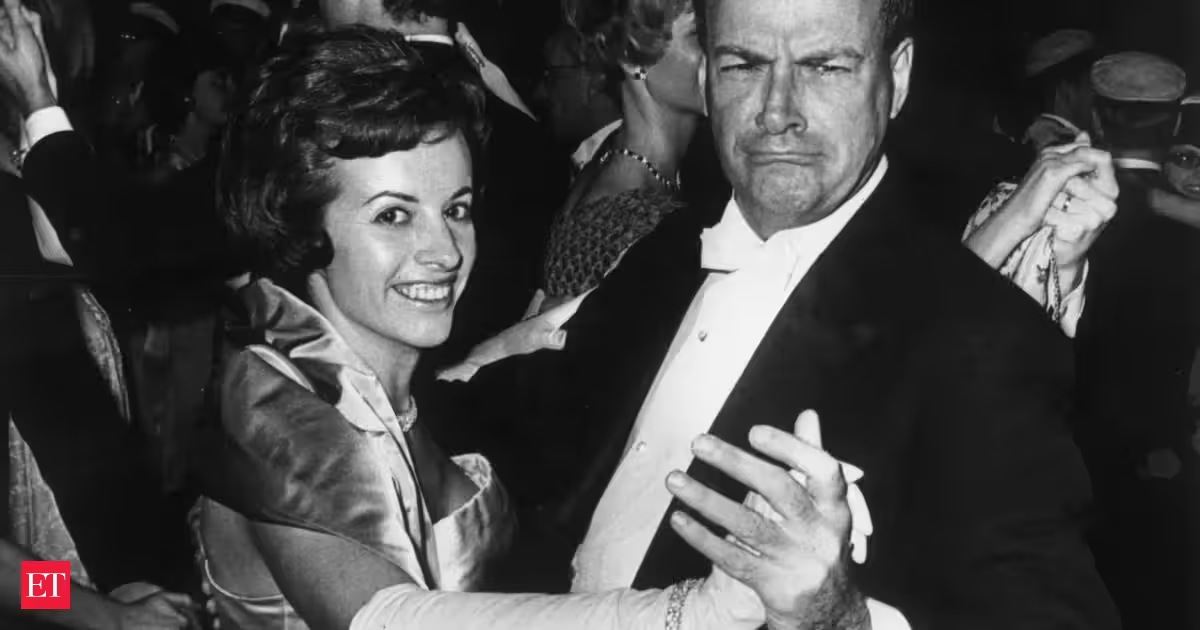
You're standing at a crossroads: a stable job that pays the bills or an idea, hobby, or project you can't stop thinking about. Friends tell you to "find your purpose," career coaches urge you to discover your passion, and social media is filled with people who seem to have everything figured out. Yet the more you search for the perfect answer, the more elusive it becomes. That tension, wanting certainty before you commit, while fearing you'll waste years if you choose the wrong path, is one of life's most universal struggles.Perhaps the problem isn't that you haven't found your purpose. Perhaps it's that you've been looking for it in the wrong place. Instead of treating meaning as a destination waiting to be discovered, what if it is something created through curiosity, action and wholehearted involvement in the things that genuinely interest you? That timeless perspective lies at the heart of Nobel Prize-winning physicist Richard P. Feynman's philosophy on living a fulfilling life, reminding us that the richest lives are often built not by searching endlessly for meaning, but by immersing ourselves in the act of doing.Quote of the Day by Richard P. Feynman: “You will never live if you are looking for the meaning of life. Fall in love with some activity and do it! Nobody ever figures out what life is all about, and it doesn't matter. Explore the world.”The quote follows like this: “Nearly everything is really interesting if you go into it deeply enough. Work as hard and as much as you want to on the things you like to do the best. Don't think about what you want to be, but rather what you want to do. Keep up some kind of a minimum with other things so that society doesn't stop you from doing anything at all.”Why Richard P. Feynman’s quote on meaning and action matters todayCareer branding, endless self-help lists, and curated social feeds now present life as a series of choices to optimize; the pressure to discover a single, defining "meaning" of what you want to become is intense. Feynman’s line is a corrective: it reframes meaning not as a pre-existing treasure to unearth but as the byproduct of engagement and curiosity. That’s liberating in modern life, where options multiply and the paralysis of choice is common; you don’t have to solve the metaphysical riddle before you begin, start doing what fascinates you, and the rest follows.This matters for mental health and productivity too. Obsessing over an abstract purpose can lead to procrastination or chronic dissatisfaction. By focusing on activities that capture attention and offer deep engagement, people often find flow, mastery, and community, concrete, lived forms of meaning that are robust against social comparison and external validation.What Richard P. Feynman’s quote means in real lifePractically, Feynman advises a behavior-first approach: choose an activity that interests you and commit time and effort to it. That could be learning an instrument, researching a topic, building a small business, coaching a team, or volunteering. The point is to trade hypothetical searching for the concrete rewards of practice: curiosity yields competence, competence yields satisfaction, and satisfaction weaves into a meaningful life, not success alone.It also reframes failure and career change. If meaning is emergent from doing rather than fixed, switching projects, failing, or pivoting becomes part of discovery rather than proof you missed your one true path. You build meaning incrementally by exploring and deepening; nearly everything can be “really interesting” if you go into it deeply enough, as Feynman puts it.Who was Richard P. Feynman?Richard Phillips Feynman (1918–1988) was a Nobel Prize–winning theoretical physicist renowned for his work in quantum electrodynamics, his role in the Manhattan Project, and his engaging, iconoclastic teaching style. Educated at MIT and Princeton, he held faculty positions at Cornell and later Caltech, where he became celebrated not just for scientific insight but for making physics accessible and exciting to non-specialists.Beyond technical achievement, Feynman was a polymathic figure: a curious tinkerer who loved bongo drums, safecracking, painting, and explaining complex ideas with memorable metaphors. His books and lectures, full of wit and plain-spoken clarity, brought scientific thought to broad audiences and shaped how many think about inquiry and curiosity.Richard P. Feynman’s legacyFeynman’s legacy is twofold: rigorous scientific contribution and a cultural model of curiosity-driven learning. Scientifically, his formalism for quantum electrodynamics earned him the 1965 Nobel Prize (shared with Sin-Itiro Tomonaga and Julian Schwinger) and remains foundational. Culturally, his insistence that understanding arises from play, hands-on exploration, and honest doubt changed how educators and communicators approach teaching science.His public persona, unpretentious, skeptical of authority when warranted, and relentlessly curious, continues to inspire scientists, teachers, and creators. The Feynman approach: pursue what fascinates you, learn by doing, and don’t confuse the search for a singular meaning with the practice of living, remains a practical guide for a restless age.
Quote of the Day by Richard P. Feynman: ‘You will never live if you are looking for the meaning of life. Fall in love with…’ - how to build a life by doing
Quote of the Day by Richard P. Feynman suggests creating meaning through curiosity and action. He believed life's richness comes from immersing oneself in activities. Obsessing over abstract purpose can lead to dissatisfaction and procrastination. Focusing on engaging activities fosters flow, mastery, and community. This approach reframes failure as part of the discovery process.
807 words~4 min read