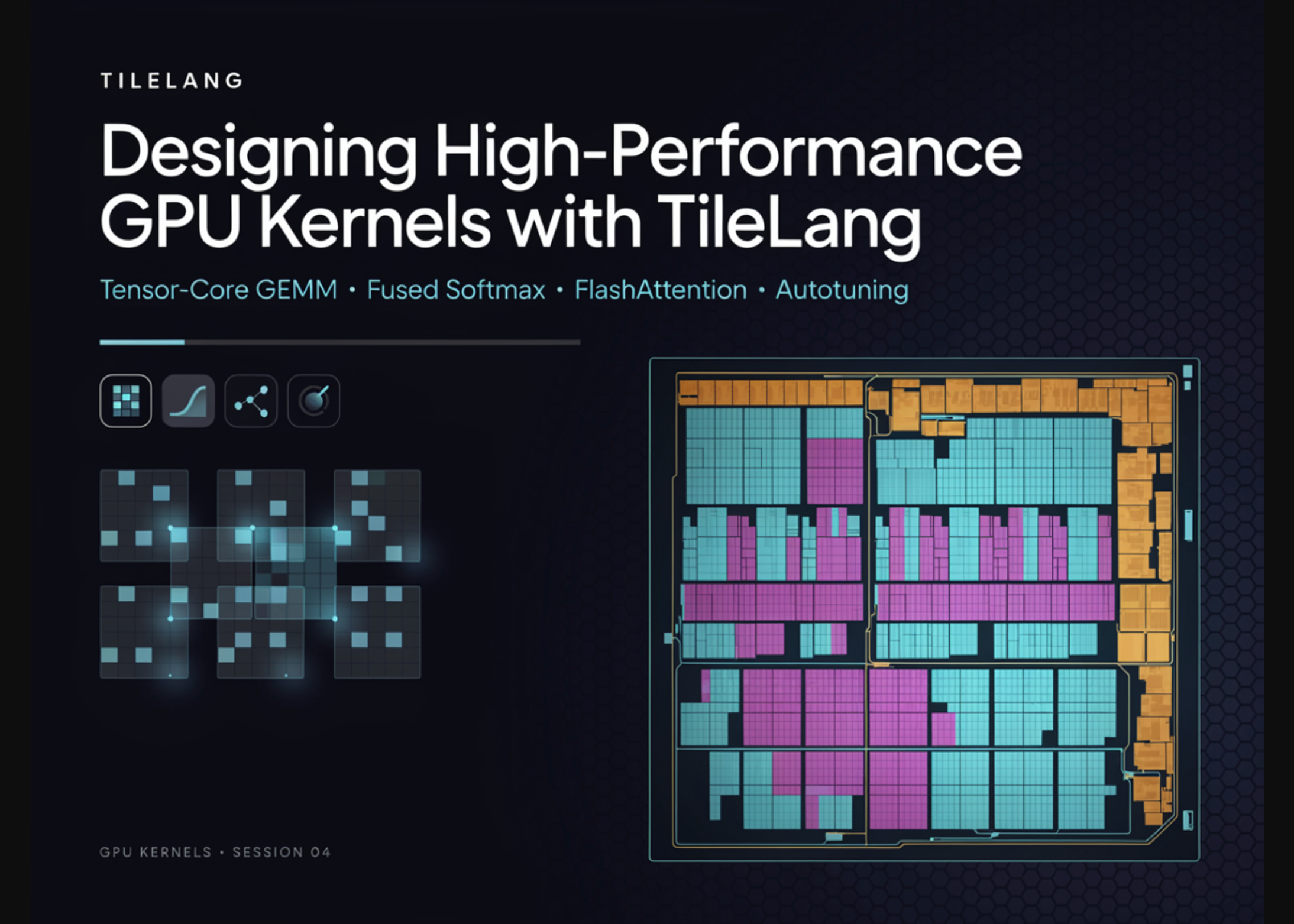
In this tutorial, we explore TileLang as a high-level Python domain-specific language for designing and compiling performance-oriented GPU kernels through TVM. We begin by validating the CUDA environment and establishing reusable benchmarking and numerical-verification utilities, then progressively implement vector addition, tiled tensor-core matrix multiplication, schedule exploration, fused GEMM epilogues, row-wise softmax, and FlashAttention. Throughout the tutorial, we work directly with TileLang’s shared-memory tiles, register fragments, pipelined loops, parallel iteration primitives, reductions, and tensor-core GEMM operators while allowing the compiler to manage thread mapping, memory layouts, synchronization, vectorization, and low-level CUDA instruction generation. We also compare our kernels against PyTorch and cuBLAS baselines, inspect generated CUDA source, evaluate memory and compute throughput, and use autotuning to identify architecture-dependent kernel configurations.
import os
import sys
import math
import time