Skip to content
GQINewsNews Archive 2026News Archive 2025News Archive 2024News Archive 2023News Archive 2022News Archive 2021News Archive 2020News Archive 2019News Archive 2018News Archive 2015-2017AnalysisQnalysisPlayersPublic CompaniesPrivate/Startup CompaniesUniversitiesGovernment/Non-ProfitVenture CapitalVenture Capital – Sorted by Quantum CompanyResourcesConferencesToolsOther Websites and Industry AssociationsEducationBooksScorecardsGate Level Software PlatformsIBM Qiskit, Rigetti Forest, Microsoft QDK, Project QReview of the Cirq Quantum Software FrameworkQubit Implementation DashboardQubit CountQubit QualityQubit TechnologySoftware/Startup PartnersCloud Platform Hardware PartnersPodcastsAboutQCR Alerts Sign-Up FormAdvertising InquiriesQCR in the NewsContactPrivacy PolicyMembership
SKKU Researchers Identify Room-Temperature “Spin Qubit” Defect in Zinc Oxide Semiconductors
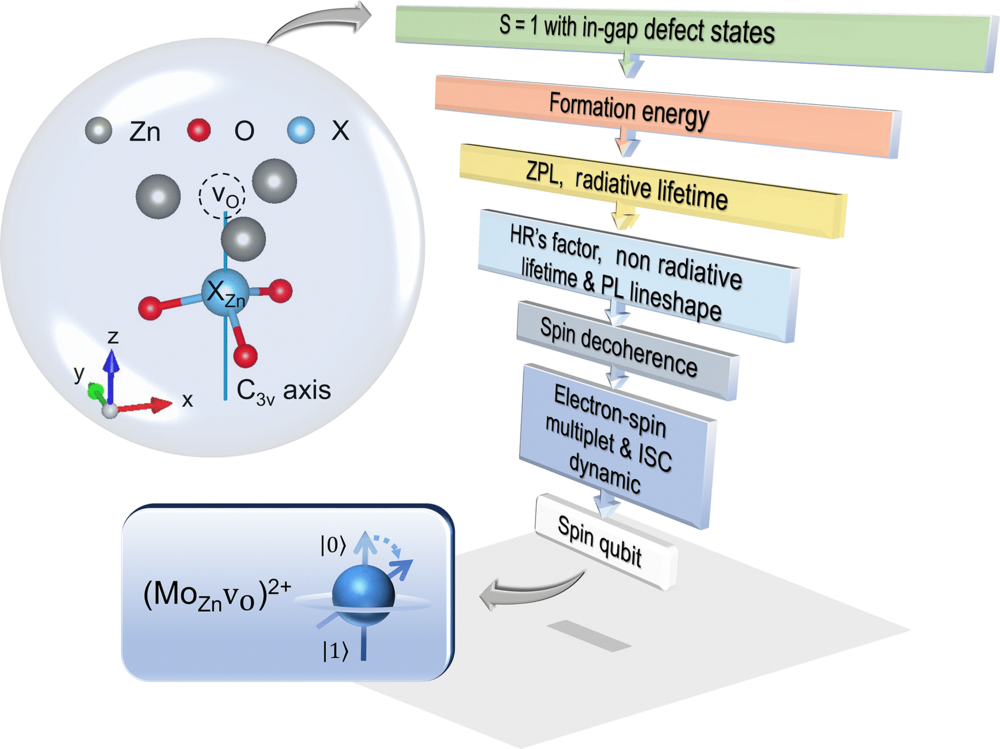
The computational workflow of defect candidate search with critical parameters.
An international research team led by Professor Hosung Seo at Sungkyunkwan University (SKKU)—in collaboration with researchers at the University of Wisconsin–Madison and the University of Washington—has computationally identified a novel atomic defect in zinc oxide (ZnO) capable of functioning as a high-fidelity “spin qubit.” Published in PRX Quantum, the findings propose a molybdenum-oxygen-vacancy complex [(MoZnvO)2+] as an optically addressable, deep-level spin-triplet defect. The discovery marks the first time a robust, room-temperature spin qubit has been identified in ZnO, a wide-bandgap semiconductor already deeply integrated into global commercial fabrication processes.