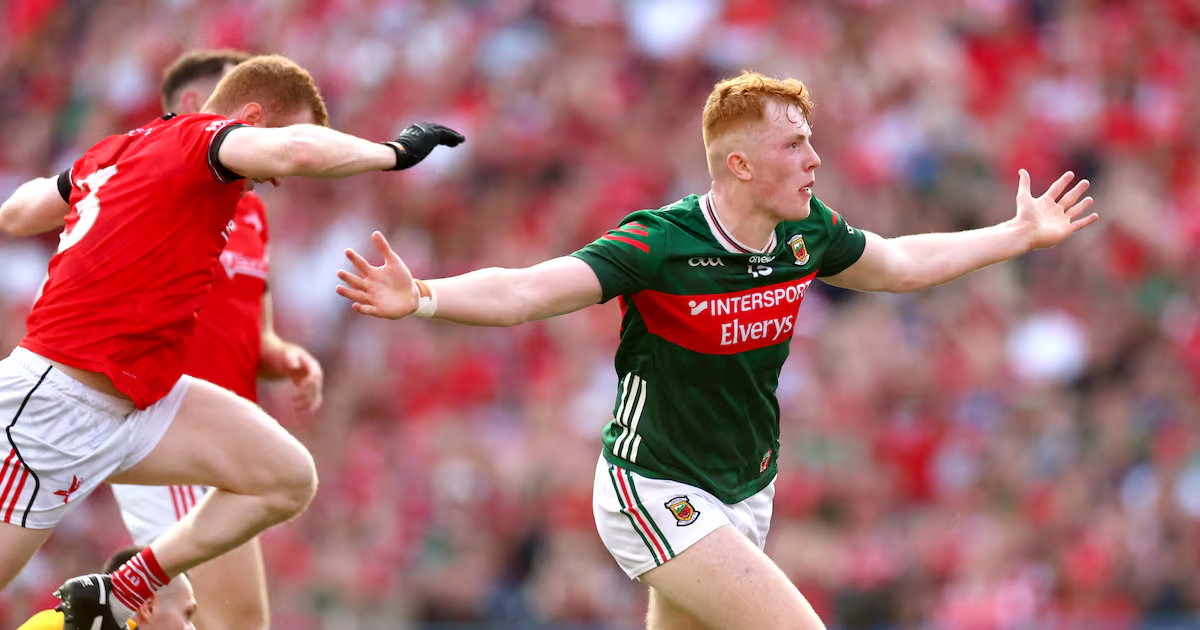
At a Mayo training weekend in the spring of 1989, John O’Mahony conducted an ambush. Most of Saturday’s schedule was blocked off for meetings, but the agenda was undeclared. At 9.30am, the players were introduced to Mick Doyle, the Triple Crown-winning coach who had electrified Irish rugby in the mid-’80s. He was a magnetic character who could command a room with his salty, raconteur’s tongue. The players were charmed.O’Mahony, though, had served dessert first. The person he really wanted them to meet was Bill Cogan, a Glasgow businessman who knew nothing about Gaelic football. For the rest of the day, he led them through workshops and meetings, beginning relationships that, over time, needed to be personal in order to work.“It was about trying to get people to see things in a different way because if they do, they’ll act differently,” O’Mahony said years later. “Bill was a businessman who knew how to get the best out of people.”In the GAA back then, sports psychology was only accepted in homemade form, and not by that name. Cogan didn’t carry that label, but his clear purpose was to the enter the minds of the Mayo players and liberate some of the besieged corners.Under O’Mahony, Mayo reached the All-Ireland final in 1989 for the first time in 38 years, failed to score for the last 16 minutes and lost to Cork by three points in an exuberant game that kicked over the traces of a depressing period in Gaelic football.Mayo's Anthony Finnerty charges with the ball during the 1989 All-Ireland final against Cork. Photograph: James Meehan/Inpho Since then, Mayo have contested another 10 finals, without winning. After those defeats, the inquests typically included a reference to Mayo’s mental capacity, and with each loss it became a self-fulfilling judgment. “When you lose that many finals, that becomes a thing, doesn’t it?” asks Padraig O’Hora, the former Mayo player.Mayo’s defeats have been a source of fascination and Scooby-Do grade detective work for decades now. Since the turn of the century, only Dublin and Kerry have reached more finals. How could Mayo have reached so many All-Irelands without an elite mentality? That judgment was always reserved until after the game that mattered most.[ Kerry v Mayo: TV details, throw-in time, team news for All-Ireland football finalOpens in new window ]Over the years, the only thing that didn’t change was the bottom line. People forgot how games were lost, or by how much. The outcome, though, was seared on their flesh with a branding iron.“When I look back on my own career,” says Billy Joe Padden, the former Mayo player, “and, say, ’04 and ’06, when Kerry beat us in the final, I always put it down to the mental aspect first, but I also put it down to the fact that we weren’t physically resilient. Everyone talks about Kerry and the great football they can play, but they can win the battle too. We didn’t impose ourselves enough physically to give ourselves a chance – and that grates with me still.”[ Mayo and Kerry’s breakout star goalkeepers will be pivotal in Sunday’s All-Ireland finalOpens in new window ]Good people helped. When John Maughan was Mayo manager for the second time in the early 2000s, he brought in Aidan Moran, a UCD professor whose client list included Padraig Harrington, Ken Doherty and Johnny Murtagh, names that gilded his introduction to the Mayo players. Padden loved him, but the intervention was of its time: on his occasional visits, Moran would address the group from the top of a meeting room and, as he left, distribute hand-outs with key messages. There were no one-on-one meetings.“People need different things,” says Padden. “One-size-fits-all for mental preparation doesn’t work.”Mayo's Billy Joe Padden in action in the All-Ireland senior football final against Kerry in 2006. Photograph: Morgan Treacy/Inpho Over the years, though, Mayo’s relationship with mental preparation became more targeted and complex. When James Horan arrived for his first spell as manager in 2011, he brought Kieran Shannon on board before an All-Ireland quarter-final against Cork and he stayed for the next three years.It was the first time that Mayo had embraced the concept of a sports psychologist that was embedded with the team. There were workshops, one-on-ones, phone calls, corridor chats at training. His presence was as integrated as that of the strength and conditioning coaches or the physio or the selectors.“I remember leaving McHale Park after workshops [with Shannon] thinking, ‘There’s no way we’re going to be beaten on Sunday’,” former Mayo player Michael Conroy said once.‘Mayo are at their best when they throw caution to the wind. Even when we got hammered, we went out with the intention to go all guns blazing. Pure chaos and go for the neck. That’s what we have to have on Sunday’— Padraig O’Hora, former Mayo playerBut collective mentality is not something that can be imported or implanted. It must grow. The right minerals must be in the soil. “It’s easy to build up a mentality when you have a good group of players,” says Jason Doherty, who retired in 2023 after 12 years on the Mayo panel.“We used to get plaudits for our resilience in coming back every year, but I think of Roy Keane [and his line], ‘It’s your job.’ Like, what are you going to do, not come back? I never really understood this thing about the resilience to keep coming back. It probably wouldn’t have been shouted about as much if we didn’t get to the actual finals. “People used to talk about our mental strength and bottling it – and the Cork hurlers are getting slagged for that now – but for us I always felt a lot of it was we never played for a full 73 or 74 minutes. We played some great stuff for 60 minutes or possibly more than 60 minutes at times. I think it was Andy Moran who used to say we were stuck around the 15 or 16 score mark when you needed 18 or 19 scores in the old rules.Mayo's Jason Doherty has his shot blocked by Philip McMahon of Dublin in the All-Ireland final in 2017. Photograph: James Crombie/Inpho “Would we have ever looked back on a big match and said it was it was our mentality let us down there? No.”During Doherty’s Mayo career they reached six All-Ireland finals. Three of them were lost by a point; one of them after a replay. In four of those finals they ran into Dublin, the greatest team of all time, or the second best at worst. In Dublin’s imperial years, nobody rattled them like Mayo did. In 2016 and 2017, especially, losing was stainless. There was honour in that, and merit, but by then Mayo had no truck with losing gallantly.“Mentality is borne out of experiences as well,” says Stephen Rochford, who had two spells on the Mayo sideline, one as coach and one as manager. “In 2012, ’13 and ’14, Mayo were beaten by the All-Ireland winners. In that period, they felt they could compete with the best team. That belief was growing all the time. I think through 2015, ’16 and ’17 [when Rochford was the manager], the core belief was there.“Going into the All-Ireland finals, I think if we had a poor mentality in 2016, say [against Dublin], we’d have capitulated having scored two own-goals in the first half [of the drawn match]. My sense is that the loss of that final [by a point in the replay] didn’t come from a poor mentality.”In 2016, their performance coach was Jennifer Kilroy, who had enjoyed success with Rochford in Corofin and whose background was not in sports psychology as such but “in process mentality and systems”, he says. When Kilroy emigrated to the United States after that season, he approached Niamh Fitzpatrick.Mayo manager Stephen Rochford (right) with physiotherapist Liam Moffat after the All-Ireland final loss to Dublin in 2016. Photograph: Donall Farmer/Inpho In a GAA setting, Fitzpatrick had been a pioneer in this field with the Wexford hurlers in 1996, but she had also been the psychologist with the Irish team at three Olympic Games, and had worked with the Irish equestrian team and a bunch of GAA teams. In a crowded field, she sat in the front rank.In March of 2017, though, tragedy ripped through Fitzpatrick’s life. Her sister, Captain Dara Fitzpatrick, and three other crew were killed off the Mayo coast when their Coast Guard helicopter came down. The pain was invasive, gruelling and chaotic.“To lose a loved one in that way, literally overnight, it is loss but it is traumatic loss,” Fitzpatrick said years later. “Stephen [Rochford] was courageous to ask me. He trusted me enough to know that whatever was going on in my life, I would be able to do whatever he needed me to do with his players.[ Marking David Clifford: Is there any way to stop Kerry’s star forward?Opens in new window ]“That year nearly broke me. Losing Dara, my marriage going at the same time, I wondered if I was going to be able to keep my home. But I think it actually drove me to bring even better to Mayo. Was that unconsciously some need to just take control over something? I couldn’t bring my marriage back, I couldn’t bring Dara back, but I could bring the absolute A game I had to Mayo. Was that it? I don’t know.”That season, Fitzpatrick was immersed with the team. They used to have what Rochford calls “360” meetings, where Rochford and Fitzpatrick would sit down with each panel member for half an hour and discuss anything that was on their minds. Nothing was off the table. The meetings ”were hard work from the point of view of a time commitment, but they were invaluable”, says Rochford. “You had to give each player the same time to make sure – as Niamh would say – that everyone’s arrow was pointing in the same direction.”Fitzpatrick had to step away early in 2018 with a health issue, but she returned in the background when Mayo reached the All-Ireland final again in 2020. In those years, her impact on that group of players was profound. When Andy Moran wrote his autobiography, Lessons Learned, in 2021, Fitzpatrick was the person he asked to write the foreword.“I found her incredible,” says O’Hora, “and I know a lot of the lads did too. There’s still some of us guys who go back to her for our own personal lives and would lean on her a lot. From my perspective, I felt I had somebody there who probably cared more about me than she did about football. I felt like she was there for nurture and to look after and protect and improve you as a person, and look after your values and let your football improve because of that.”Fitzpatrick, though, was no longer involved when Mayo were beaten by Tyrone in the 2021 All-Ireland final. Of all the finals they have lost in the last 15 years, that is the one that raises the most uncomfortable questions. Tyrone were an unremarkable team on a cannonball run through the championship. Mayo failed to seize the day.“I really, really felt like we were going to win that All-Ireland and we just didn’t get it right,” O’Hora says. “It was there for the taking, and we kind of waited for it to be handed over a little bit more than actually going and biting it – myself included.Mayo's Padraig O’Hora tackles Darren McCurry of Tyrone in the 2021 All-Ireland final. Photograph:
Mayo’s mentality has always been questioned after All-Ireland defeats, but is it at simple as that?
In spite of everything or because of everything, Mayo have not allowed the flame of possibility to die
2,124 words~10 min read