Students examine how everyday people experience tech policy
June 25, 2026
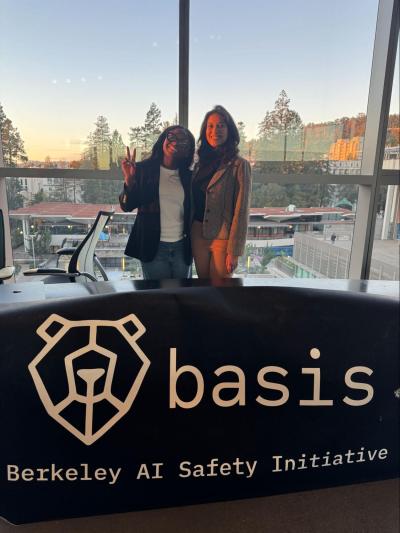
Graduate students Priyal Shrivastava and Simi Olusola-Ajayi during the U.S. AI Policy Hackathon, hosted by the Berkeley AI Safety Initiative.
Carnegie Mellon University students are stepping out of the classroom ready to prove that the people who design technology are uniquely qualified to help regulate it.A spring special topics course, “Design and/of Policy,” taught by Assistant Professor Sarah Fox in the Human-Computer Interaction Institute (HCII), encouraged students to see themselves as not just consumers or builders of technology, but as active participants in shaping its future.The highly collaborative course approached the subject of policy through the lens of human-computer interaction (HCI) and design practices. Rather than focusing strictly on legal frameworks, this people-first approach pushed students to explore how ideal policies work in practice, who will enforce them, and who might be harmed by them.What makes an HCI approach to tech policy so vital is its focus on implementation. It moves past the rosy "tech-colored glasses" outlook – a naive assumption that the next clever piece of code can solve every societal problem. While it’s common to think of tech development happening in a straight line, students learned that tech policy is more of a knot – deeply tangled problems with many stakeholders, competing incentives, trade-offs and unintended consequences.“HCI practitioners and researchers are increasingly being called on to participate in policy conversations around emerging technologies,” said Fox. “I want the students to understand how design and policy together shape social life, and to recognize the responsibility designers and technologists carry in shaping the systems, behaviors and institutions that increasingly mediate our everyday experiences.”