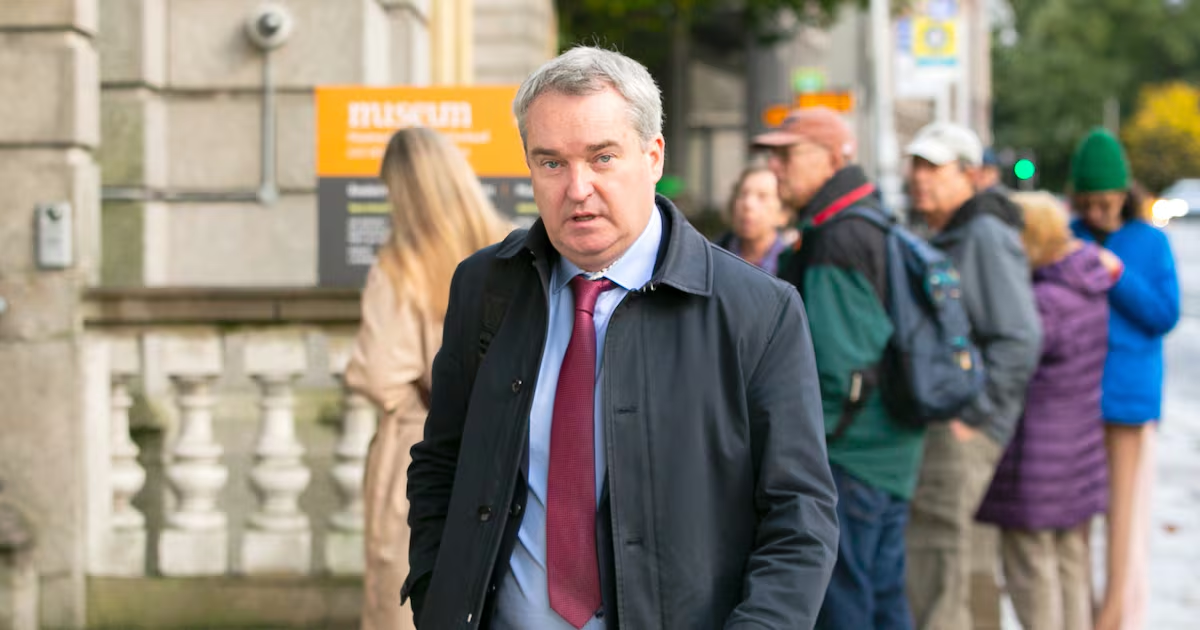
Politicians and officials must be freed “from a culture of ‘Gotcha’” when things go wrong if they are to deliver major projects more quickly, senior civil servant Robert Watt has said.Now leading the Dublin Regeneration Authority, he told the MacGill Summer School in Glenties, Co Donegal, of the difficulties politicians and officials faced in delivering projects.“If we’re going to do things quickly and take risks, we have to have an acceptance that some things will go wrong. But we have to have a culture which learns from that as opposed to a culture which is about blame and pointing the finger,” the former Department of Health secretary general said.Politicians and officials must be encouraged to take “balanced risks” and supported when things go wrong. “If there’s an appetite to do things faster, well, then you need to enable leaders to take risks,” Watt said.Political and journalistic culture must also change. “If something goes wrong, you have to support them, encourage them and have a culture of learning as opposed to a culture of ‘gotcha’,” he said.Such a culture created issues for Opposition politicians and journalists, who were often more comfortable responding to failure, Watt also said.He said he had once almost persuaded Leo Varadkar during his time as taoiseach to say “he wanted more failure” on occasions in return for speedier delivery, though Varadkar baulked in the end.Watt rejected the charge that the long-delayed €2 billion national children’s hospital in Dublin was “a fiasco”, especially since the State had not built a hospital in 40 years and did not have the institutional memory of building one when the project began.Prof Bent Flyvbjerg, a global infrastructure expert at Oxford University, said said Ireland’s difficulties delivering major projects on time and on budget were no worse than anywhere else.Looking at evidence from 146 countries, Flyvbjerg said: “Every country I go to, including Ireland, I always hear that ‘We are the worst. We are the worst at delivering infrastructure’. “There’s a reason for people thinking this, because the situation is pretty bad. If you look at the performance of specific projects, and it’s not difficult, here or elsewhere, to find problems. Just think about the children’s hospital here.“It’s a nightmare. But it’s not like the only place where you have nightmares like this, so my consoling words are that, yes, it’s bad, but it’s not worse than in other places. “You’re just as bad as everywhere else. And that’s the way it is in every country. Every country thinks they are the worst. You’re not. It just is plain difficult to deliver infrastructure.”Humans are hard-wired to underestimate risk. “The one precise thing that we are not good at, that our brains are not good at, and this is across the board for everybody, each one of us, is risk assessment,” he said. Sean Finlay, president of the Irish Academy of Engineering, criticised length of time taken on Shannon-Dublin water pipe project “We just don’t understand risk. Our brains have not been designed to handle risk properly. And if there’s anything that involves risk, it’s building these billion-dollar or 100 million euros projects.”Separately, the length of time An Coimisiún Pleanala will take to decide on a plan to bring water from the Shannon to Dublin has been sharply criticised by the head of the Irish Academy of Engineering.Sean Finlay said the multibillion euro plan was “not a difficult engineering project: it’s a trench to put a pipe in. It’s a long trench. It’s 140 kilometres”.However, the plan was lodged last December yet the planning authority said a decision would not be made until July next year, though it now appeared it might happen by March.“There were questions raised and objections raised in April, and the consulting engineers in question were able to reply by May,” Finlay said.
‘Gotcha’ blame culture must end if key projects to be delivered faster, says Robert Watt
Politicians and officials should be enabled to take ‘balanced risks’ but supported when schemes go awry
633 words~3 min read