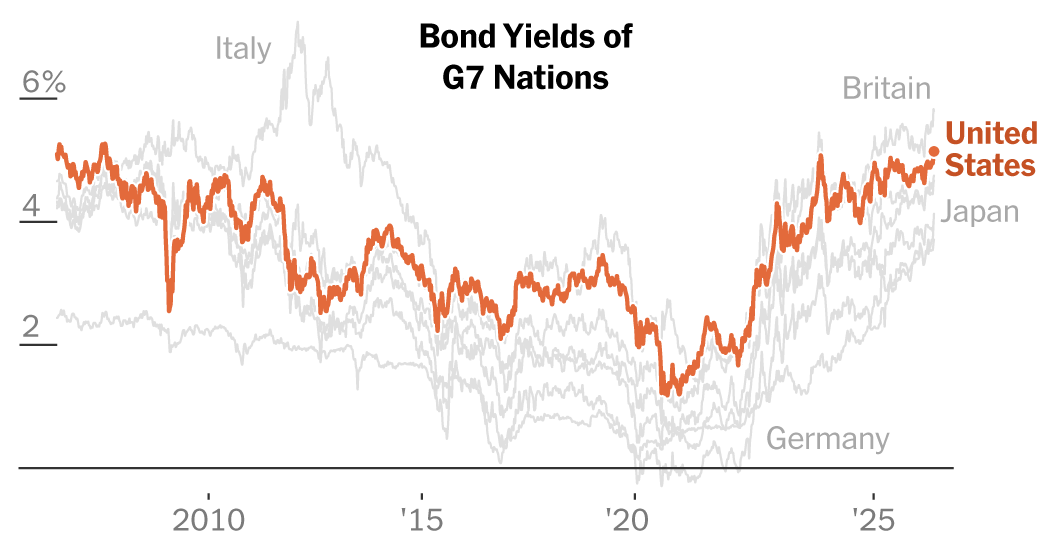
The Bloomberg Global Treasury Index, which tracks fixed-rate government debt from investment-grade nations across 37 countries and 24 currencies, has seen its yield climb to 3.68%, the highest reading since 2008. Some measures of the index are pushing closer to 4%, a level that would carry significant psychological weight for bond markets and, by extension, everything riskier than a government IOU.
What is actually happening in bond markets
The Bloomberg Global Treasury Index is not a niche instrument. Built in 1999 with historical data stretching back to 1987, it aggregates the borrowing costs of governments across the developed world into a single benchmark figure. The weighted average yield to maturity on the index currently sits at approximately 3.67%, with a yield to worst measure around 3.50%. The index is not yet uniformly at 4%, but intraday readings and certain calculation methodologies are already touching that threshold.
UK 10-year gilt yields exceeded 5% for the first time since 2008 earlier this year. Japanese government bond yields have climbed to multi-year highs, a notable development given that Japan spent much of the past decade as the poster child for zero-rate policy.