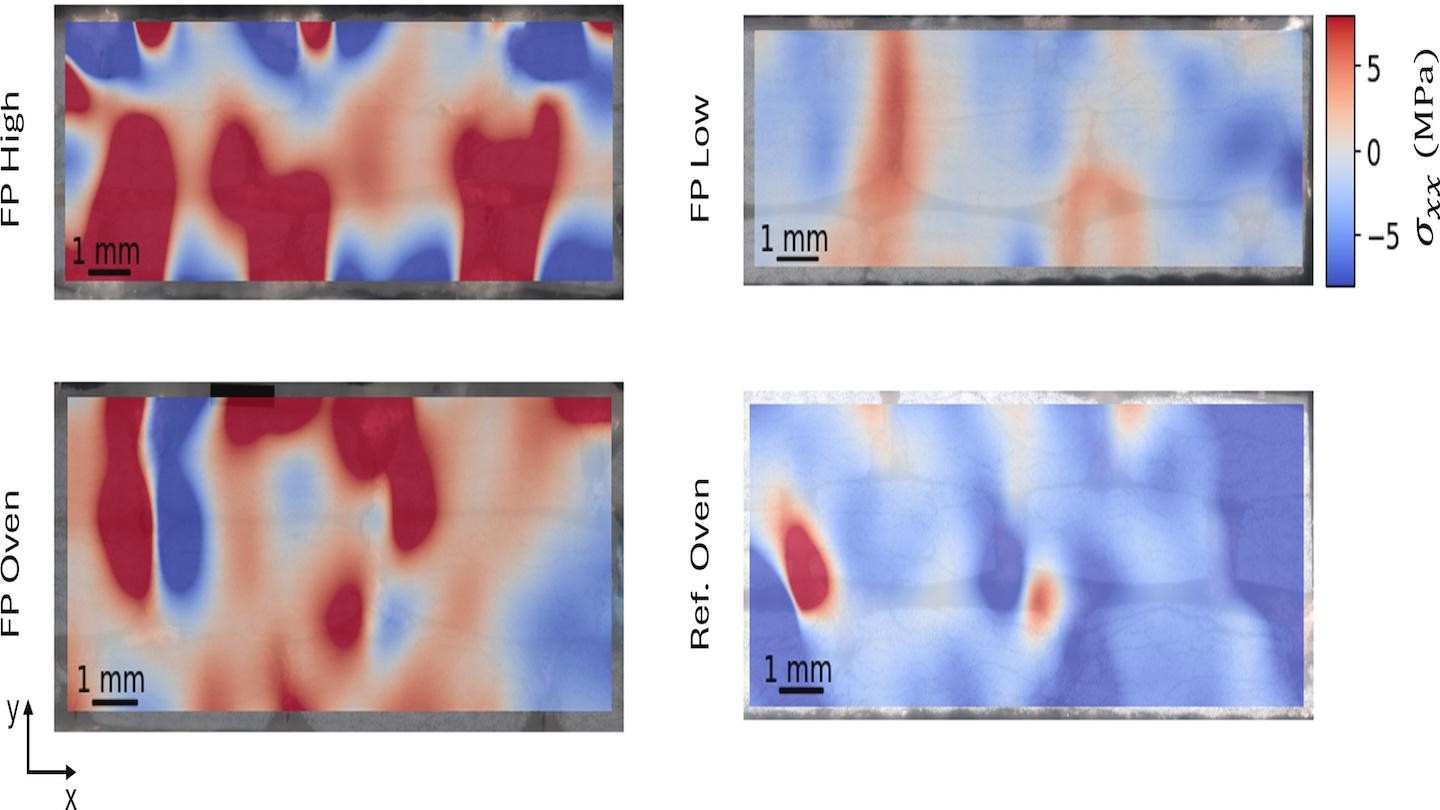
Influence of processing conditions on internal stresses, crack formation, and cure kinetics in frontally polymerized compositesFrontal polymerization (FP) is increasingly considered as a low-energy alternative to conventional oven curing for manufacturing composites. Although high fiber volume fractions have been successfully manufactured, the impact of FP-induced thermal gradients on residual stress formation remains unclear, preventing the progress in improving the dimensional stability and structural reliability in advanced composites. In this work, internal stresses generated during front propagation in unidirectional carbon fiber composites were quantified using digital image correlation of carbon fibers. By systematically varying initiator concentration and processing conditions, the reaction exothermicity and front velocity were tuned, enabling direct correlation between thermal history, cure heterogeneity measured using Raman spectroscopy, and stress development and release. The results reveal that FP induces a distinct residual stress state compared to conventional curing, strongly governed by local cure gradients and transient thermal expansion. Reducing reaction enthalpy decreased the magnitude of locked-in stresses by up to 75%, while highly reactive systems promoted stress concentrations and matrix pre-cracking. This study provides a first quantitative assessment of transverse residual stresses in FP-processed structural composites and paves the way for future studies on micro- and meso-scales in FP advanced composites.FundingThis work was supported by the National Growth Fund Program, Nxtgen Hightech Composites 01: Digital composite automation for sustainable aviation (The Netherlands).
New article in Composites Part A
Influence of processing conditions on internal stresses, crack formation, and cure kinetics in frontally polymerized composites
222 words~1 min read