Sometimes the most important economic policies are not gazetted; they aren’t debated in parliament, approved by the cabinet or published in the Government Gazette. Yet they profoundly influence investment decisions, shape business confidence and determine whether capital is deployed or withheld. These are the policies communicated through signals.The recent public comments attributed to the director-general of the National Treasury, suggesting that manufacturing is unlikely to be the primary source of employment growth in South Africa, have therefore generated debate far beyond the narrow question of whether manufacturing, services, tourism or construction will create more jobs in the years ahead. While that debate is important, it ultimately misses the bigger issue. The more important question is the signal South Africa is sending about the future of its productive economy.There is a fundamental difference between an academic expressing an economic opinion and the director-general of the National Treasury expressing one. Economists are expected to challenge orthodox thinking and provoke debate, but the Treasury occupies a unique position in government. It ultimately finances public policy, determines fiscal priorities and influences the implementation of every big economic programme undertaken by the state. Markets, investors and businesses understand this distinction. They listen carefully because they know today’s public comments often become tomorrow’s policy priorities. For that reason consistency matters. Economic policy cannot speak with two voices.For decades successive South African administrations have consistently identified manufacturing as central to industrialisation, export competitiveness and long-term economic development. More recently, the government’s renewed Industrial Development Strategy has again reaffirmed manufacturing as a pillar of the country’s growth agenda, placing productive sectors at the centre of economic renewal. Against this backdrop, comments suggesting that manufacturing is unlikely to be where future employment growth will occur inevitably create uncertainty. Whether this was the intended message is almost secondary — signals are interpreted by those who receive them, not by those who send them.Permanently alteredSouth Africa desperately needs stronger growth in construction, tourism, agriculture, services and the digital economy. Every sector capable of creating employment should be encouraged and supported. However, supporting one sector should not require diminishing confidence in another, especially one that represents one of Africa’s largest, most sophisticated manufacturing bases.There is another reason the recent comments deserve careful reflection. It is certainly true that manufacturing has become less labour-intensive across much of the world. Automation, robotics and digital production have permanently altered the relationship between manufacturing output and employment. However, South Africa’s manufacturing experience cannot simply be explained by global technological change.Our manufacturing sector has spent much more than a decade operating in an environment characterised by escalating electricity costs, unreliable logistics, deteriorating municipal infrastructure, congested ports, rail constraints and persistent policy uncertainty. For example, the metals and engineering sector has operated for years with big underutilised capacity. Factories capable of producing substantially more have simply lacked sufficient demand to justify higher production.This distinction matters enormously. If manufacturing employment has declined because technology has permanently displaced labour, perhaps relatively little can be done. If, however, manufacturing has underperformed because firms have operated within an increasingly punitive business environment, policy choices remain critically important.That observation inevitably brings us back to the Treasury, which is not merely an observer of economic outcomes; it is one of their principal architects. Its decisions influence infrastructure investment, public procurement, fiscal incentives, municipal reform and industrial financing. These are not peripheral considerations. They are among the most important determinants of manufacturing competitiveness and long-term investment.Invested heavilyNowhere is this more evident than in the area of public procurement. For years industry has argued that government procurement should become a far more deliberate instrument for strengthening domestic productive capacity. Local procurement, if appropriate and economically justified, is not simply about purchasing locally. It is about creating predictable demand that encourages firms to invest, expand production, improve productivity and employ more people. South Africa has already invested heavily over many decades in developing industrial capability. Allowing that capability to remain underutilised represents an enormous economic opportunity cost.If, however, manufacturing has underperformed because firms have operated within an increasingly punitive business environment, policy choices remain critically important.The international environment makes this discussion even more pertinent. Worldwide governments appear to understand that industrial capability has once again become a strategic national asset. The US has embraced industrial policy through substantial manufacturing incentives. The EU has introduced strategic industrial initiatives aimed at strengthening domestic production. China continues to deploy industrial policy as a central instrument of economic development, while India has aggressively expanded production-linked incentive programmes to build manufacturing capability. Far from retreating from manufacturing, the world’s largest economies are competing intensely to attract and retain it.The reason is straightforward. Manufacturing is not simply another sector of the economy. It is where research becomes production, engineering becomes commercial innovation, supply chains develop, exports expand, and productivity improves.Continuous reinventionManufacturing possesses an extraordinary ability to reinvent itself. The factories that once produced steel, machinery or vehicle components increasingly become the foundations for producing advanced materials, renewable energy technologies, medical devices and sophisticated industrial equipment. Manufacturing is therefore not only about what an economy produces today; it is equally about what an economy is capable of producing tomorrow.This is not an argument that industry alone has advanced. The Treasury itself recognised this almost a decade ago. In its 2017 discussion paper, “Towards an Economic Strategy for South Africa”, the Treasury observed that engineering-intensive manufacturing offers a path towards higher value-added production and possesses a unique characteristic for continuous reinvention as economies evolve. That insight remains as relevant now as it was then.Ultimately, this is why policy coherence matters. Confidence is built when investors believe government institutions are pulling in the same direction. Uncertainty emerges when different parts of the state appear to send different messages about the country’s long-term priorities. South Africa’s greatest economic challenge is not simply attracting investment; it is attracting patient capital, the kind of investment that commits for 20-30 years, builds factories rather than financial portfolios and develops industrial capability that survives political cycles. That kind of investment depends fundamentally on confidence that policies will remain consistent, institutions are aligned, and government speaks with one voice.The recent debate should therefore not become an argument about whether manufacturing is more important than tourism, construction or services. It should instead prompt a much more fundamental conversation: how does South Africa intend to industrialise? History consistently demonstrates that countries rarely industrialise by accident. They industrialise because policy, institutions and public and private leadership continually reinforce and align behind a shared long-term vision.• Chibanguza is CEO of the Steel & Engineering Industries Federation of Southern Africa.
TAFADZWA CHIBANGUZA | Policy is not only what government does, but also what it says
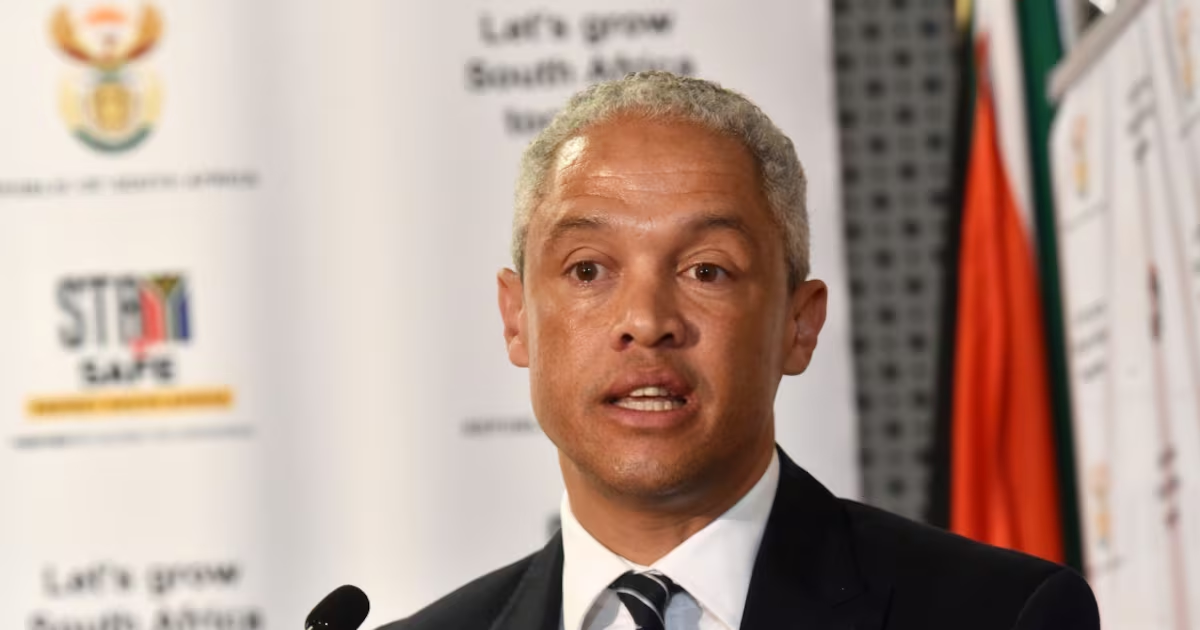
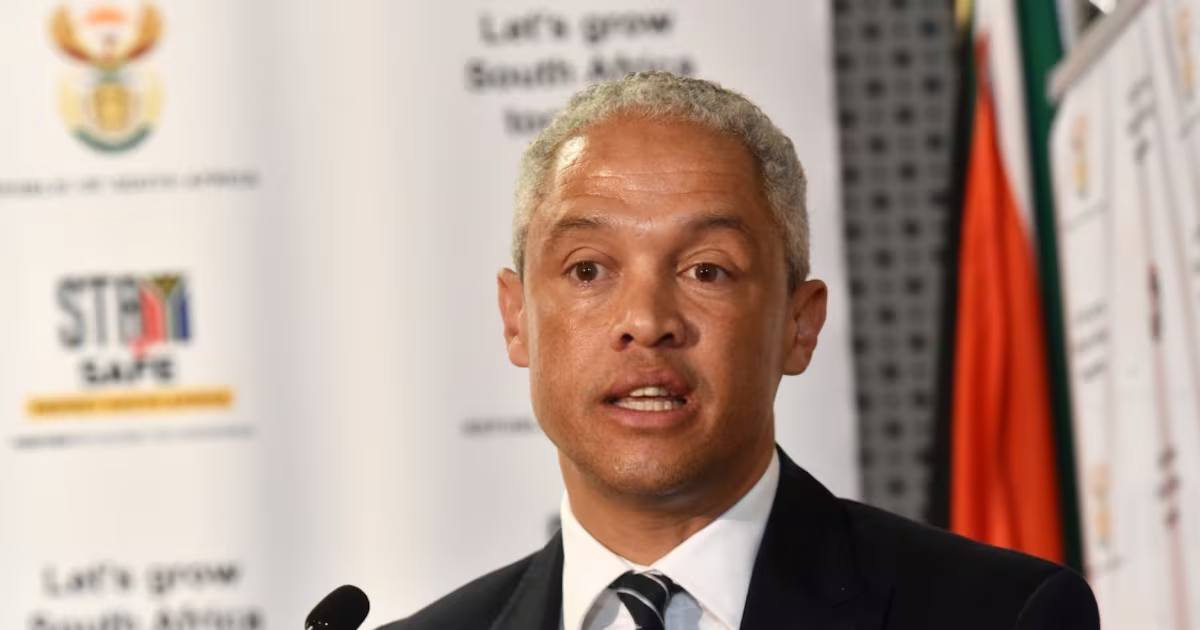
Comments attributed to director-general of the National Treasury, suggesting that manufacturing is unlikely to be the primary source of employment growth in South Africa, raises questions
1,093 words~5 min read