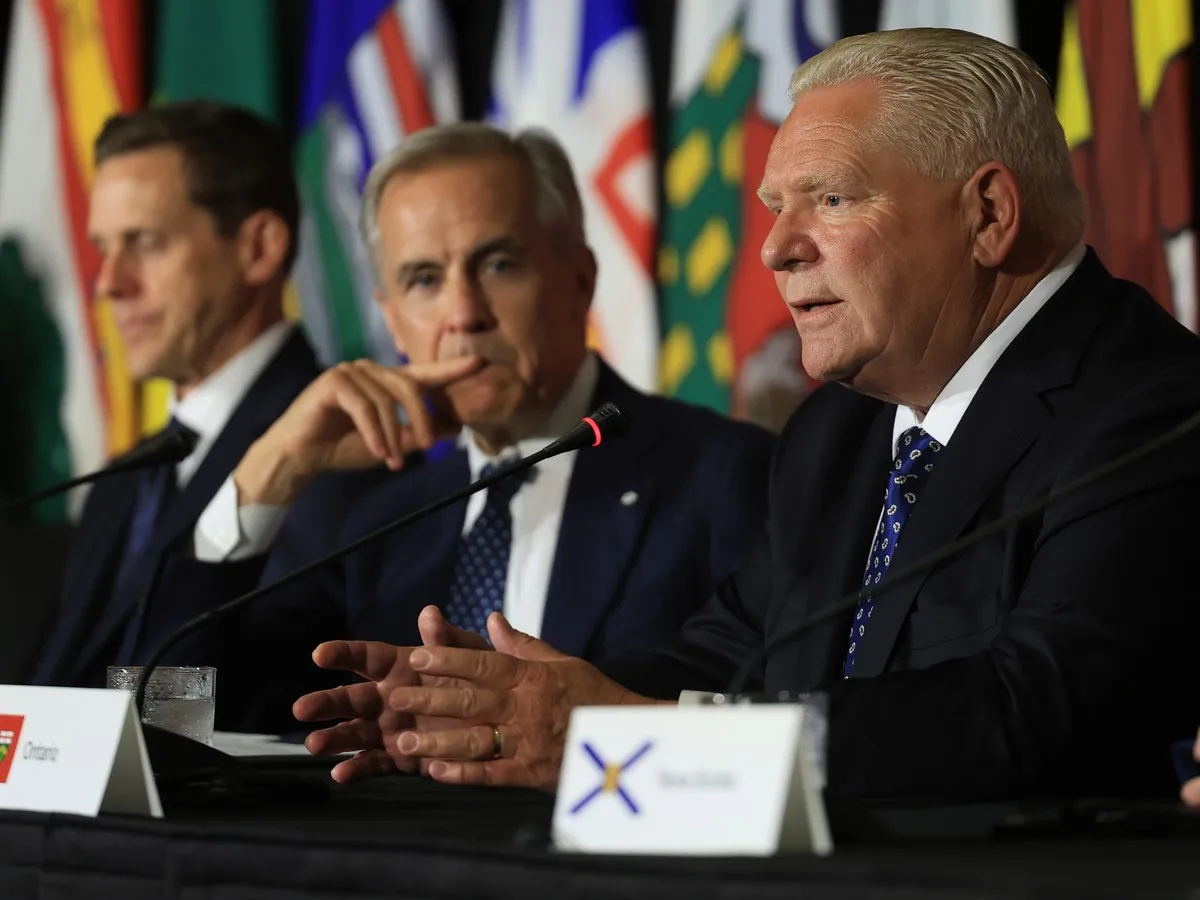
Skip to Content Subscribe Our Offers My Account Manage My Subscriptions FAQ Newsletters Canada Canadian True Crime Canadian Politics Health World Israel & Middle East Financial Post NP Comment Longreads Puzzmo Diversions Comics NP News Quiz New York Times Crossword Horoscopes Life Eating & Drinking Style Sponsored Play for Ontario Travel Travel Canada Travel USA Travel International Cruises Travel Essentials Culture Books Celebrity Movies Music Theatre Television Business Essentials Advice Lives Told Tails Told Shopping Buy Canadian Home Living Outdoor Living Kitchen & Dining Tech Style & Beauty Personal Care Entertainment & Hobbies Gift Guide Travel Guide Amazon Prime Day Deals Savings National Post Store More Sports Hockey Baseball Basketball Football Soccer Golf Tennis Driving Vehicle Research Reviews News Gear Guide Obituaries Place an Obituary Place an In Memoriam Classifieds Place an Ad Celebrations Working Business Ads Archives Healthing Epaper Manage Print Subscription Profile Settings My Subscriptions Saved Articles My Offers Newsletters Customer Service FAQ Newsletters Canada World Financial Post NP Comment Longreads Puzzmo Diversions Life Shopping Epaper Manage Print Subscription HomeNP CommentHeather Exner-Pirot: Cutting off oil exports to spite Trump would cripple CanadaResources should be used as carrots, not sticks You can save this article by registering for free here. Or sign-in if you have an account.Ontario Premier Doug Ford responds to a question as Prime Minister Mark Carney looks on during the final news conference concluding the First Ministers meeting in Charlottetown, PEI Thursday July 23, 2026. Photo by TIM KROCHAKDoug Ford is mad, and he has every right to be. While his province suffered from wildfires and evacuations, a lineup of American politicians chose to criticize and politicize Ontario’s response, rather than offer to help. To add insult to injury, U.S. President Donald Trump imposed a new set of unjustifiable tariffs on Monday that disproportionately harm Ontario’s economy.Enjoy the latest local, national and international news.Exclusive articles by Conrad Black, Barbara Kay and others. Plus, special edition NP Platformed and First Reading newsletters and virtual events.Unlimited online access to National Post.National Post ePaper, an electronic replica of the print edition to view on any device, share and comment on.Daily puzzles including the New York Times Crossword.Support local journalism.Enjoy the latest local, national and international news.Exclusive articles by Conrad Black, Barbara Kay and others. Plus, special edition NP Platformed and First Reading newsletters and virtual events.Unlimited online access to National Post.National Post ePaper, an electronic replica of the print edition to view on any device, share and comment on.Daily puzzles including the New York Times Crossword.Support local journalism.Create an account or sign in to continue with your reading experience.Access articles from across Canada with one account.Share your thoughts and join the conversation in the comments.Enjoy additional articles per month.Get email updates from your favourite authors.Create an account or sign in to continue with your reading experience.Access articles from across Canada with one accountShare your thoughts and join the conversation in the commentsEnjoy additional articles per monthGet email updates from your favourite authorsSign In or Create an AccountorIn response, at the Council of the Federation this week, the gathering of premiers and the Prime Minister in Charlottetown, Ford implied we should leverage our oil and potash to “dismantle” the U.S. and make them “feel the pain.”The National Post newsletter that doesn’t hold back, giving readers the unvarnished truth on media, politics and culture.By signing up, you consent to receive the above newsletter from Postmedia Network Inc.A welcome email is on its way. If you don't see it, please check your junk folder.The next issue of Right? will soon be in your inbox.We encountered an issue signing you up. Please try againWhile an emotional reaction is understandable, weaponizing our resources in a trade war undermines our broader national interests. Canada’s highest and best purpose in the international system is not to use our energy and minerals for coercion; it is to constrain that kind of predatory behaviour from others.First, the practical details. Canada is indeed a massive exporter of oil to the United States, about four million barrels a day. No country in the world imports more oil from another than they do from us, and many American refineries require our kind of heavy oil.But more than vulnerability, this has created an interdependence. They must buy from us because we must sell to them, and we are irrevocably tied across the continent through a system of pipelines developed over decades. Canada could theoretically cut off oil and gas supplies to the U.S.A., but in practice it would mean we could no longer sell our most valuable export, and would fall into recession, and much of eastern Canada would be cut off as well. This mutually assured destruction is why energy exports have not been ensnared by tariffs in the first place.It is not only Canada and the United States that would be harmed. Disrupting this essential energy trade at a time when the world is staring down the barrel of three concurrent oil crises — Iran and the Strait of Hormuz, Houthis and the Bab-el-Mandab Strait, and Ukrainian attacks on Russian refineries — would tip an incredibly precarious situation into a full-blown crisis, with devastating economic impacts around the globe.There are also longer-term effects to consider. We are in a geopolitical era where economic coercion is rampant, and energy and critical minerals are being manipulated and weaponized for short term political gain. Export restrictions, blockades, tariffs, sanctions, and confiscations have become commonplace.Perhaps there is a temptation to play these same games, but it is not one Canada is culturally or institutionally suited for. Rather, Canada has an enormous opportunity to leverage its reputation as a trustworthy and reliable exporter of energy and resources to diversify its trading partners and grow its global market share. Supply chain security has real economic value today and will over the course of this decades-long commodity cycle. Ford’s threats, empty though they may be, introduce the possibility that Canada may withhold its resources for political ends. This is a damaging message to send and should go no further.Finally, there is no comparison between pulling whiskey off of liquor store shelves, and cutting off oil supplies in the midst of an energy crisis. One is a protest; the other falls just short of an act of war. Canada is far more popular than Trump in the United States, holding an 80 per cent favourability rating, while Trump’s approval rating is now down to 36 per cent. This is a material advantage in trade negotiations. It would be squandered if we exacerbated Americans’ energy costs and pushed them into shortages.Fighting fire with fire may be emotionally appealing, but it will end with Canada getting burned. We have a far better option: diversifying our trading partners. It happens to be a seller’s market for Canada’s energy and minerals, and with recent announcements for ports and pipelines, we are making strides towards getting more product to new markets. Let’s direct our energy towards that.No one will convince me that China, Russia, Iran and the U.S. are better off because of their economically coercive tactics. In fact the entire world is suffering due to the collective pivot away from free trade and a rules-based order.While recognizing the short term harms many Canadian families are feeling, I sincerely believe these conditions present an opportunity for Canada. Our energy and critical minerals are not our greatest competitive advantage right now; our trustworthiness is. Let us prove that success comes not from spiting adversaries but from making new friends.Heather Exner-Pirot is the director of energy, natural resources, and the environment at the Macdonald-Laurier Institute. Join the Conversation This website uses cookies to personalize your content (including ads), and allows us to analyze our traffic. Read more about cookies here. By continuing to use our site, you agree to our Terms of Use and Privacy Policy.
Heather Exner-Pirot: Cutting off oil exports to spite Trump would cripple Canada
Resources should be used as carrots, not sticks
1,301 words~6 min read