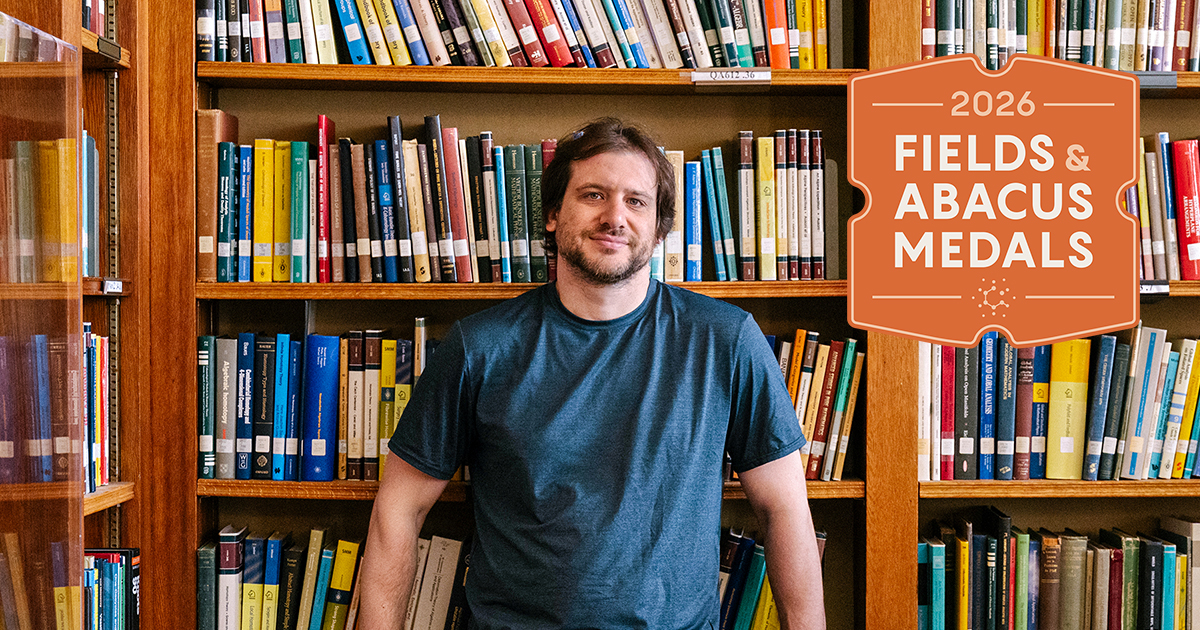
Several eminent mathematicians tell different versions of the same story about John Pardon.
Fifteen years ago, János Kollár was seated next to Pardon at a Phi Beta Kappa dinner. Kollár held an endowed chair as a full professor at Princeton University, where he’d been teaching for over a decade after stints at the University of Utah and at Harvard University as a member of its Society of Fellows, arguably the country’s most prestigious postdoctoral fellowship. Which is to say, Kollár is not bad at math. Pardon was an undergraduate, a few months into his senior year.
Kollár had gotten stuck on a question in the field of topology. At the dinner, he mentioned it to Pardon in passing. Two weeks later, he got an email from Pardon — with the solution. “And it’s not just that he solved the question I needed, but he did a much more general case in a very nice way,” Kollár recalled. He found working with the 21-year-old a pleasure. It felt, he said, “like working with a postdoc who had very good ideas.”
When Pardon graduated the following May, it was at the top of the Princeton class. In his valedictory address, he asked his fellow graduates, rhetorically, “When is the last time you had a truly original idea?” He proceeded to answer his own question: “The single most basic form of expression that humans draw upon is imitation of others, and so I think having an original idea may qualify you as being partially insane.”