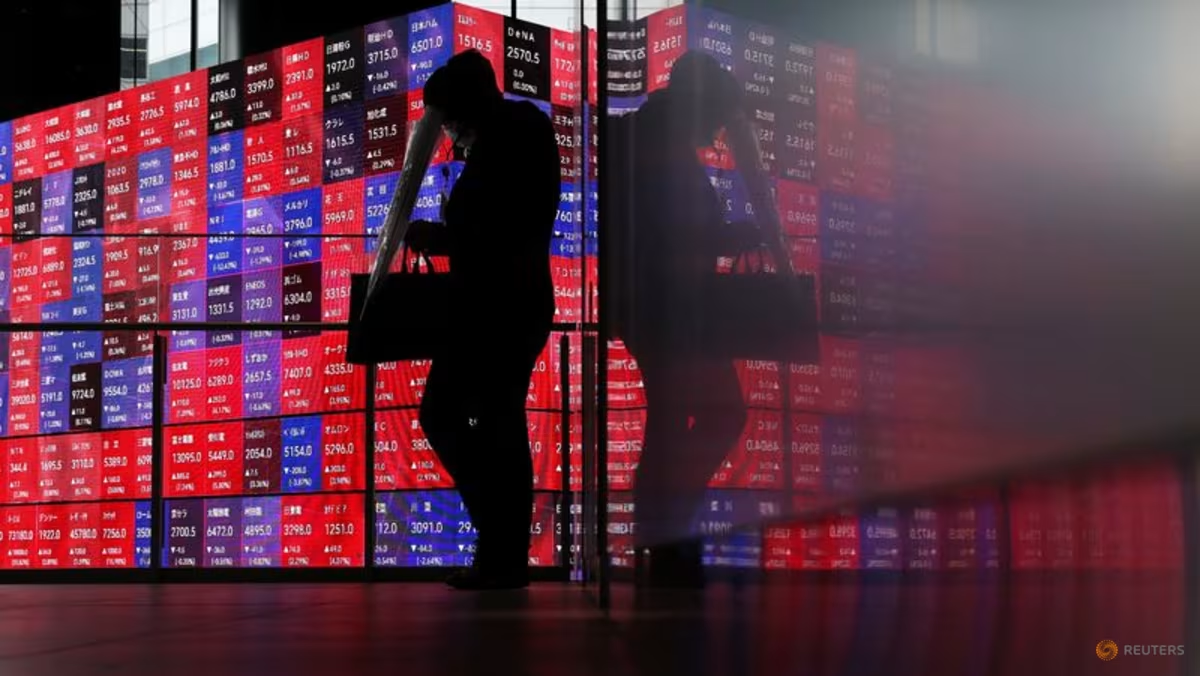
July 23 : Oil prices spiked to $100 a barrel for the first time since May, major tech giants knocked U.S. stocks lower, and Europe's borrowing costs spiked to long-term highs in an unsettling day across markets on Thursday. Brent crude jumped 6 per cent to $100.50 a barrel following attacks on tankers in the Red Sea that choked off a second crucial Middle East artery for global oil supplies alongside Iran's near-closure of the Strait of Hormuz. This marks the first time the international oil benchmark has hit that level since late May as the U.S.-Iran war has heated up again. The Iran-aligned Houthis struck two Saudi oil tankers as part of a naval blockade on Saudi Arabia, sending prices higher as the brief cessation of hostilities between Iran and the U.S. recedes in the rear-view mirror. The U.S. military carried out a new round of strikes on Iran, marking a 12th successive night of American attacks, and prompting further Iranian retaliation. The White House has threatened additional attacks on Iranian infrastructure and key locales for its nuclear facilities.
Wall Street was on the back foot after Alphabet and Tesla - the first two of the so-called "Magnificent Seven" megacap companies to report this season - spooked investors as both burned through cash in their most recent quarter due to their big spend on AI infrastructure. Tesla shares tumbled 12 per cent on Thursday as it posted its first cash burn in two years. Alphabet fell about 7 per cent after the Google parent also burned through cash and said it would ramp up AI spending by another $15 billion to $200 billion for the year.Investors have rewarded the so-called hyperscalers with lofty valuations on expectations of big revenue gains, but some are now outspending their operating cash flow.The Dow Jones Industrial Average fell 1 per cent, the S&P 500 lost 1 per cent, and the Nasdaq Composite slid around 1.9 per cent [.N] EUROPEAN BORROWING COSTS RISEEurope’s government borrowing costs rose to long-term highs as reignited inflation worries prompted some hawkish signals from the European Central Bank, even as the bank held rates steady.European share markets also fell after an earnings miss from chipmaker STMicroelectronics sent its shares tumbling 18 per cent. The pan-European STOXX 600 index fell 1.1 per cent. Germany's 10-year Bund yield, the benchmark for euro zone borrowing costs, rose above 3.2 per cent for the first time since 2011 — back when oil was also on a tear and the bloc's debt crisis was about to break out again."Uncertainty remains high and the full inflationary impact of the energy shock has yet to play out," the ECB said as it held rates at 2.25 per cent, having lifted them in June."The Governing Council is therefore closely monitoring the intensity and duration of the shock, as well as its indirect and second-round effects," the ECB added.Markets had bet on just a one-in-five chance of another interest rate hike at the meeting. They do, however, see a four-in-five chance of a hike at the next one in September."The messaging remained unchanged and open," Morgan Stanley's analysts said on the ECB's policy statement. "We maintain our call for another rate hike in September, if energy prices remain elevated."Asian markets gained overnight. The KOSPI surged more than 4 per cent in Seoul, led by 4.8 per cent and 3.7 per cent respective gains for SK Hynix and Samsung. Tokyo's Nikkei and Hong Kong's Hang Seng also ticked higher.YEN SLIPS BACK TO 40-YEAR LOWThe euro dipped back below $1.14 following the ECB decision. The oil price rise and the continent's scorching summer weather this month look set to hit harvests and push up food prices, while low water levels on key rivers could create awkward shipping bottlenecks.Elsewhere, the Japanese yen was back at a 40-year low versus the dollar after a brief lift prompted by a Bloomberg report on Wednesday that Bank of Japan officials were open to raising rates at a faster pace, faded.Japan's BOJ-sensitive two-year government bond yield touched a 31-year high in Tokyo on the oil moves and rate hike talk, while Japan's finance minister had issued his latest verbal warning about possible FX market intervention.The dollar index, which measures the greenback against a basket of currencies including the yen and the euro, rose about 0.3 per cent.