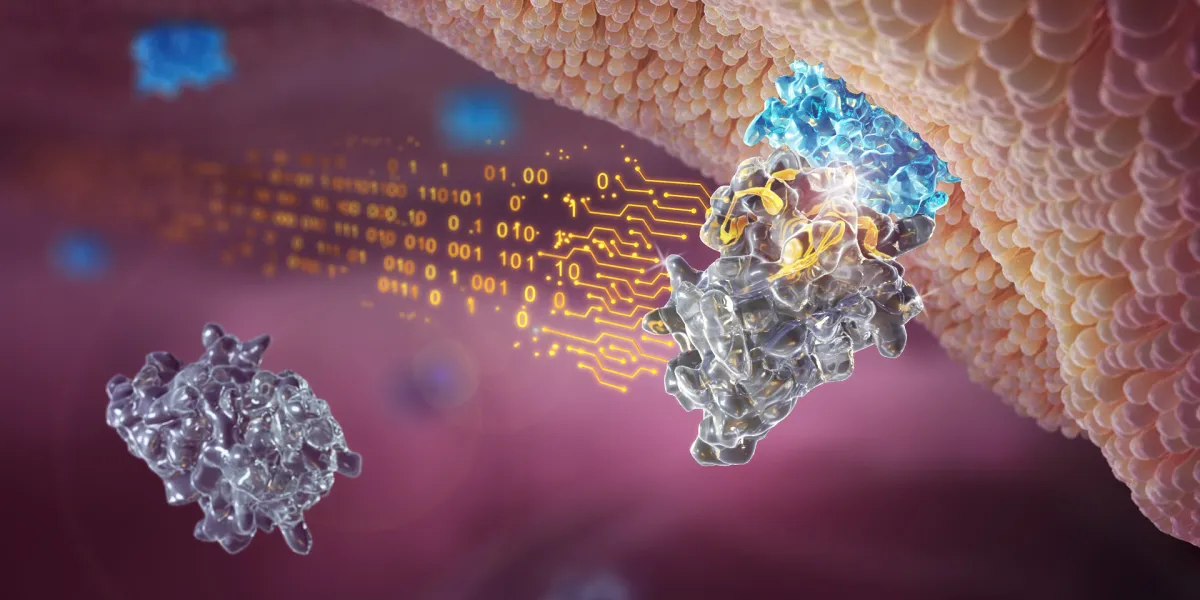
Designing and developing a new medicine is an expensive, failure-prone scientific challenge. A new drug can take many years to develop, at the cost of a significant investment. And even then, most possible candidates never reach the patient. For biologic medicines, therapies made from engineered proteins rather than synthetic chemistry (which are often used to treat conditions across most major acute and chronic diseases), the complexity is even greater. Scientists explore vast quantities of possible molecules, looking for the rare few that will bind to the right target, remain stable in the human body, and be manufacturable at scale. Today, AI is speeding up these processes and has quickly become a core part of the infrastructure in pharmaceutical R&D. AI-assisted design is a growing part of how biologic drug candidates are developed, and companies like AstraZeneca are actively building its engineering teams to push this further. “Everything we do, whether it’s design, make, test, or analyze, is now computationally enhanced,” says Puja Sapra, senior vice president and head of R&D biologics engineering and oncology targeted discovery at AstraZeneca. “The cycle times are getting shorter while productivity and innovation increase.” Sapra explains that AstraZeneca’s approach follows a build-measure-learn loop. AI generates or prioritizes candidate molecules computationally, predicting which designs are most likely to succeed. Scientists then focus lab resources only on the top-ranked candidates. This leads to a tighter feedback cycle with fewer dead ends, faster iteration, and the ability to go after disease targets that were previously considered untreatable by medicine. Because the number of possible molecular combinations far exceeds what any human team can systematically explore, using AI to narrow and refine the options for testing has become a major focus in biologics drug design.
How AI helps scientists design the next generation of medicines
As generative AI captures public attention, a different kind of AI is reshaping drug discovery. Machine learning models are helping to compress decade-long timelines and cracking problems that were previously unsolvable.
TL;DRAI
AstraZeneca uses AI to accelerate drug design with a 50% timeline reduction potential (McKinsey). For tech leaders: proprietary multimodal data + frontier AI + robotics automation create R&D moats; de novo design unlocks undruggable targets.
1,409 words~6 min read