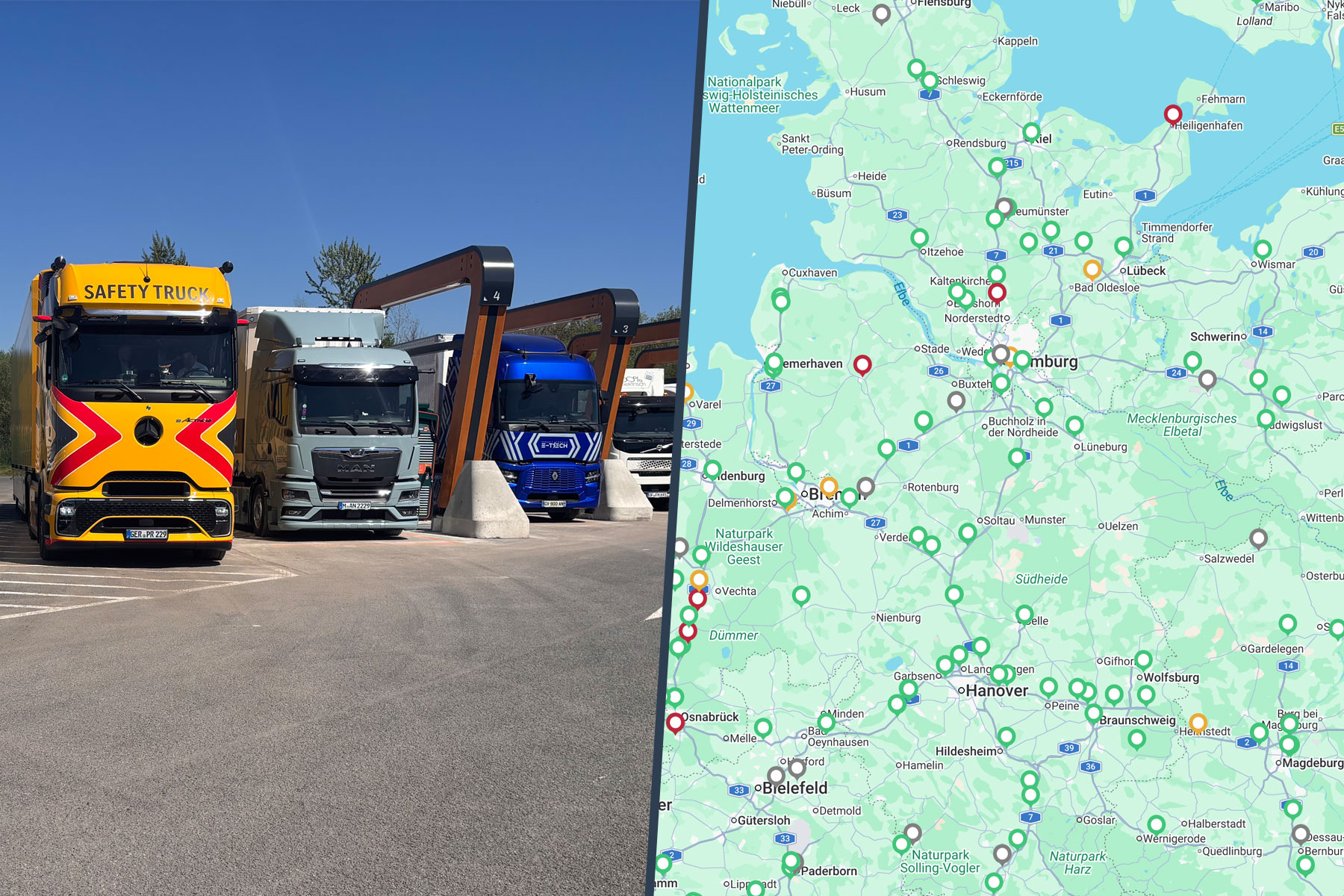
If you want to know how many public charging points Germany has, the charging station register maintained by the country’s Federal Network Agency (Bundesnetzagentur) is the key reference. As of 1 June 2026, it lists 53,300 publicly accessible DC charging points nationwide. However, if you want to know how many of these can accommodate a 40-tonne truck, you have to dig much deeper. That is exactly what the electrive editorial team has done. Our aim was to assess the current state of Germany’s HGV charging network and track its development over the past few years.
The earliest reports on HGV charging infrastructure in the electrive archives date back to 2018. At the time, the topic was still largely aspirational. Headlines such as ‘Tesla is already working on an electric truck charging network’ (2018) and ‘NREL w/ industry test new megawatt charging standard‘ (2021) reflected an industry laying the groundwork for heavy-duty electrification rather than deploying infrastructure at scale. Much of that work has since become reality. This brings us to our first insight:
1 – Good things take time – electrifying road freight requires patience
One of the first milestones in Germany came in March 2021, when the HoLa (High-Power Charging for Long-Haul Trucking) project brought together industry and research partners to develop a nationwide charging concept for electric trucks. Later that year, the NEFTON consortium, led by the Technical University of Munich, began developing a prototype battery-electric truck with bidirectional megawatt charging capability. At the time, both projects were firmly in the research phase.