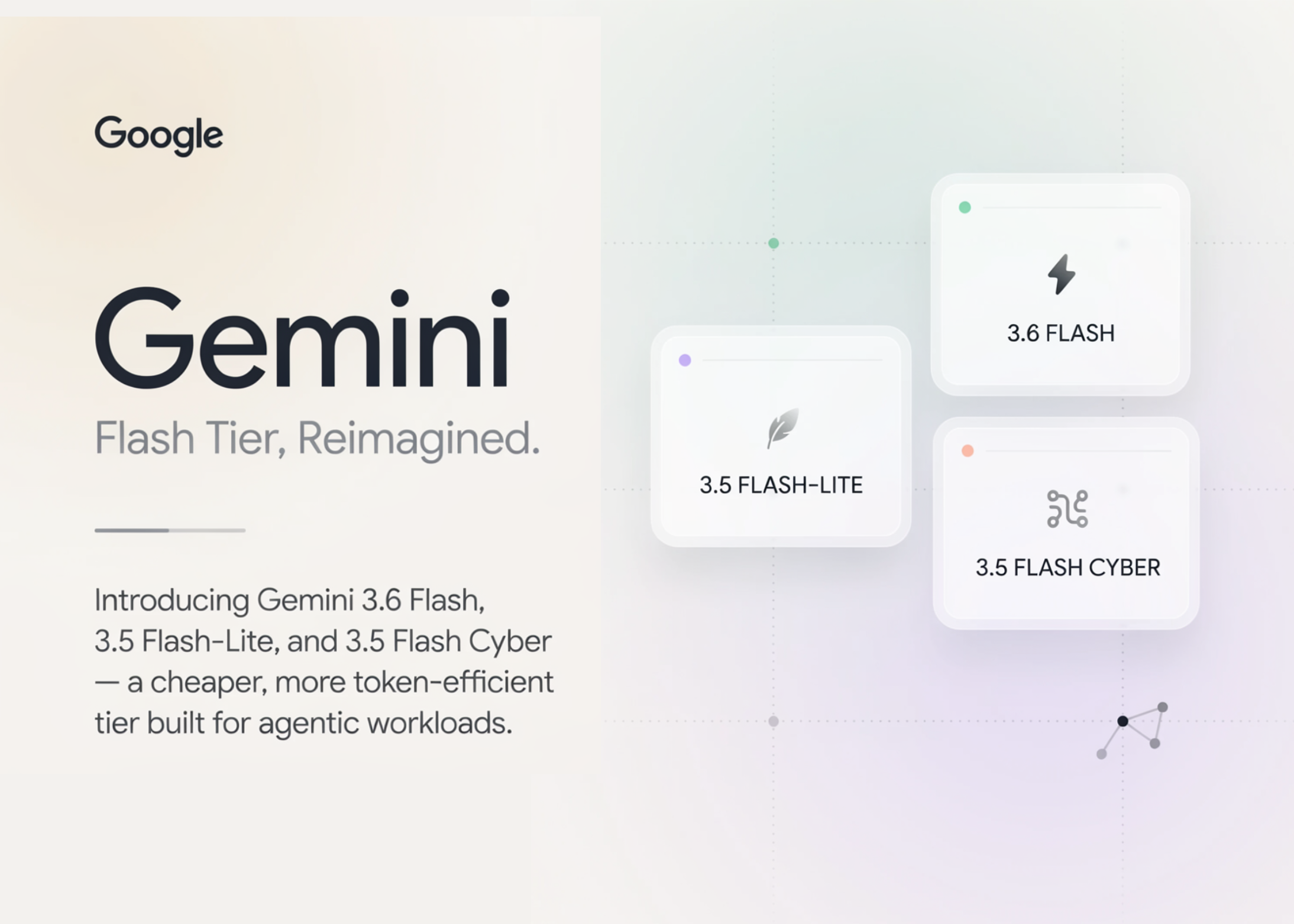
This week's releases cluster around a theme: reducing the overhead that compounds in production agentic systems. Gemini 3.6 Flash ships with measurable token reduction and a price cut, Vercel's AI Gateway gets service tier routing for latency-cost tradeoffs, and Python cold starts quietly drop by half with zero code changes required. Nothing experimental here—most of this is worth touching immediately if you're already in these ecosystems.
Gemini 3.6 Flash cuts output tokens by 17%
Google's 3.6 Flash reduces output token usage by 17% versus 3.5 Flash while lowering cost to $1.50/1M input and $7.50/1M output. The improvement is most pronounced on coding and web tasks, which happen to be the workload profile of most production agents. The companion model, 3.5 Flash-Lite, trades some quality for throughput—350 output tokens/sec—at $0.30/$2.50 per million tokens.
Token efficiency isn't a vanity metric in agentic systems. Multi-step workflows compound output costs: every intermediate reasoning step, tool call response, and context accumulation multiplies what you pay. A 17% reduction per model call can translate to significantly more than 17% savings across a full agent loop, depending on how many hops your workflow runs. The throughput number on Flash-Lite matters too—if you're running high-volume document classification or search reranking, 350 tokens/sec opens architectures that weren't cost-viable before.