In brief
Google launched Gemini 3.6 Flash and 3.5 Flash-Lite today, with better efficiency and lower costs than 3.5 Flash—but Gemini 3.5 Pro, promised at I/O 2026 for June delivery, remains in testing after falling short on coding internally.
3.6 Flash uses 17% fewer output tokens than 3.5 Flash while dropping the output price from $9 to $7.50 per million tokens, making it cheaper to run AI agents at scale.
Google confirmed it has begun pre-training for Gemini 4, which it calls "our most ambitious pre-training run yet."
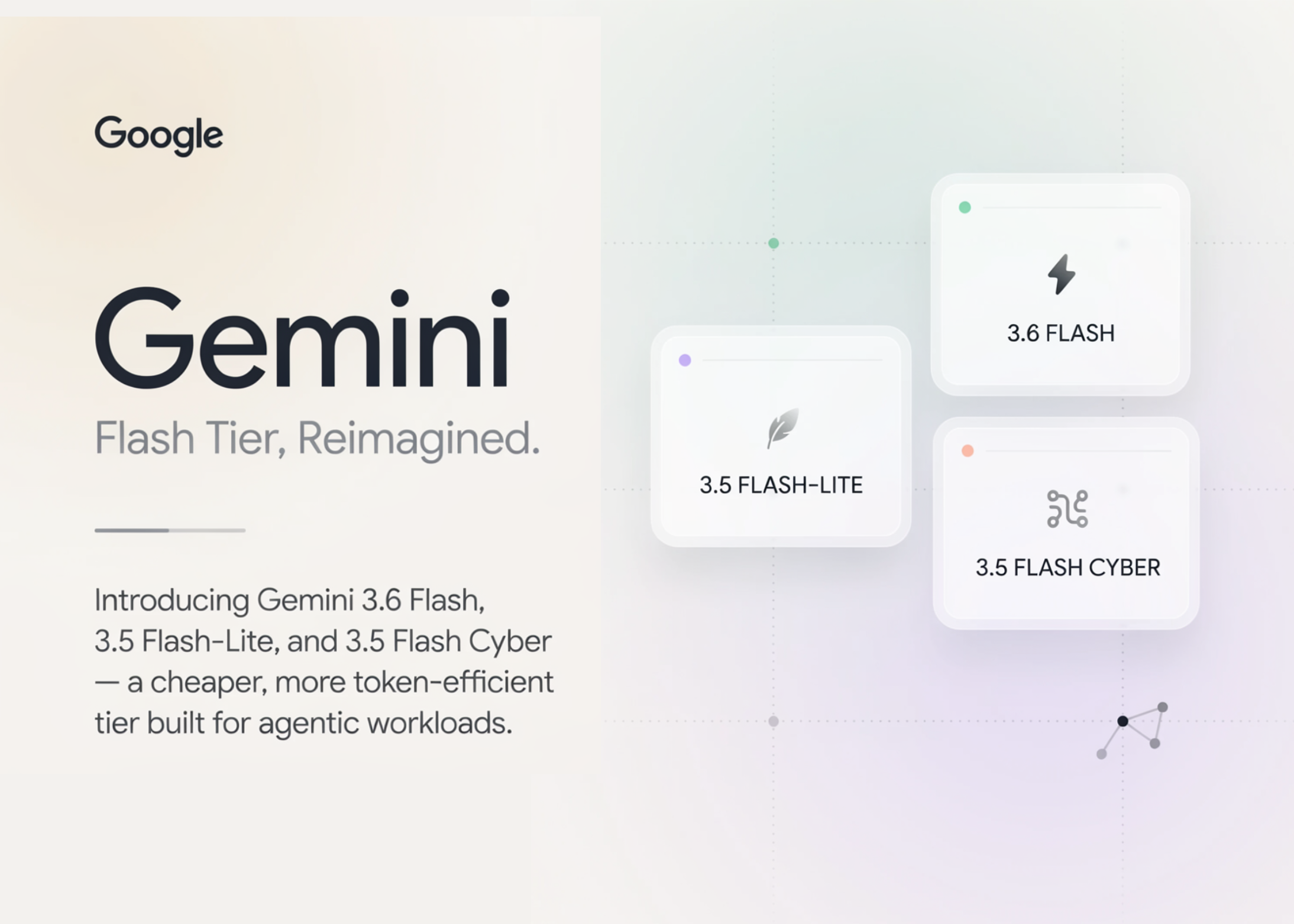
Google launched three new AI models today: Gemini 3.6 Flash, 3.5 Flash-Lite, and 3.5 Flash Cyber. That wasn't what most people expected.After unveiling Gemini 3.5 Flash at Google I/O 2026 in May and promising a Pro version within a month, Google quietly missed its own deadline. Gemini 3.5 Pro was held back because it fell short of internal targets, per Bloomberg, particularly on coding tasks. A late-June attempt to fix it by updating the training data—the massive datasets a model learns from—produced disappointing results. Alphabet stock fell roughly 4.4% on the report, erasing an estimated $200 billion in market cap in a single session.The last Pro-tier model Google shipped was Gemini 3's successor, Gemini 3.1 Pro, back in February.The Flash series is Google's line of speed-optimized models—fast, cost-effective, and built for AI agents, which are programs that operate semi-autonomously to handle tasks like managing documents, processing data pipelines, or browsing the web without a human clicking through each step. Pro models are the heavy lifters: slower, pricier, and built for complex reasoning where raw power matters more than speed.What each AI model does—and who it's forGemini 3.6 Flash is the main release. It uses 17% fewer output tokens—tokens being the basic unit AI processes, roughly three-quarters of a word—than 3.5 Flash, per the Artificial Analysis Index. It's also cheaper: $1.50 per million input tokens and $7.50 per million output tokens, down from $9 on the output side for 3.5 Flash. For businesses running agents at scale, that difference compounds fast.On benchmarks—standardized tests that score AI by percentage of tasks completed correctly—3.6 Flash hit 49% on DeepSWE v1.1, which tests long-horizon software engineering like building and debugging full codebases, versus 37% for 3.5 Flash. On MLE-Bench, a machine learning engineering test, it scored 63.9% versus 49.7%. It topped the table on OSWorld-Verified—a test where the AI takes control of a computer screen to complete real tasks—at 83.0%, ahead of Claude Sonnet 5 (81.2%) and GPT-5.6 Luna (72.6%).Rivals in the same category still lead elsewhere: GPT-5.6 Luna scores 67% on DeepSWE and 84.7% on Terminal-Bench 2.1, which tests agentic terminal coding. Claude Sonnet 5 tops knowledge work on GDPval-AA v2—a benchmark scored on an Elo rating scale like chess, where higher numbers mean better real-world task performance—at 1607 versus 3.6 Flash's 1421.We tried the model for coding and the results were… underwhelming to say the least.