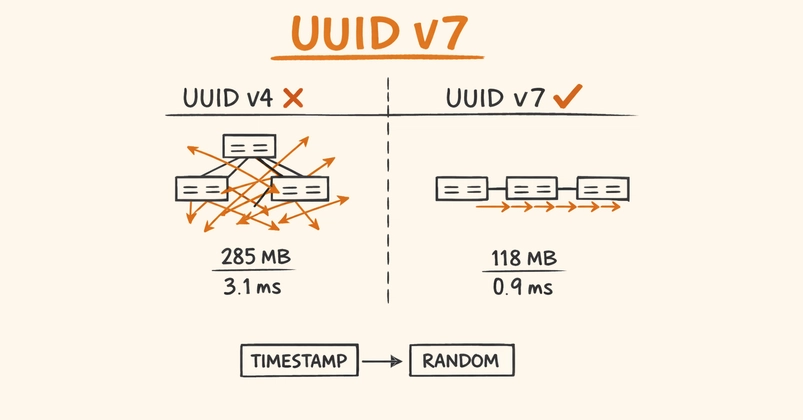
Random UUID v4 makes a poor primary key: values land all over the index, so B-tree inserts scatter across pages and page splits go up. UUID v7 puts a millisecond timestamp in the leading bits (standardized in RFC 9562), so generation order equals sort order and you get locality back.
I needed a UUID generator that runs entirely in the browser, and while building it I implemented v7 by hand instead of pulling in a library. Here is the layout, the implementation, the trap I hit, and when each version is actually the right choice.
The v7 layout
The 128 bits break down like this:
| 48bit unix_ms | 4bit ver(=7) | 12bit rand_a | 2bit variant | 62bit rand_b |