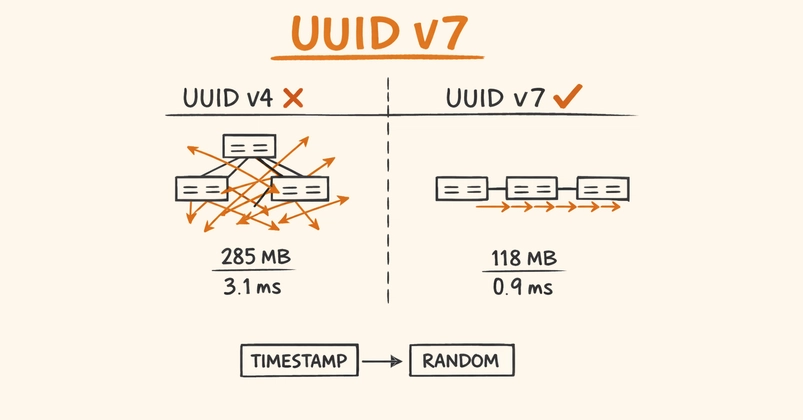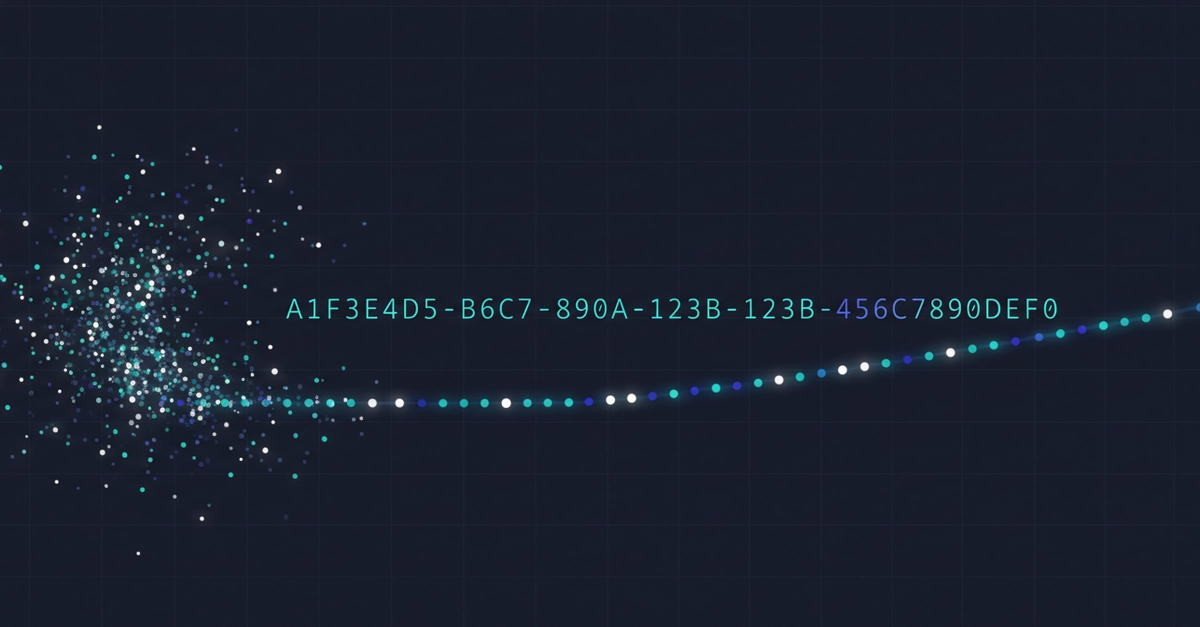
Every backend developer types uuid() a thousand times before ever asking what those 36 characters actually are. Then one day a senior engineer says "stop using v4 for your primary key, it's wrecking the index," and suddenly the thing you treated as a magic random string has versions, trade-offs, and a surprising amount of math underneath. Here is the whole picture.
A UUID is 128 bits wearing a costume
A UUID is just a 128-bit number. The familiar form — f47ac10b-58cc-4372-a567-0e02b2c3d479 — is those 128 bits written as 32 hexadecimal digits, split into groups of 8-4-4-4-12 with dashes for readability. The dashes carry no information; they're punctuation.
But not all 128 bits are free. Two small fields are reserved:
4 version bits — which UUID type this is (the 4 in ...-4372-... marks a version 4).