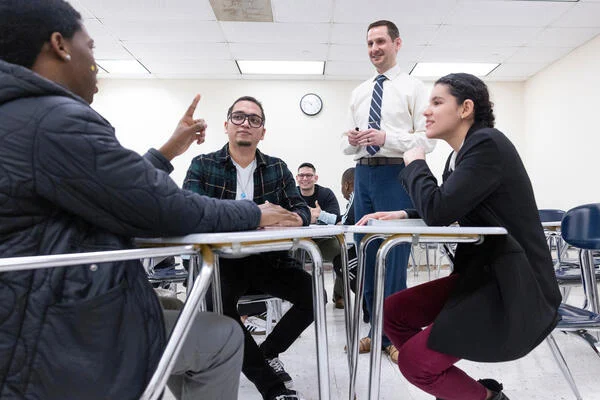
The study found that the majority of students who failed dual-enrollment courses were Hispanic, and they were more likely to be socioeconomically disadvantaged, lower achieving and male.
Jean-François Fort/Hans Lucas/AFP via Getty Images
States have increasingly expanded students’ access to dual enrollment—the practice of allowing high school students to simultaneously enroll in college courses for college credit—to give them a head start and ease the transition to postsecondary education. But what happens to the high schoolers who fail their college-level classes?
According to a new study published by the Annenberg Institute at Brown University, students from socioeconomically disadvantaged backgrounds are more likely than their better-off peers to fail dual-enrollment classes, regardless of their prior academic achievement or preparation. And students who fail a dual-enrollment course are considerably less likely to attend college, the study noted. At the same time, it found that even those who attempt a dual-enrollment course and fail are more likely to enroll in college than those who never participate in dual enrollment.
To conduct the study, researchers examined administrative data on about 1.74 million public high school students in California who entered ninth grade from 2015–16 through 2018–19. They analyzed how the likelihood of failure varies based on students’ prior academic achievement, whether it differs by socioeconomic status and how such failure impacts college-going decisions.