Disclosure: I build Schemity, a desktop ERD tool - this post is from our blog and uses it for the examples.
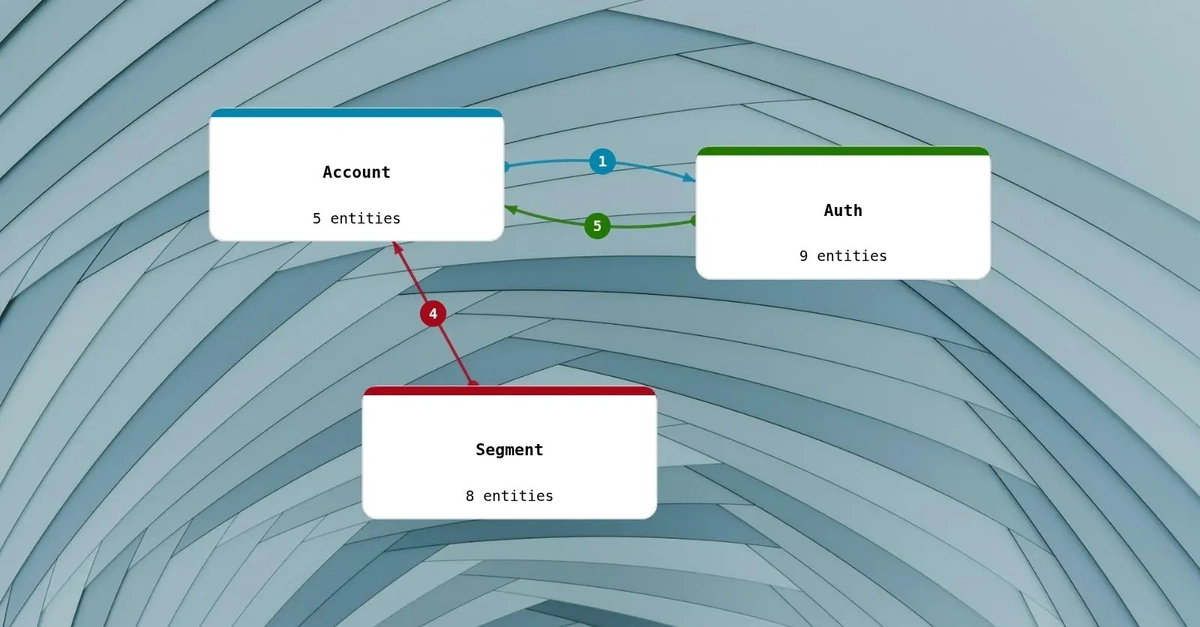
TL;DR: Hand-drawn context maps go stale because nothing ties them to the schema, and cross-context coupling stays invisible until an extraction fails. Schemity's Context Map derives the map from your foreign keys: each context view becomes one node, arrows show dependency direction with a foreign key count, and double-clicking an arrow lists the exact foreign keys behind it.
You do not need to draw your context map, because your schema already contains it: every foreign key that crosses a context boundary is one edge of the map. Schemity's Context Map renders that map for you - each context view collapses into a single node, and the arrows between nodes are derived from the actual foreign keys in the diagram, not from anyone's memory of them.
The reason this matters is what teams do today instead. The context map - the DDD picture of which bounded contexts exist and who depends on whom - is usually a drawing. As one practitioner report on Context Mapper puts it, DDD models "are typically developed on a whiteboard or with Post-it notes," and few tools support maintaining them - which is why a dedicated DSL for writing context maps by hand has existed since 2018. A whiteboard photo is stale the day after the workshop. A hand-written DSL file is better, but it is still a second artifact: someone has to notice that the schema changed and go edit the map to match. Nothing enforces that, so nobody does it, and the map quietly stops being true.