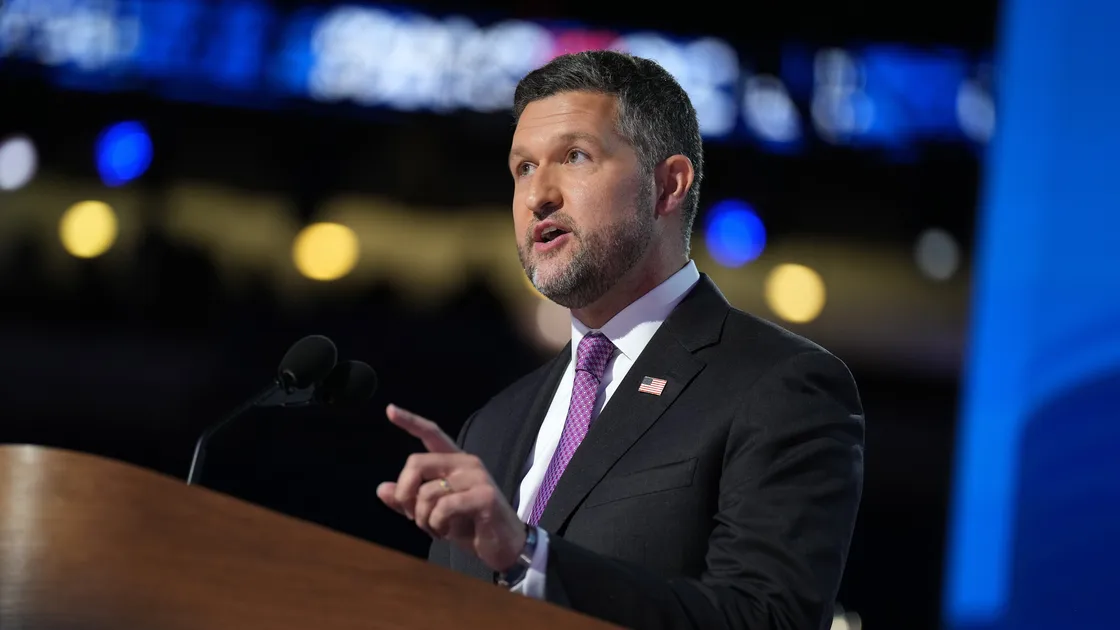
WASHINGTON — In 2024, a super PAC allied with the American Israel Public Affairs Committee spent $4 million to boost then-state Sen. Sarah Elfreth in a contested Democratic primary in Maryland. It’s not an exaggeration to say the money was decisive: It was more than twice as much as Elfreth’s campaign raised and spent. It was one of a string of wins for AIPAC in Democratic primaries, starting in 2022, when it backed candidates who would keep military aid flowing to Israel. The group has long been clear about what it expects from candidates it backs: There should be no conditions on aid to Israel under any circumstances. But last week, Elfreth was one of the 10 Democrats who voted “present” on a symbolic amendment to cut off aid to Israel, signaling an unwillingness to shoot down the effort completely. Another 21 Democrats who had received financial backing from AIPAC voted for the amendment. Altogether, 103 Democrats voted for the amendment in a rebuke of Israel and its prime minister, Benjamin Netanyahu, who has overseen a war in Gaza that has led to more than 70,000 deaths. In a lengthy statement, Elfreth called the vote a ploy by House Republican leaders to divide Democrats. She said the amendment was poorly written, but also, regarding Israel, that “the current dynamics of our allyship are not sustainable for the region and our nation.” AIPAC appeared to cut off fundraising support to the Democrats who voted yes. One of them, Rep. Pat Ryan (D-N.Y.), said he welcomed the consequences. “I expect groups like AIPAC will not support me in my future elections and frankly, I don’t want their support,” Ryan wrote on social media after the vote. “Hardline stances that refuse to stand up to a corrupt and increasingly dangerous Netanyahu regime have no place in our politics.”The vote showed how AIPAC’s grip on American politics is slipping, at least among Democrats. The group, which continues to pour tens of millions of dollars into contested primaries with mixed success at best, is fundamentally trying to convince members of Congress to ignore the clear moral judgment of their constituents, while also turning itself into the No. 1 example of political corruption in the country.“If AIPAC cares about saving the US-Israel relationship, the best thing it could do right now is to disband,” former Rep. Tom Malinowski (D-N.J.), who lost a Democratic primary this year thanks partly to more than $2 million in spending by an AIPAC affiliate, said in an interview. “It has only toxic influence.”“The message to mainstream Democrats was that we will destroy you if you don’t blindly and unconditionally support whatever positions we take.”- Former Rep. Tom Malinowski (D-N.J.)Malinowski, who served two terms in the House from 2019 to 2023, supports aid to Israel, with conditions. But AIPAC and its affiliates consider conditioning aid to be “not a pro-Israel position” and spent heavily against him ahead of the February Democratic primary, ultimately won by Rep. Analilia Mejia (D-N.J.), a progressive and an Israel critic who’s called its deadly war in Gaza a genocide. “AIPAC explicitly told me and others that they preferred a ‘squad’ Democrat to win in my race than to have somebody like me who would be making these arguments from a credible, pro-Israel point of view,” Malinowski told HuffPost. “The message to mainstream Democrats was that we will destroy you if you don’t blindly and unconditionally support whatever positions we take, and I think most Democrats, most mainstream Democrats, responded to that by saying, ‘Well, then you can go fuck yourselves.’”AIPAC’s reputation among rank-and-file Democrats is poisonous, party operatives say, referring to internal campaign surveys. AIPAC’s super PAC routinely tries to disguise its spending by funneling cash through pop-up or unrelated groups so voters don’t know where the cash is coming from. Potential presidential contenders, even moderate ones, are determined to keep the group at arm’s length.“If someone is receiving a lot of support from AIPAC, it makes it harder to campaign with them,” said an adviser to one 2028 presidential contender, who requested anonymity to speak frankly, pointing to the ultrawealthy conservatives whose $100 million fills the coffers of United Democracy Project, a PAC affiliated with AIPAC. “Base voters in New Hampshire are going to want to know why you helped out a candidate backed by Trump-supporting billionaires.”AIPAC, for now, remains determined to solve the problem with more campaign spending. It has spent nearly $20 million backing Rep. Haley Stevens in Michigan’s Senate race and more than $1.4 million backing Rep. Wesley Bell in Missouri’s 1st District, aiming to hold off progressives in both races. But its spending is only further alienating the Democratic voters it is allegedly trying to win over, who are largely skeptical of money in politics. “Every dollar they spend makes their long-term problem worse,” said one Democratic pollster, who requested anonymity because key parts of Democratic leadership still support the group. “It reinforces the idea that Democrats who are pro-Israel are only doing it for the money, which makes it hard for voters to believe anyone is doing it for any other reason.” Even Rahm Emanuel, the former Chicago mayor, Democratic lawmaker and White House chief of staff — and a possible 2028 presidential contender — warned Israel this month that its war in Gaza is making it a pariah nation. “Your government has been complicit in the horrors now being inflicted on innocent families in the West Bank,” Emanuel, long an ardent defender of the country who volunteered in assisting the Israel Defense Forces during the Persian Gulf War, said in a speech at Tel Aviv University.In a statement, AIPAC said last week’s aid vote “sends a dangerous signal to both our allies and our enemies around the world.” The amendment, by Rep. Thomas Massie (R-Ky.), would have cut off the annual $3.3 billion allotment the U.S. has been providing Israel under the terms of a 2016 memorandum of understanding. The amendment failed thanks to every Republican but Massie and 98 Democrats voting against it, but Massie called it a resounding success. “To get over 100, to get a majority in the Democratic caucus, demonstrates a couple things,” Massie told reporters. “Number one, public opinion is changing. Number two, it’s being reflected here in Washington, D.C., and number three, the AIPAC grip, at least on one party, has been severely diminished.”
AIPAC Spent Millions Electing These Democrats. They Just Defied It.
The pro-Israel group’s absolutist stance has alienated even moderate Democrats who support the Jewish state.
1,060 words~5 min read