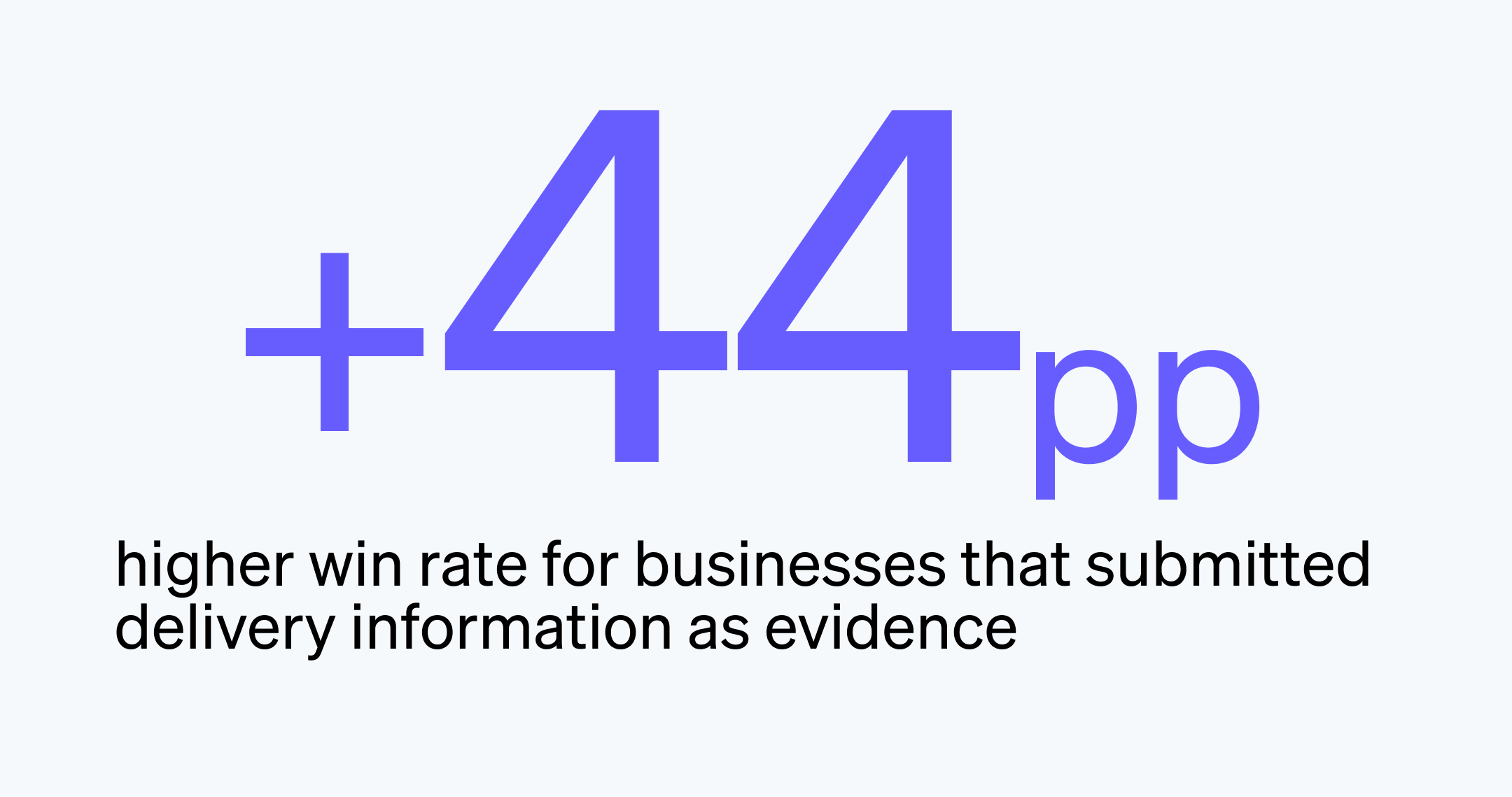
“Product not received” disputes—where a cardholder claims they didn’t receive what they paid for—are the most common nonfraud dispute category on Stripe. It can be challenging to know which claims are legitimate and which are not: some customers genuinely never received what they paid for, while others incorrectly claim they didn’t receive the order. To understand what can influence win rates, we analyzed evidence packets from one million disputes over a 16-week period. We compared win rates for packets that included various types of evidence—such as delivery confirmation or content consumption logs—against those that didn’t, isolating which features correlated with higher win rates. Here’s what the data shows for businesses broadly, what’s different for businesses selling digital goods, and what it means for how you mitigate disputes.Businesses that submitted delivery information saw a 44 percentage point higher win rate
For businesses selling physical goods, disputes with delivery confirmation as evidence had a 27 percentage point higher win rate than disputes without it. Adding a GPS delivery map as evidence, which shows where the carrier scanned the package, lifted win rates by an additional 15 percentage points on top of delivery confirmation alone. And including a recipient signature as evidence added a further two percentage point lift. Together, disputes with delivery confirmation, a GPS map, and a signature had a 44 percentage point higher win rate than disputes without them.Yet many businesses still don’t include delivery confirmation in their dispute responses. Part of this gap is awareness, but the bigger barrier is operational. For most businesses, shipping data and dispute workflows live in separate systems. Matching a specific dispute to the right order and confirmed delivery status often requires manual work and is hard to scale. Businesses that submitted evidence after the delivery was confirmed saw a 27 percentage point higher win rate