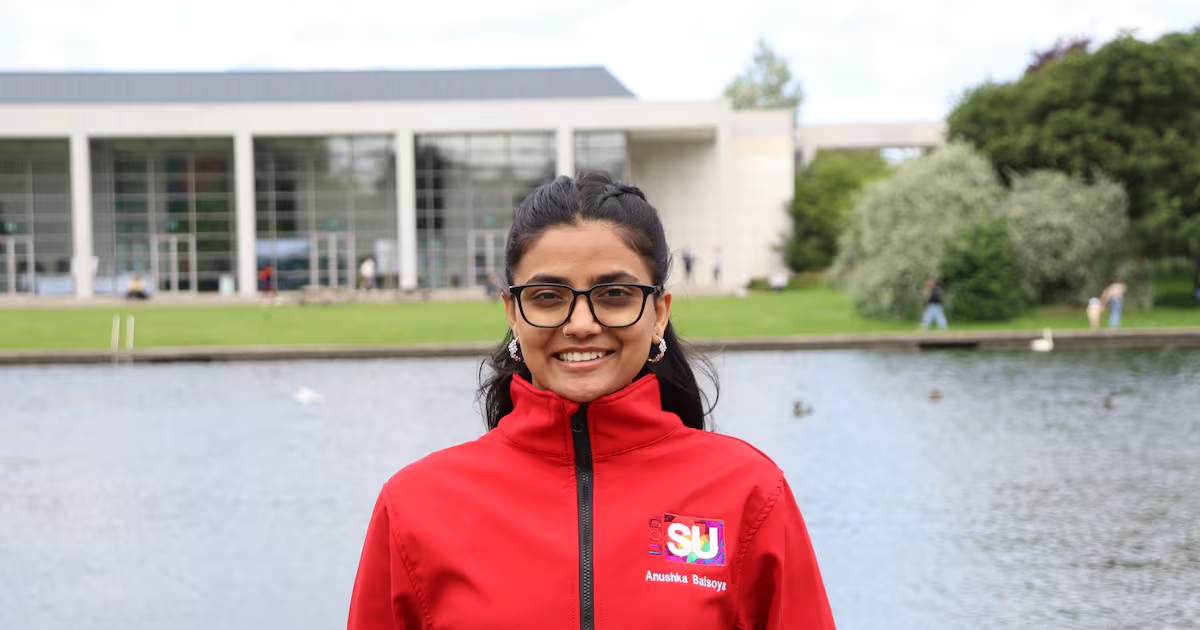
“If you really want to fit in with the crowd” in Dublin, you have to be prepared for the “hidden costs” of living in the city, says Anushka Baisoya.Baisoya, a postgraduate food science with nutrition student at University College Dublin, says she was lucky enough to avail of a €10,000 scholarship towards her fees but still paid more than €19,000 for the year as a non-EU student arriving from New Delhi, India. The fees are just one aspect of a number of costs that have burdened her since landing in Dublin, she says.Dublin is ranked the third most international student city in the world, behind only Melbourne and Sydney, according to a Quacquarelli Symonds (QS) Best Student Cities report released on Tuesday. QS, which analyses the higher education sector, is best known for its annual global rankings of universities. The company’s new report shows that for those who have made the journey to study, they will realise Dublin is one of the most expensive cities for students, ranking 137th out of 150 cities when it comes to affordability, with the 150th city being the least affordable.Despite moving up four places from last year’s ranking, Dublin remains in the bottom 10 per cent for affordability alongside cities such as Oslo, Hamburg and Miami.“The load was heavy,” Baisoya says, adding that groceries, accommodation and the “limited” time she can afford to spend “bar-hopping” or exploring “other culturally important things” with friends all add up. She spends €30-€40 a week on “five to seven” basic items she needs for food in a week. She spent the first months of the last academic year in Yugo student accommodation in Dublin 8, but the €1,300 monthly rent was too high to bear. By January 2026, she sacrificed previous luxuries to halve her rent in order to live in a shared room in Clonskeagh, south Dublin, for €650 a month.Baisoya, who was elected as a postgraduate officer in UCD student union in June, says a lot of conversations with international students while campaigning echo her own financial stresses over the past year.Baisoya is one of thousands of international students who have chosen Ireland to study in recent years.Research from the Higher Education Authority shows Ireland had 44,535 non-Irish-domiciled students enrolled in higher education in the 2024-2025 academic year, up 10.2 per cent in a single year and equivalent to 16 per cent of all enrolments. International tuition across Dublin’s five ranked institutions averages about $23,900 (€20,917) a year. The QS report found it was cost of living rather than academic fees that separated Dublin from cities charging comparable tuition.Dublin scores well for university rankings and employer activity. The city’s significant disparity between its best and worst categories is the widest split in the top 50 cities ranked.The report finds accommodation to be the main pressure. The Government estimates the existing accommodation shortage at 15,000 student beds, with about 42,000 further beds required by 2035.Patrick Nyhan Patrick Nyhan, from rural New York state in the US, says he and his friend applied for 80 places offering accommodation in 2025, hearing back from only three.Nyhan is entering his third year of philosophy, political science, economics and sociology in Trinity College Dublin in September. College fees have cost him almost €40,000 over the past two years and he pays a little over €1,000 a month for rent in a house near Landsdowne Road in Dublin 4. His friend, whom he lives with, pays the other half.“Anything that is nonessential is so much more expensive,” Nyhan says.When it comes to clothing or even allergy medication in some cases, he waits until he returns home to buy the items, he says.Whether it is the “inconsistency and inefficiency” of public transport or the high price of a cup of coffee, Nyhan says it can be “very frustrating how expensive everything is”.“There’s so few things to do in this city that don’t cost money,” he says. In hindsight, would he have moved to Dublin if he had known how expensive it was?Nyhan says he holds sentimental value to friends and parts of the city but “I probably would not do it all again”, he says.Ben Sowter, senior vice-president at QS, says for a city with a population of fewer than 600,000 people, Dublin’s student diversity is “remarkable”.Sowter says Dublin’s 137th affordability ranking “should concern people”.“You cannot be the world’s third most international student city and its 14th least affordable indefinitely. One of those two numbers will move,” he says.For many Irish-domiciled students, Dublin’s low affordability ranking is all too familiar. Hugh Emerson 'never went through college thinking I’ll have enough money to go home at the end of the week' Hugh Emerson, a graduating international relations student in Dublin City University, says some basic expenses became “pinch points” during his four years in college.“I can’t remember the last time I went out to buy new clothes, for instance,” Emerson says.He says he is lucky enough to have support from his parents back home in Tralee, Co Kerry, for the €3,000 a year domestic fee and average of €1,000 a month his accommodation cost for three out of four years in college. Gathering enough money for two or three drinks every six weeks with friends, going to the cinema or even travelling home to Tralee was always a burden, he says.“I never went through college thinking I’ll have enough money to go home at the end of the week,” Emerson says.Daniel Walsh, president of Amlé (formerly the Union of Students in Ireland), says the biggest issues facing students today are the “exact same issues that students were highlighting 10 or 15 years ago”.The situation is “definitely getting worse”, Walsh says, adding the supply of student accommodation has failed to match the large growth in the student population over the previous two decades.Walsh says DCU has more than doubled the size of its student population since 2006. A spokesperson for DCU says the high cost of construction resulting in “unsuitably high” student rents has been a big reason behind the university failing to deliver any new accommodation units since 2002.Walsh says investment is needed for “purpose-built, student-specific accommodation” that would prevent students from having to continuously look to the private market.
‘There’s so few things to do that don’t cost money’: Dublin named 14th dearest city for students
Dublin has been ranked as the 137th least affordable of 150 cities in a new report
1,036 words~5 min read