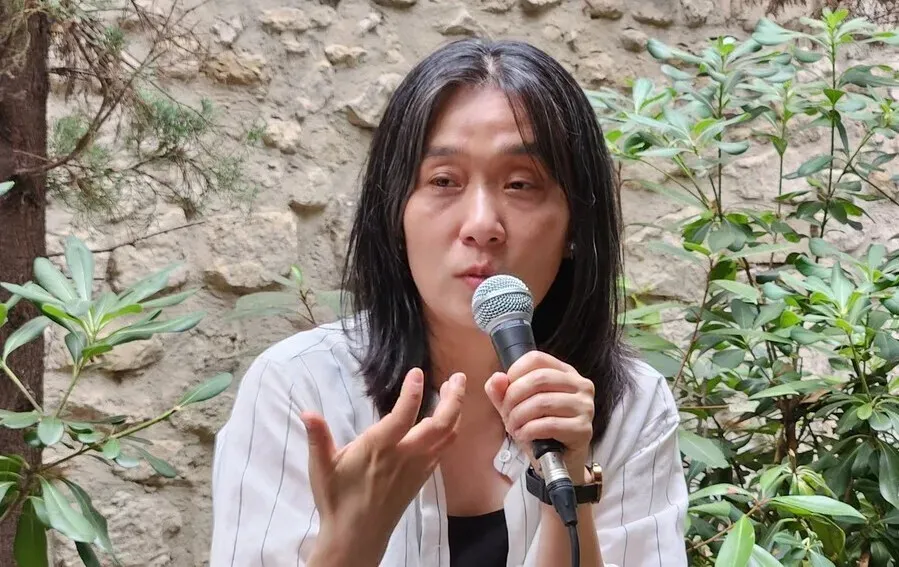
The writer Han Kang speaks to Korean reporters during the Avignon Festival in France on July 15, 2026. (Yonhap)
Calling a recent controversy in which a Seoul high school baseball team mocked the 1980 uprising in Gwangju an “important incident,” Nobel Prize-winning author Han Kang, 56, said that the public “shouldn’t just let it pass amid shock and surprise.”“Figuring out how to overcome the problem of hatred is an important challenge for us,” she added.The writer’s comments came Thursday while meeting with Korean reporters at the Avignon Festival in France, during which she addressed the controversy over athletes from Seoul’s Paichai High School shouting trash talk at opponents from Gwangju Jeil High School that appeared to make light of the May 18 Democratization Movement. “If this incident is sending us a signal, we must carefully identify the problems that have surfaced and put our heads together to ponder how to move forward,” she said. “My teacher friends have been giving this issue a great deal of thought in their classrooms.”“They’re asking questions like ‘What can we do’ and ‘As the older generation, how did we end up failing like this,’ so this incident seems extremely important,” she added.The reporter who asked Han to weigh in on the issue initially appeared to imply that the public response was “somewhat excessive,” but the author said, “I think we need to give this issue deeper consideration."“I don’t think it’s good for one shock to eclipse another, only for the next shock to cover up the previous one until everything is swept away,” she added.This implied her concern that Starbucks Korea’s ill-advised “Tank Day” marketing campaign that made fun of the uprising, mockery from far-right politicians and the incident at the high school baseball game could get entangled and dilute one another, attracting attention merely to surface-level manifestations rather than the underlying core of the issue, or even causing such manifestations to become cliché and lose their impact.Turning to war, conflict and hatred around the world, Han said, “The method of overcoming the problem of hatred is an important challenge for us.”“It’s time for all of us to reflect on how to change course in this era of hatred and move forward in a different direction,” she added. “If we all agree that hatred is problematic, there is hope.”The Korean news outlet Newsis reported that on the night of July 7, Han hosted a reading planned as the final event ahead of the temporary closure of her independent bookstore Onul Books, which she opened in 2018.“Instead of feeling regret that it won’t last forever, I feel grateful and consider it nothing short of a miracle that I got to continue this work over the past eight years,” she told reporters.The author also hinted at opening another bookstore.“I’ve been spending a long time abroad, so finding a new space so soon was difficult,” she said. “I think I’ll pause for a while, get things in order and maybe return someday.”Given her increased interactions with Korean media, Han complained that official appearances with the public and media after winning the 2024 Nobel Prize in literature were “frankly burdensome.” “So I stayed in my hole for a while, but now that interest seems to have greatly died down, I feel a little lighter,” she said.At the festival, Han attended a Q&A with fans on July 12. And on Wednesday, she appeared on stage at the end of “Oiseau,” a lecture and performance based on her 2024 novel “We Do Not Part,” joining actors Isabelle Huppert of France and Lee Hye-young of Korea in reading lines from the work.By Im In-tack, staff reporterPlease direct questions or comments to [english@hani.co.kr]