in History, Religion | July 20th, 2026 Leave a Comment
One might assume from a modern viewpoint that the hairstyles worn by monks arose to deal with male pattern baldness anxiety. As in the school uniform approach, you can’t single out one person’s baldness when everyone is bald. But this, again, would be a modern view, full of the vanity the tonsured—those with religiously shaven heads—ostensibly vowed to renounce. According to the Catholic Encyclopedia, the tonsure (from the Latin verb for “to shear”) began as a “badge of slavery” among Greeks and Romans. It was adopted “on this very account” by early monastic orders, to mark the total surrender of the will.
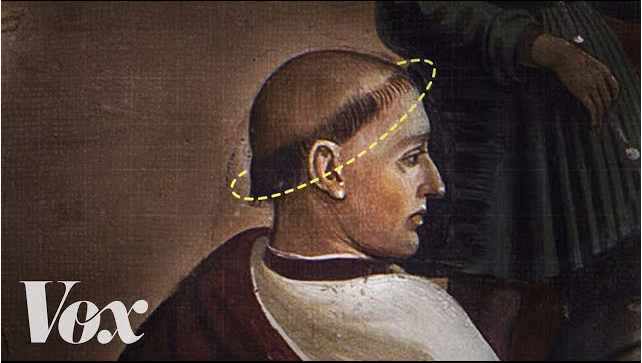
Would it surprise you, then, to learn that there were tonsure wars? Probably not if you know anything about church history. Every article of clothing and of faith has sparked some major controversy at one time or another. So too with the tonsure, of which—we learn in the Vox video above—there were three styles. The first, the coronal (or Roman or Petrine) tonsure, is the one we see in countless Medieval and Renaissance paintings: a bald pate at the crown surrounded by a fringe of hair, possibly meant to evoke the crown of thorns. Next is the Pauline, a fully shaved head, seen much less in Western art since it was “used more commonly in Eastern Orthodoxy.”