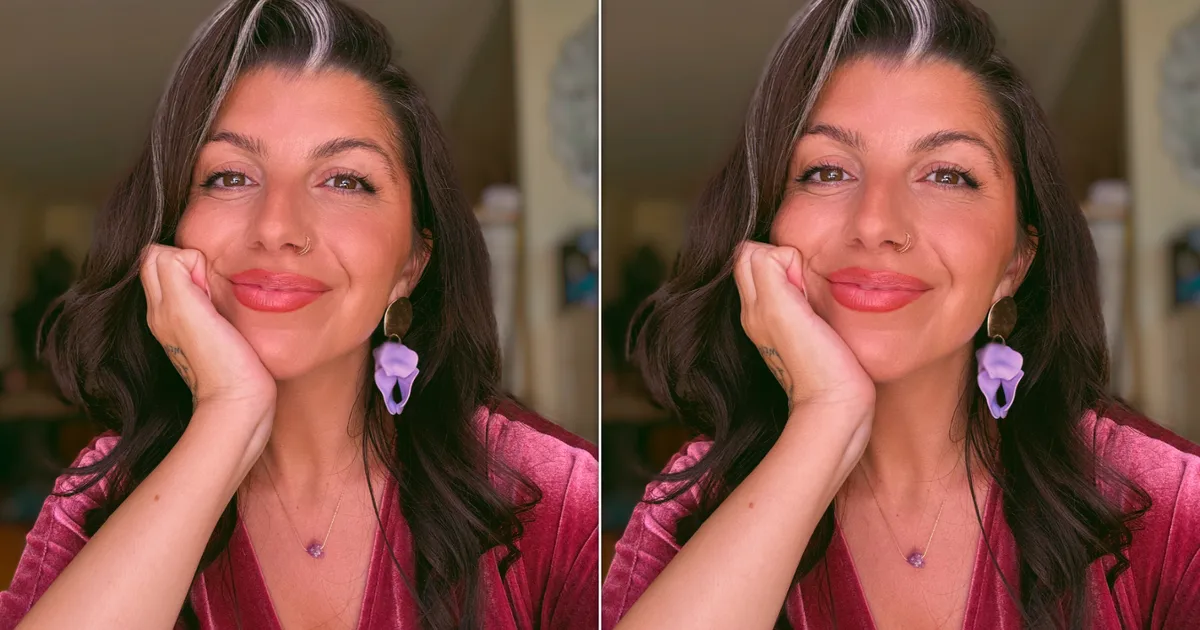
When Bruna Nessif was 16, a striking streak of white hair appeared at her roots, right around her center part. She hated it. Premature graying isn’t exactly on most 11th-graders’ radars.“Even though it ran in my family, I was insecure about it, so I dyed it up until college,” said Nessif, the author of “Let That Shit Go: A Journey to Forgiveness, Healing & Understanding Love.”That bold white patch is often called a “Mallen streak” or a “skunk streak.” Clinically, though, it’s known as poliosis — a localized absence of melanin in the hair follicles that causes the hair to grow without pigment. The term “Mallen streak” is a nod to Catherine Cookson’s Mallen trilogy, whose wealthy, ruthless Mallen family members all share the hereditary white streak.In recent years, the stripe has become an it-girl staple ― “the Mallen streak has become the ultimate symbol of alt beauty: communicating glamour, danger and deviance,” Dazed wrote in 2023.But when Nessif developed her single strip in the early 2000s, she was “mortified.” After college, she eventually put the hair dye down and grew to embrace it. Now in her 30s, her bold, two-toned tresses have become a signature part of her look. Courtesy of Bruna Nessif“It’s ended up being a really beautiful reminder that there’s power in letting yourself be seen authentically,” Bruna Nessif said of her white streak. “I love that it’s so uniquely me.” “Once I stopped, I realized other people loved it. I’d always get called Rogue from ‘X-Men’ and get told I look like a superhero,” Nessif told HuffPost. “It’s ended up being a really beautiful reminder that there’s power in letting yourself be seen authentically. I love that it’s so uniquely me.”In the past, many people reached for the hair dye at the first sign of a white streak, hoping to avoid “Bride of Frankenstein” comparisons. Today, though, a growing number of public figures wear theirs proudly, including “Bodyguard” actor Richard Madden and former Director of National Intelligence Tulsi Gabbard.“You Have to Admit, Her Hair Looks Good,” a headline on a Slate piece about embracing a Gabbard-esque streak read.Samir Hussein via Getty Images / Tom Williams via Getty ImagesActor Richard Madden, left, and Tulsi Gabbard, the former Director of National Intelligence, right, both sport “skunk streaks.”These days, Ash Therese, a hairstylist in New York City, said she has non-graying clients coming in asking for white or dramatic-colored (light purple, bright blue) “money pieces” ― bright, face-framing highlights in the front sections of the hair. “I think the streak is chic. I think it’s sexy,” Therese said. “I mean, hell, life isn’t easy. How wonderful that you’ve lived enough of it for your hair to begin showing its story?” Therese is such a fan, she recently gave her partner gray money pieces around their face to accentuate the gray hair they already had.Why does it naturally occur? When it isn’t the result of hair dye, a localized patch or streak of gray or white hair is fairly common and affects people of all genders, said Dr. Aamna Adel, a consultant dermatologist and hair-loss specialist based in London. It’s less common than gray throughout the hair, but not uncommon.“It tends to run in families,” she said. “It can appear at almost any age, but when it shows up early, in the teens or twenties, there’s usually a genetic component.”When a streak has been present from birth, it can occasionally be linked to genetic conditions such as Waardenburg syndrome or piebaldism ― both congenital, genetic disorders affecting melanin development that cause white forelocks and depigmented skin patches ― but Adel said the conditions are uncommon.Factors like chronic stress, lack of sleep, smoking and nutritional deficiencies, particularly a lack of zinc, can bring graying on a little earlier, but a single, defined streak is usually more about genetics than anything else, Adel said. Here’s how lean into your gray streak (or dye it).Angelina Murphy, a celebrity hair extensionist in Seattle, has seen stress speed things up when it comes to gray. When the streak first shows up ― or just gray hair in general ― people usually aren’t super enthused about it, she said. “At first, they almost always want it gone,” Murphy told HuffPost. “The first reaction is usually, ‘Cover it!’ But over time, I find that a lot of women become more open to blending it instead of constantly coloring it every few weeks.” Jared Siskin via Getty ImagesA guest at 2018’s men's fashion week in New York City sports some bold gray strands.Sometimes clients who are put off by the arrival of grays will try to pluck the strands out. That’s almost always a bad idea, said Kayla Lofaro, stylist and owner of Discotheque Salon in Los Angeles. “Tweezing a whole streak can permanently damage the hair follicles, leading to thinning or patchy regrowth,” she said. “Plus, it will just grow back gray anyway.”Murphy agrees, and recommends clients opt for soft, face-framing highlights or a balayage around the gray streak, she said.“It blends everything together beautifully and gives clients a much softer grow-out without that harsh line of demarcation,” she said. If you want to lean into your streak, the trick is making it look intentional, said Lofaro.“Parting the hair to highlight the streak can look incredibly chic and high-fashion,” she said. As for upkeep, gray hair lacks pigment, which can sometimes make it look a bit dull or unruly.“Get yourself a clear gloss treatment to add incredible shine and soften the texture,” she said. “It will make the silver look vibrant and glassy.”You’ll also want to watch out for yellowing and consider purple shampoo.“Natural silver absorbs environmental pollutants, smoke, and heat easily, which can cause it to turn a bit yellow,” she said. “Using a purple shampoo once a week will keep the streak looking bright, clean, and icy.”If you want the streak entirely gone, a permanent hair dye is needed.Therese said the best advice she received about embracing unexpected hair changes came from her mentor: No one is thinking about you as much as you’re thinking about yourself.“I don’t mean that in a negative, ‘you don’t matter’ kind of way,” she said. “What I mean is this: Ideally, the people in your life who are worth your time are going to love that gray streak in your hair. The people who matter don’t give a crap about your gray hair. And if they do, maybe those aren’t your people.”Plus, she thinks that culturally, we’re moving toward a place of greater acceptance and celebration of ourselves and the way we naturally look. If the gray doesn’t truly bother you, there’s no reason to cover it or change it, Therese said. “Natural is in. Perfection is out. Leave all that perfection BS to AI,” she said. “I love natural-looking hair that’s a little undone, a little effortless, and a little playful. I love seeing tinsel shimmering in people’s hair as I walk through the city.”
The Real Reason Some People Get Poliosis, A Distinctive ‘Skunk Stripe’ In Their Hair
Hipsters may be dyeing streaks into their hair, but for some people, that distinctive “skunk stripe” happens naturally. Here’s why.
1,157 words~5 min read