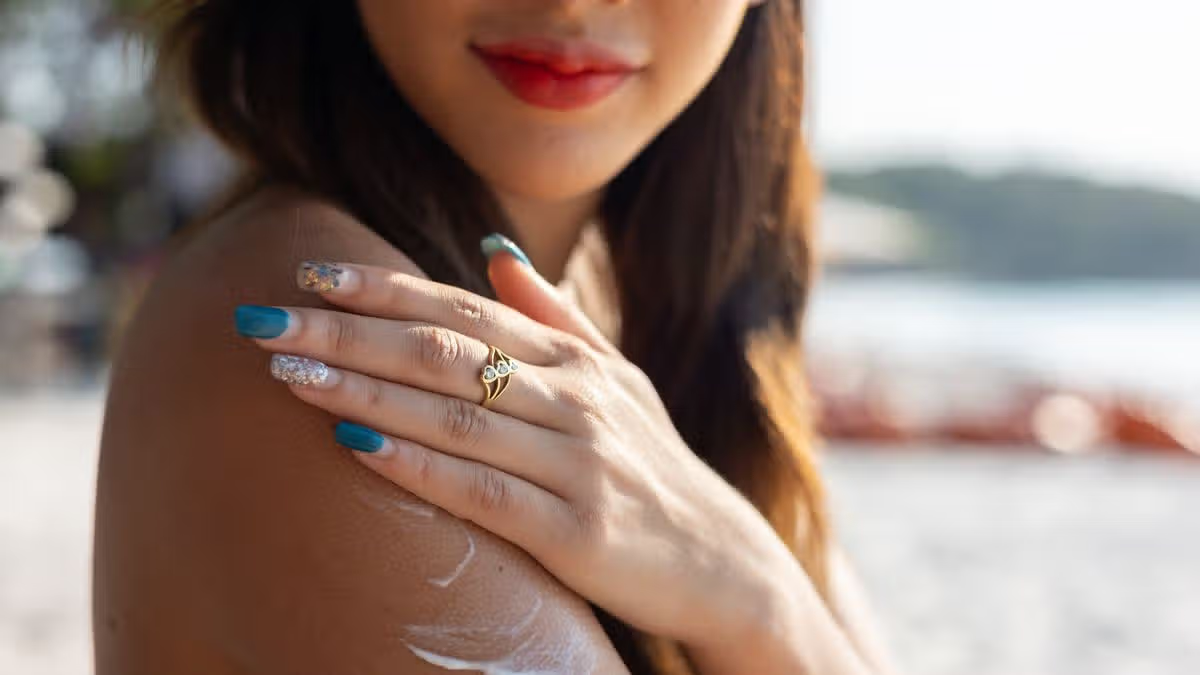
‘I have never used a sunbed, but I think they should all be destroyed’Anyone can get skin cancer, so we all need to protect our skin and observe it for changes. Photograph: iStock Mon Jul 20 2026 - 06:01 • 6 MIN READIt is estimated that one in five people in Ireland will develop skin cancer at some stage in their life.“Approximately 11,556 people were diagnosed annually with skin cancer in Ireland in the period between 2018-2022, accounting for 34 per cent of all invasive cancers,” says, Bernie Carter, assistant director of nursing at the Marie Keating Foundation (MKF). “There are two main types: non-melanoma skin cancer and melanoma skin cancer. “Non-melanoma skin cancers (NMSC) are the most common type in Ireland with over 10,000 cases diagnosed annually, accounting for 90 per cent of all skin cancers. Fortunately, NMSC can usually be treated and mortality is generally low. Around three-quarters of NMSC are basal cell carcinomas, with the remainder being squamous cell carcinomas.“Melanoma skin cancer accounts for 11 per cent (1,243) of skin cancers annually in Ireland between 2018-2022. This is a less common but more aggressive type of skin cancer with a five-year survival rate of 93 per cent, and higher survival rates seen in females than in males.”This month has seen some extremely hot days in Ireland, and across Europe. But, regardless of the temperature outside, the Marie Keating Foundation is urging people to be aware of the signs of skin cancer and to seek advice if they have any concerns.Carter says fairer-skinned people, with lots of freckles and moles, are more at risk. However, anyone can get skin cancer, so we all need to protect our skin and observe it for any new changes.Sometimes, the changes can have no symptoms whatsoever and may just appear as a new mole or growth. This is what happened with Garvan McFeeley (59), who went to see his doctor in 2021 for an unrelated issue and just happened to mention a growth he had on his right ear.Although his GP didn’t think there was anything unusual about it, she referred him to hospital for removal as it was “marginally too big to deal with at the surgery”.Having had it removed, McFeeley didn’t think anything more about it, but a week later, he got a call from the hospital asking him to come back urgently for a follow up appointment. “After the growth was surgically removed, it was examined as a matter of routine,” he says. “I got a call a week later saying they needed to see me ASAP. Obviously, something nasty was discovered – but which flavour of nasty I did not know.Garvan McFeeley. Photograph: Karl Hussey “Then, after an anxious weekend, I got the bad news [that the growth was cancerous – an amelanotic melanoma]. I was distraught and the shock was awful. As it was during Covid times I had to attend the appointment on my own and this made it even worse as I had to phone home with the news. The doctors from my GP surgery were also shocked, as they thought it was a standard referral.”Three weeks after his diagnosis, the Dublin man underwent a second bout of surgery, followed by PET and CT scans, various tests and further examinations. Fortunately, he didn’t require any further treatment. He is grateful the growth was detected and treated early and says he is now very cautious about being out in the sun, and others should be too. “I am doing well now and my loving wife, family, friends, work colleagues and employer have been really wonderful – our dogs were a great source of solace too,” he says. “There are good supports out there for cancer patients and their families and the melanoma support group I am in has been great – in fact, everyone I have encountered along the way have been wonderful. “In the hospital I was in the public system all the way and I can honestly say I received the best of care. The nurses, doctors, my cancer nurse, the lab technicians, porters, cleaners and catering team were all phenomenal. They do an amazing job. Tea and toast postsurgery is a four-Michelin-star dining experience.“I would advise people [who have been diagnosed with skin cancer] to use any and all supports they can. But my advice to everyone would be to coat yourself in sun cream, making sure it is in date and read the quantity needed. Putting on sun cream on midwinters day is a bit odd still or putting it on before sunrise if you are going travelling, but it’s so important. I have never used a sunbed, but I think they should all be destroyed. I’ve been through a rollercoaster and it takes a long time to get through it.” Carter says the first sign of non-melanoma skin cancer is “usually a lump or crusted area of skin that has not healed”.“It does not go away and slowly progresses over months or sometimes years,” she says. “Non-melanoma skin cancer often develops on areas of skin that are in the sun a lot. These include your face, ears, hands, upper chest and neck.“The first sign of melanoma is often a new mole or changes in an existing mole – normal moles are usually round or oval, with a smooth edge. They are no bigger than 6mm wide. Signs to look out for include a mole that is getting bigger, changing shape or colour, bleeding or becoming crusty, itchy or sore. “Contact your GP as soon as possible if you notice any skin change which is new for you and which doesn’t heal inside three weeks. This could be a lump that is tender and grows quickly, a cut or break in the skin that doesn’t heal or changes to a mole, freckle or patch of skin, especially if the changes happen over a few weeks or months.“While it’s not likely to be skin cancer, it’s best to check it out. Your GP can examine your skin and they may refer you to a specialist if they’re unsure or suspect skin cancer.”Surgery is the main treatment for both non-melanoma and melanoma skin cancer. And in some cases, treatment for melanoma skin cancer may also include chemotherapy or immunotherapy.”The majority of melanomas are diagnosed early, with 87 per cent of females and 81 per cent of males being diagnosed at stage one or two,” says Carter. “In recent years mortality rates for melanoma have remained stable.[ The skin check you should never skip, plus great products to protect you from the sunOpens in new window ]”Incorporating sun protection into everyday routines helps reduce both cumulative and intermittent exposure to the UVA and UVB rays. Many people are aware of the risks associated with intense, short-term exposure to Ultraviolet [UV] rays which can lead to sunburn and skin damage. However, the accumulation of everyday UV exposure over a lifetime is also a significant risk for skin cancer developing.”ABCDE checklist for checking moles for changesAsymmetry – if you draw a line down the centre of your mole, is it larger on one side?Border – are the borders of your mole uneven, jagged or notched?Colour – has your mole changed colour over time or does it contain several different colours?Diameter – is the circumference of your mole larger than the top of a rubber on a pencil (larger than 6mm – the size of a pencil rubber), although melanomas can sometimes be smaller than this.Evolving – has your mole changes in height, appearance or are you experiencing any changes within or around your mole (eg itching, bleeding, crusting) age.The “SunSmart Code” can be used to reduce the risk of skin cancerSeek Shade if outdoors from 11am to 3pm, when the sun is at its strongest. Always use a sunshade on a child’s buggy.Slip on some clothes made from close-woven material that covers skin. Slap on a wide-brimmed hat to protect exposed skin such as face, neck and ears from harmful rays.Slide on sunglasses with UV protection to shield your eyes from UV rays and protect yourself from cancer and chronic conditions such as cataracts.Slop on sunscreen with an SPF of 30+ for adults and 50+ for children, with high UVA protection and water resistance. Apply regularly and thoroughly throughout the day.IN THIS SECTION
Regardless of the temperature outside, you need to be aware of the signs of skin cancer
‘I have never used a sunbed, but I think they should all be destroyed’
1,386 words~6 min read