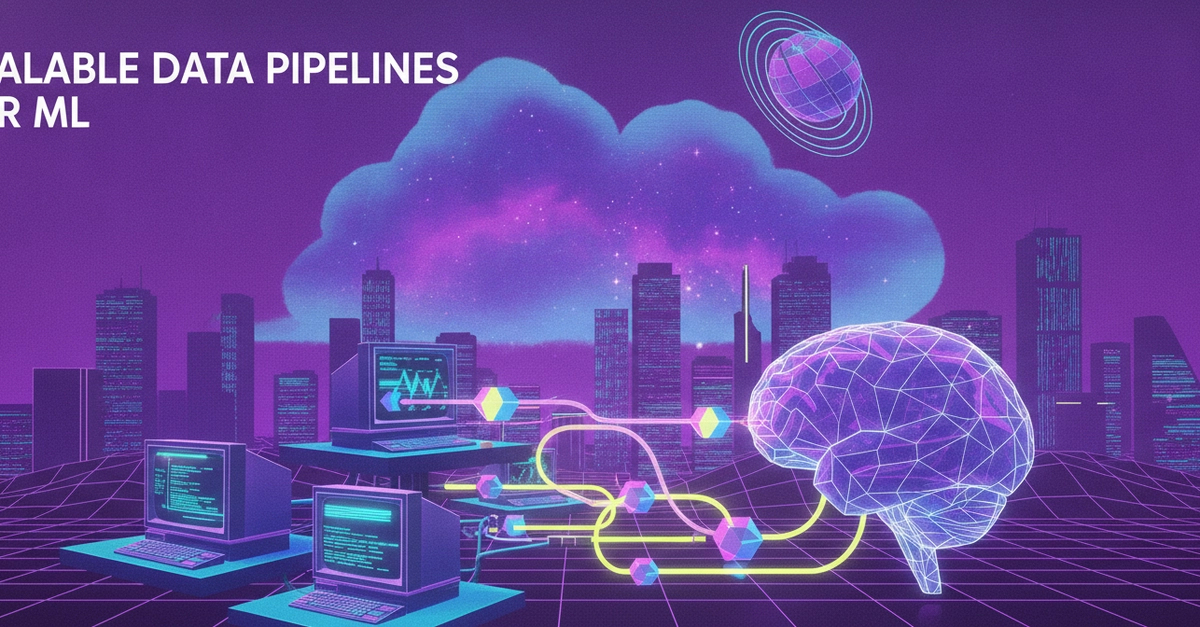
Most ML projects do not fail because the model is wrong. They fail because the data pipeline feeding the model cannot survive contact with production. A notebook that trains a model on a clean CSV proves nothing about whether that model gets fresh, correct, timely data once real users and real systems are involved.
Data engineering and ML engineering are converging fast. Teams that treat pipeline design as a first-class discipline ship faster and break less often than teams that treat it as plumbing.
Batch vs Streaming: Choosing the Right Processing Model
The first architectural decision is whether a pipeline processes data in batches or as a continuous stream, and this choice shapes everything downstream.
Batch pipelines process accumulated data on a schedule: hourly, daily, or triggered by an event like a file landing in storage. They suit training pipelines, periodic feature recomputation, and workloads where a few hours of staleness is acceptable. Batch systems are simpler to reason about, easier to debug, and cheaper to run since compute is not always-on.