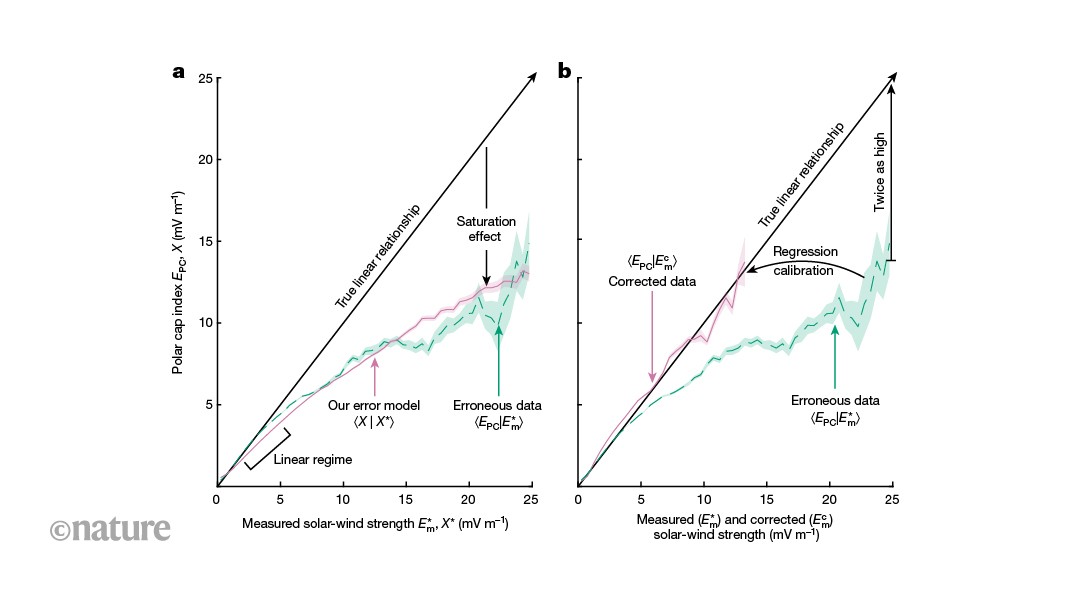
Cataclysmic solar storms may be rare, but they do happen. And unlike the legendary 1859 Carrington Event—which knocked out telegraphs across Europe and North America and dragged the Northern Lights down to Florida—some have happened recently enough to give us a sense of how modern electronics might fare. Solar radiation from 2003’s “Halloween Storms,” for example, disrupted a Federal Aviation Administration navigation system for 26 hours and led to the FAA’s first ever advisory warning of excessive radiation doses on commercial flights. But space physicists led by NASA’s Goddard Space Flight Center in Maryland have recently determined that the very rarity of these major solar storms means scientists and policymakers have likely been underestimating the worst-case scenarios for solar weather’s impact. As detailed in their new study, published in the journal Nature, ongoing “erroneous measurements” have also skewed these estimates, bolstering the reigning theory that there is some kind of upper limit to the bursts of solar storm energy that can be transferred into Earth’s polar ionosphere. Shockingly, there may be no limit. “Fortunately, these very extreme cases are rare, but this also means we have limited data to work with and only time will tell what happens at the very extreme one-in-a-thousand-year kind of event,” study coauthor Maria Walach said in a statement. “If there is no upper limit to our planet’s response to the solar wind, modelling for extreme cases needs to take this into account and we should be vigilant of space weather effects,” according to Walach, a space physics lecturer at Lancaster University.
We’re Underestimating the Power of ‘One-in-a-Thousand-Year’ Solar Storms, NASA Warns
New research led by NASA Goddard found persistent “erroneous measurements” skewing past estimates for how severe geomagnetic storms can get.
651 words~3 min read