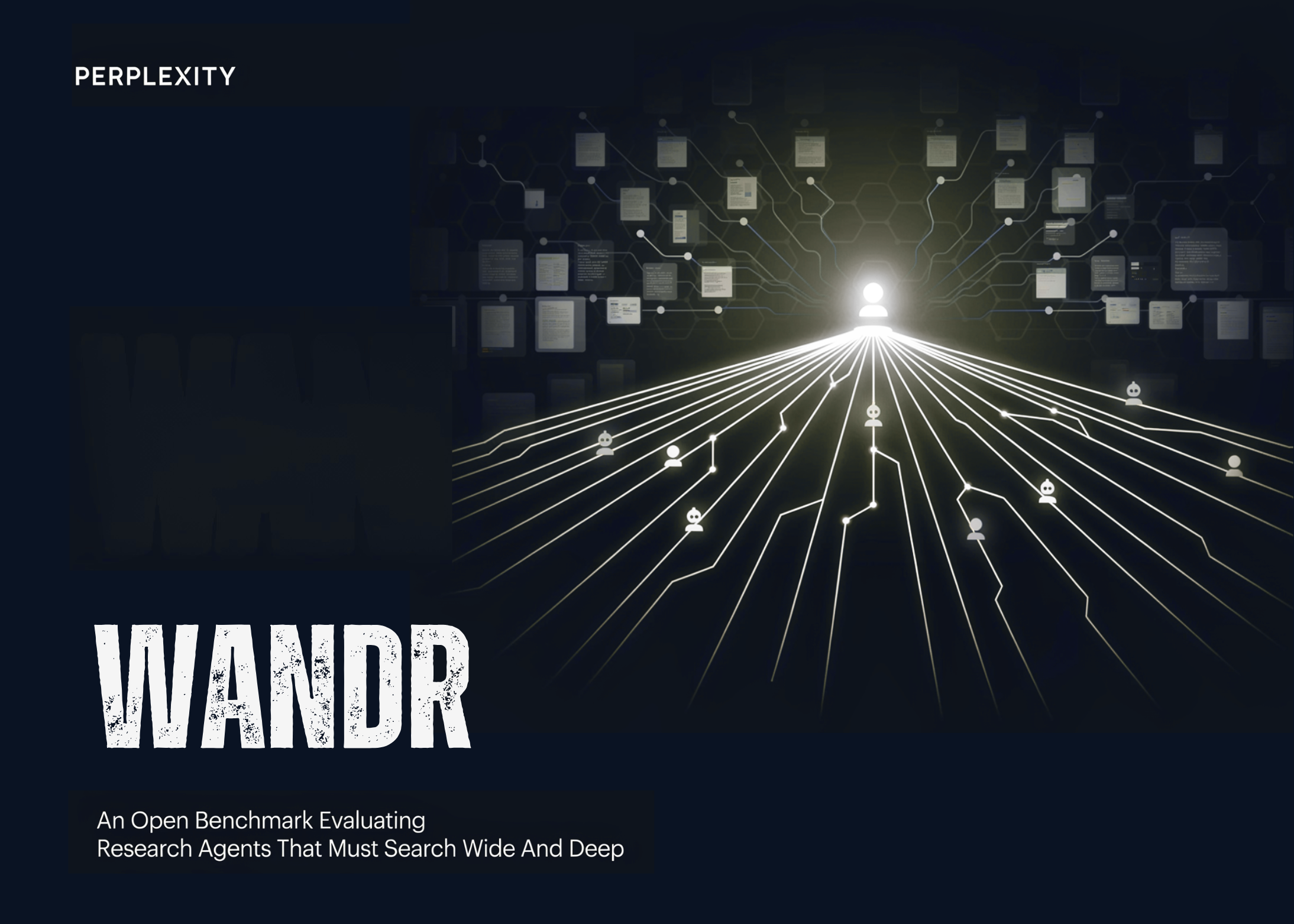
Research agents already handle real knowledge work today. Teams delegate competitive mapping, due diligence, and literature review to them. However, most benchmarks test a single answer, not large evidence-backed collections. Perplexity targets that gap with a new open benchmark.
Perplexity released WANDR (Wide ANd Deep Research). It is an open benchmark and evaluation harness. It is built around 500 realistic, challenging data-collection tasks for knowledge work. WANDR is the wide sibling of Perplexity’s DRACO benchmark for deep research. DRACO asks whether an agent produces an accurate, complete, objective long-form report. WANDR instead asks whether it can build a large collection with evidence.
What is WANDR
At its core, WANDR tests two demands together. Wide means discovering a large, often open-ended set of qualifying entities. Deep means investigating every entity enough to support each claim with evidence. Combining both changes the problem for agents. A few compelling examples are not enough here. A polished narrative built on incomplete research also falls short.
To capture this, WANDR uses a composable qualification key hierarchy. One task might request company(n) -> employee(m) -> url(k). This means n qualifying companies, m employees each, and k supporting pages each. Every complete path through the tree gets validated independently. The same structure can represent a flat list, nested search, or matrix.
 aws.amazon.com