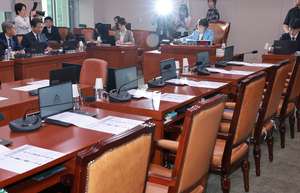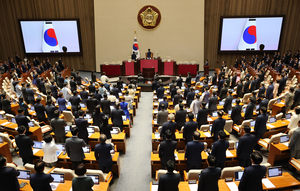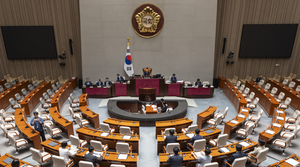
The National Assembly's Budget and Accounts Committee holds its first plenary session of the second half of the 22nd Assembly on Thursday. Lawmakers from the main opposition People Power Party boycotted the meeting in protest over the allocation of standing committee chairmanships. (Yonhap) The National Assembly has still not resumed normal operations nearly seven weeks into its new session, as rival parties remain deadlocked over the allocation of committee chairs.The Assembly cannot carry out its legislative and oversight functions until all committee chairs are selected.Even if the impasse breaks, the rival parties will plunge into a series of high-stakes battles over prosecution reform; special counsel investigations into the former president and first lady; and a proposed special investigation into alleged irregularities at the National Election Commission.The flash point comes Monday, when the ruling Democratic Party of Korea plans to hold a plenary session to push through legislation extending three special counsel investigations into ousted President Yoon Seok Yeol's declaration of martial law, allegations of corruption and other illegal activities involving former first lady Kim Keon Hee, and the death of a Marine.The extension would allow the three investigations to continue for 30 days, extending their mandates from July 24 to Aug. 23. It would also increase the number of government officials seconded to the special counsel teams from 130 to 150, and expand the scope of the investigations to include obstruction of government audits.The main opposition People Power Party has warned it will launch a filibuster if the Democratic Party brings the measure to a vote. Five-term Rep. Yoon Sang-hyun is expected to be the first opposition lawmaker to take the floor.The People Power Party on Sunday also criticized the four special counsel teams, including the second omnibus special counsel launched under President Lee Jae Myung's administration, accusing them of lacking sufficient investigative capacity while wasting public funds."The politically motivated special counsel investigations and the astronomical waste of taxpayers' money must stop immediately," the party said in a statement issued by senior spokesperson Rep. Choi Bo-yun.The party argued that the investigations had already spent 6.46 billion won ($4.34 million) in public funds on office rent alone to house the special counsel teams.Another point of contention is the Democratic Party's push to revise the Criminal Procedure Act. The proposed revision would consolidate investigative powers under the police by abolishing prosecutors' direct investigative authority and their power to conduct supplementary investigations.The proposal forms part of what the party describes as the second phase of prosecution reform, following the establishment of the serious crime investigation agency and the public prosecution service. The Legislation and Judiciary Committee at the Assembly took up the bill at a meeting convened by the Democratic Party on July 8.On July 15, the People Power Party introduced a counterbill that would explicitly guarantee prosecutors' supplementary investigative powers by law. The proposal would also postpone the launch of the public prosecution office and the serious crime investigation office until 2027, delaying prosecution reform by one year.The rival parties are also divided over proposals for a special counsel investigation into alleged election mismanagement by the National Election Commission, including ballot shortages during the June 3 local elections.Both parties have introduced bills calling for a special counsel investigation, but they disagree over who should nominate the special prosecutor.The Democratic Party has proposed an immediate recount and a nomination process led by an independent third party. The People Power Party argues that the largest opposition party should have the authority to nominate the special counsel.The dispute has left the National Assembly in a state of partial paralysis, as rival parties have failed to bridge their differences over the allocation of standing committee chairmanships.At the center of the dispute is the chairmanship of the Legislation and Judiciary Committee, a powerful panel that reviews bills before they reach the floor.The People Power Party argues that the post should go to the largest opposition party as a check on the governing party, while the Democratic Party insists that retaining control of the committee is essential to advancing its prosecution reform agenda and special counsel legislation.On June 30, the Democratic Party unilaterally elected chairs for 11 of the Assembly's 18 standing committees, including the Legislation and Judiciary Committee, amid a boycott by the People Power Party.
Assembly still idle 50 days into new session as contentious bills queue up
The National Assembly has still not resumed normal operations nearly seven weeks into its new session, as rival parties remain deadlocked over the allocation of
710 words~3 min read