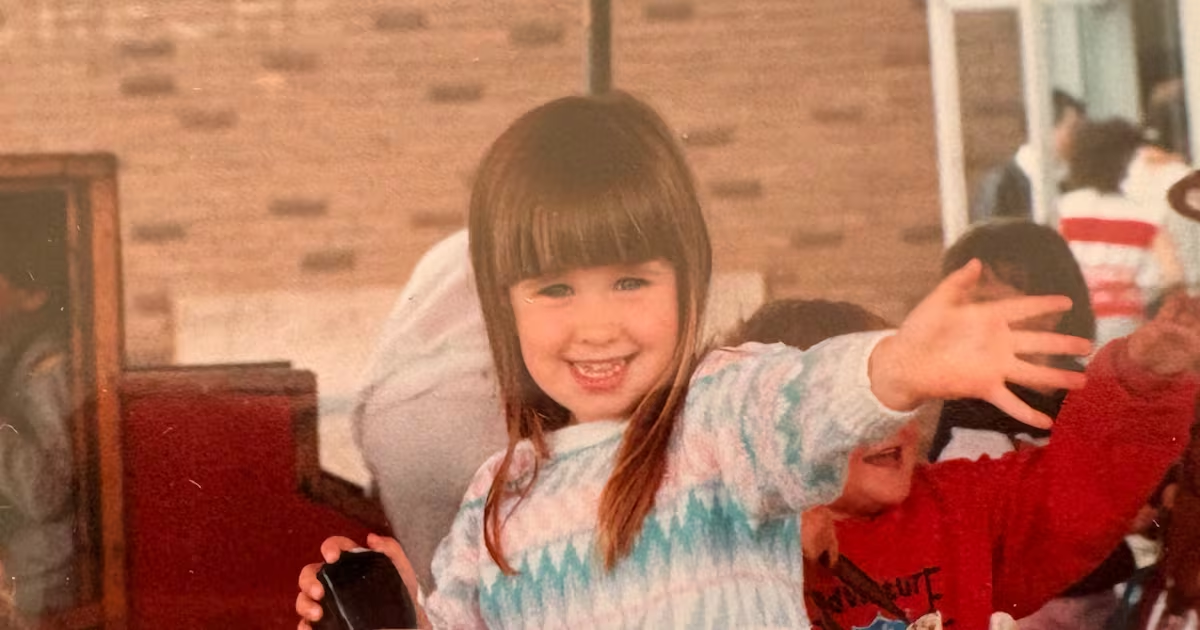
They loved it: the turf sheds, the Tayto, adults pressing five and 10-euro notes into their hands and the dozens of cousinsWriter Laura McDonagh as a child at the fairground in Salthill, Co Galway Laura McDonaghSun Jul 19 2026 - 06:00 • 8 MIN READThere’s a conversation that occurs in our household every year. It typically takes place in the no man’s land between the hedonism of Christmas and the more puritan discipline of January. It’s always initiated by my husband, choosing a moment when I’m brimming with Miniature Heroes and the desire to be a better person. “Shall we, ah, look at booking a holiday?” he’ll ask, his tone high and hopeful. “Maybe Mallorca ... or France? I could do some research, look at Eurocamps …?”He isn’t being unreasonable. We work hard all year. We’re lucky enough to be able to afford a trip abroad. Fair play to him, he’s waited until the kids are in bed so as not to be besieged with an immediate barrage of unappealing or unaffordable suggestions: “LAPLAND!” “ARGENTINA!” “DISNEYWORLD!” But he’s learned over the last 17 years that I find holidays difficult – bewildering, even – and he has to approach carefully, like a frontiersman heading off a skittish mule, hands raised, woah Nelly. It isn’t my fault – nor his, actually. Raised in a package-holiday-loving British family, he sees a fortnight in sunnier climes as an inalienable annual right. Lest there be any doubt, he’s the “good” kind of British tourist: culturally curious, respectful of local traditions. No shouting in English while pointing at a menu; no loutish 10-pint entitlement. But our holiday expectations are fundamentally different, informed by our respective childhood experiences. You see, while he was doing the Macarena by the pool in a family-friendly Spanish hotel, I was in Aunty Kathy’s kitchen, Kimberley biscuit in hand, waiting for the death notices to come on the radio. Every summer, we would travel from the north of England to spend three weeks in my parents’ native west of Ireland. It’s only recently that the linguistic specificity has struck me: how we’d talk about going “home” or “back” to Sligo. The word “holiday” – conjuring sunloungers, stripy towels and an all-inclusive buffet – simply didn’t fit. And even now, more than 30 years later, these formative experiences mean that I find the conventions of a Jet2-advert-style holiday – pools, palm trees, drinks with little umbrellas – somewhat alien. Since having my own kids I’ve done them, but they don’t come naturally to me. Holidays in the 1990s were all about escaping domesticity, responsibility and rain. But for those raised by Irish parents in Britain, they were almost the opposite. Our trips to Ireland were a kind of homecoming. Part-parade to show that all of it – the daily distance, the kids’ strange accents, the inevitable heartache – had been worth it. At the same time, they were part-pilgrimage. An opportunity to slip back into old customs and ways. To satisfy themselves that everything back home was just as it always was (even if it wasn’t) and that they were still who they thought they were (even if they weren’t). John McGahern’s That They Might Face The Rising Sun explores this tension between returning emigrants and the family and friends who never left. Back home for the summer from his job in England, the character of Johnny throws darts in the pub, buys rounds for strangers, names all the houses between the town and the lake. Meanwhile his brother Jamesie talks derisively behind his back. “There’s a big difference between visiting and belonging,” he sniffs. The Odyssean journey was all part of the experience. Sweet papers and elbows in the back of our Nissan Bluebird, soundtracked by one schizophrenic mixtape (Side A: The Drifters and Mary Black; Side B: Paul Simon and The Chieftains). Ryanair was only just getting going – but even if we’d been able to afford the airfare, the excess baggage for five would have been prohibitive. Hanging out in a milking shed was just as likely as a trip to the beach, meaning wellies and waterproofs for everyone alongside sandals, shorts and T-shirts. And then there was the weather. One year, it rained for the whole of August. “Ne-ver ag-ain,” muttered Mum through gritted teeth, spacing the syllables for emphasis. Except when the following August rolled around, and off we went. Every year, we knelt at Confession in Knock, devoured 99s at Enniscrone and topped and tailed in our cousins’ beds. We racked pool balls in Kennedy’s and guzzled fizzy drinks that weren’t allowed “in England” (we especially revered red lemonade out of the bottle, affording it the kind of gastronomic respect now reserved for protected delicacies such as Champagne or Gorgonzola). Tubbercurry’s Old Fair Day was an annual highlight, where country singers performed on a flatbed lorry and farmers negotiated livestock deals via an elaborate code of nose-scratching and talking out of the side of their mouths. ‘We especially revered red lemonade out of the bottle, affording it the kind of gastronomic respect now reserved for protected delicacies’ One summer, I came out in hives and my mother took me to a faith healer: a surreal incident that became embossed in my memory as yet another thing that would never happen “in England”. Another year, a wake at a neighbour’s where the corpse was shockingly sallow and mummy-like to my second-generation sensibilities (and yet everyone told his widow he “looked mighty”). In 1993, we went to Beat on the Peat – a festival of turf-cutting and country music to which Brendan Shine arrived in a helicopter. Google cannot confirm the helicopter but I remember it viscerally. It was my generation’s papal visit.Generally, though, the order of things was slow and unassuming. Mundane, even. Bike rides up to the shop for a packet of Meanies. Trips to the well to fill mineral bottles with spring water. Painting the cottage my parents bought after they tired of all the topping and tailing (and, possibly, the head lice that spread like wildfire between all the cousins one Easter). Routine tasks and jobs: supermarket trips, visits to the bank, Sunday Mass. To us, Sligo was half-holiday – a thousand delightful novelties and little freedoms – and half-home – domestic and familiar and comfortable, like a jacket you find at the back of your wardrobe and are delighted to discover still fits. ‘To us, Sligo was half-holiday – a thousand delightful novelties and little freedoms – and half-home – domestic and familiar and comfortable’ If that all sounds a bit saccharine, forgive me – we second-generation Irish just can’t help ourselves. Actor and comedian Steve Coogan counts the “endless” holidays he spent in Mayo among his happiest memories. A misty-eyed Noel Gallagher uses the same adjective – “endless” – to describe his and Liam’s childhood trips to his mother’s native Charlestown. Maggie O’Farrell recalls wearing an Aran jumper over her swimming costume on the beaches of Connemara and Dingle. Shane MacGowan’s formative summers in Tipperary are so mythologised that it’s easy to forget that the Pogues’ frontman was born in Kent, educated at one of Britain’s most prestigious private schools and lived in England from the age of six until his early 40s. The lyrics to The Broad Majestic Shannon – all card games, fiddles, rosaries and lovers – are full of nostalgia for the remembered and romanticised landscape of his childhood. [ Twelve family escapes around Ireland, from beach resorts to woodland hideawaysOpens in new window ]We can thank memory’s “golden window” for the rose-tinted retrospection. Between the ages of five and 10, our immature, neuroplastic brains are busy building new pathways between the prefrontal cortex (the brain organiser) and the hippocampus (the memory maker). This development – plus a burgeoning sense of self and increased linguistic ability – helps process and store memories. In childhood, special events such as holidays are recorded in multisensory detail, meaning that in adulthood, a particular scent, sound or taste can unleash an avalanche of reminiscences. In Proust, it’s a morsel of tea-soaked madeleine that triggers a flood; for the second-generation Irish, it’s the smell of turf. On The Late Late Show in 1996, Noel Gallagher told Gay Byrne it would “almost bring a tear to your eye”. Not very on-brand for the Gallaghers, who spent the rest of 1996 giving asterisk-strewn interviews and falling out with each other. But I can relate. In fact, ask anyone who travelled to Ireland in childhood what they remember about their summers and they’ll invariably mention turf. Don’t blame our soft, sentimental hearts; blame our primitive olfactory bulbs. Conscious that my eldest child was reaching the end of this precious memory window, I took all three boys to Sligo last summer. They’d been before for short trips, whereas this was a full fortnight in a rented cottage with no breakfast buffet or elaborate entertainment plans. My husband had a family wedding in Australia and so my dad – aged 77 – came along too. I didn’t know how they would take it, these children accustomed to gelato, street entertainers, crepes with Nutella, kids’ clubs. But they loved it: the turf sheds; the Tayto; the graveyards; adults pressing five and 10-euro notes into their hands. The Marian shrines; ordering “The Dinner”; the dozens of cousins – a handy catch-all term for relations too distant to fathom – they’d never met before. [ The ultimate guide to the Irish summer: 50 great things to do come rain or shineOpens in new window ]By chance, we were there for Tubbercurry’s Old Fair Day, which was celebrating its 40th anniversary (middle-aged fair day, more like). A few things had changed – there’s now an official media partner and a pop-up prosecco tent – but it’s still a country fair at heart. One exhibitor encouraged the boys to pose for photos with his micro pygmy goats. “Ah come on now lads, your Mammy’ll always remember the day you were little farmers,” he told them, handing the youngest a kid, white and wiry. When it bleated like an accordion he almost dropped it, and I thought of Noel Gallagher expressing astonishment at Mayo’s “nettles” and “stacks of hay” in contrast with the concrete and council flats of Burnage. Outside the craft tent, we found a reproduction mantelpiece topped with brass kettles, rashers sizzling in a huge pan on the open fire beneath. “Look boys – that’s just how it was,” said Dad, rubbing his hands approvingly. Turns out it’s not just Manchester-born rock stars who get misty-eyed. Laura McDonagh. Photograph: Jo Ritchie People who know about such things say that slow travel is the thing. Avoiding touristy hotspots. Staying in one place and immersing yourself in a community. Supporting the local economy. Travelling on foot or by bike where possible. Apparently it reduces stress, avoids burnout and encourages presence. Digital detoxes are a core component of this kind of holiday. That one makes me laugh: try getting a phone signal around Quarryfield, my dad’s homeplace. I think of the landlords and proprietors of the family-owned businesses we frequented, the bike rides, wiggling the TV aerial in vain to try to get a clearer picture. Is that what we were doing all those years ago without realising it?Laura McDonagh at Quarryfield, her father’s homeplace I don’t know what kind of holidays those Sligo trips were. I don’t think they were holidays at all in the true sense of the word. I just know that I loved them; that they made me feel settled and content in a way no other trip has managed to compete with. And I know that my boys loved their 90s-style Irish holiday, too. Back to twixmas, the Miniature Heroes, the holiday chat, my hopeful husband. “Let’s look at a Eurocamp for July,” I tell him. “And maybe price some flights to Knock?” I can’t wait to do it all again. Laura McDonagh is a second-generation Irish writer living in Newcastle, Tyne and Wear. Her first book, Commonplace – a memoir about growing up Irish in Britain, memory and belonging – will be published by New Island Books in February 2027IN THIS SECTION
I brought my three boys from England to Sligo to replicate my childhood summer holidays
They loved it: the turf sheds, the Tayto, adults pressing five and 10-euro notes into their hands and the dozens of cousins
2,031 words~9 min read