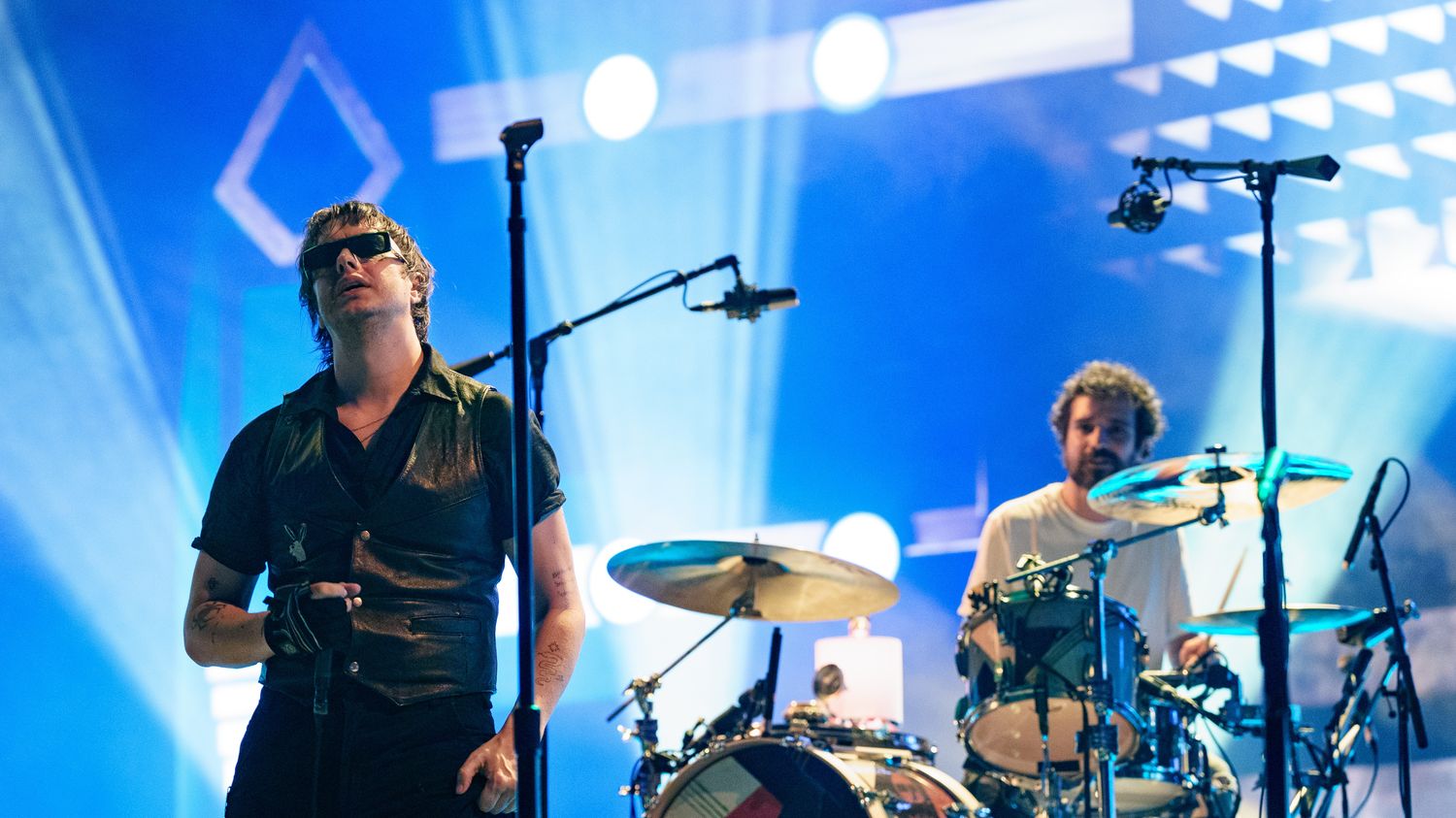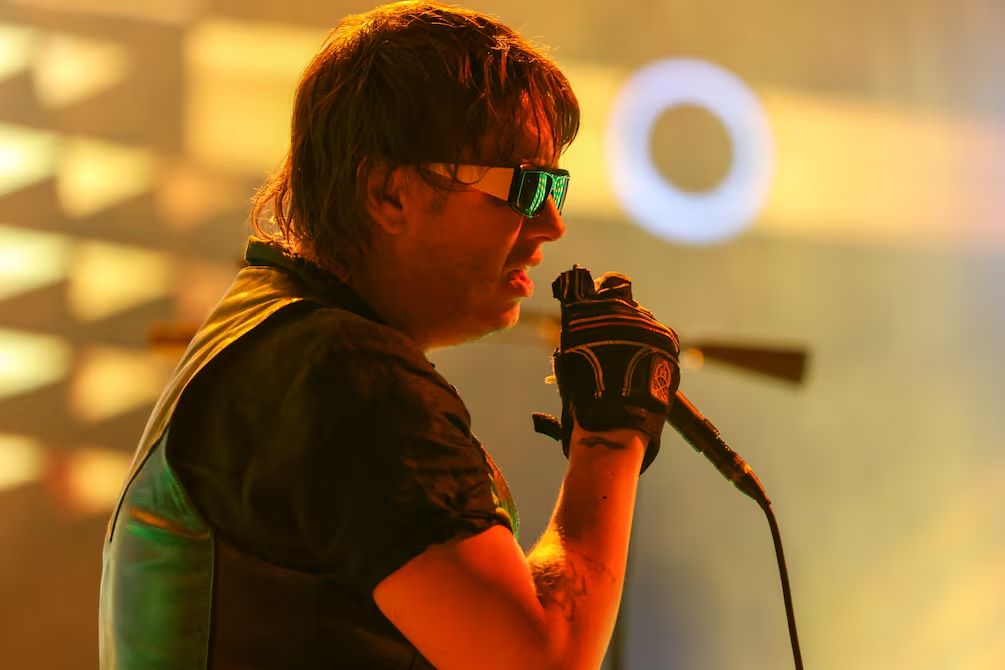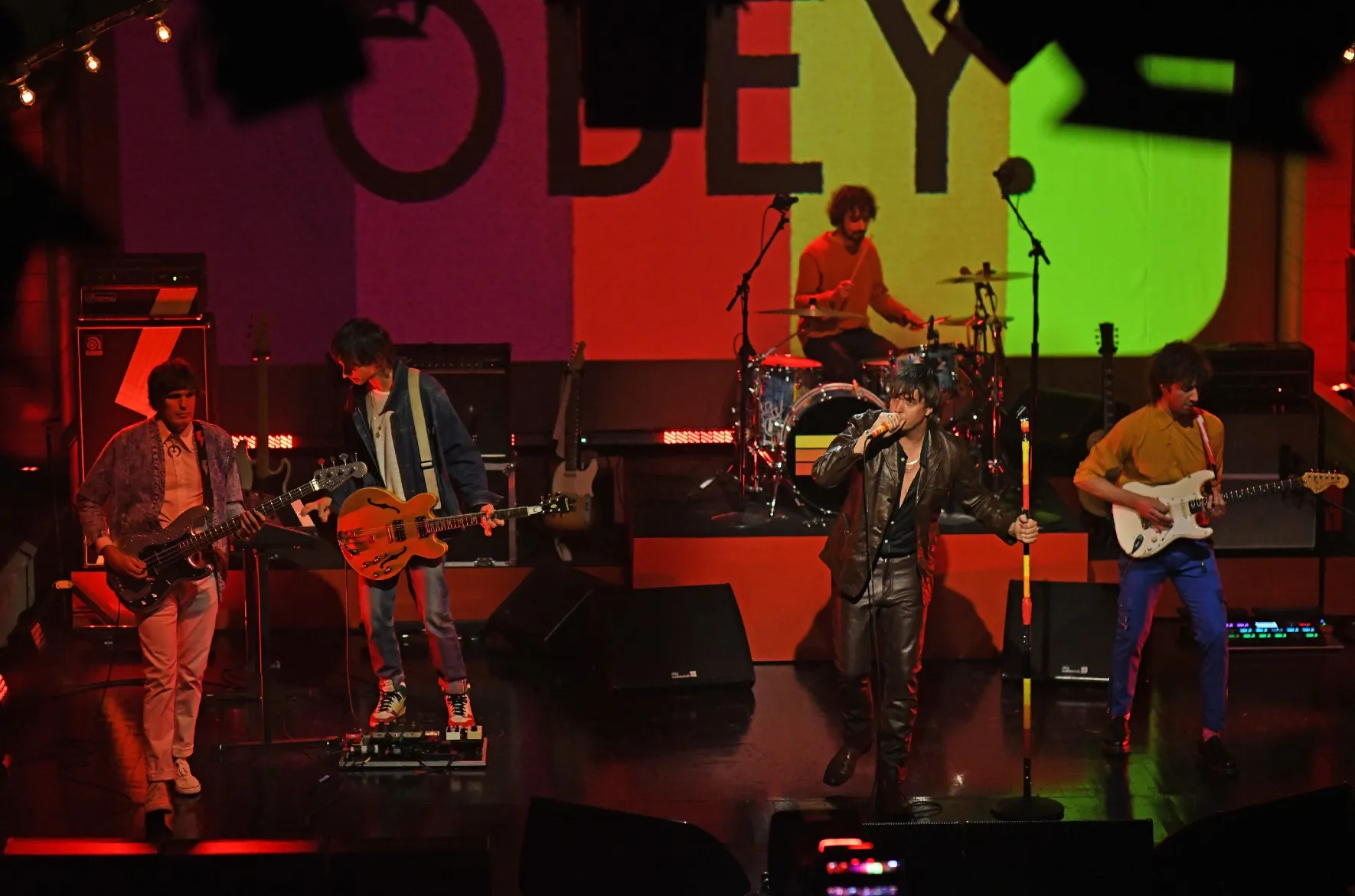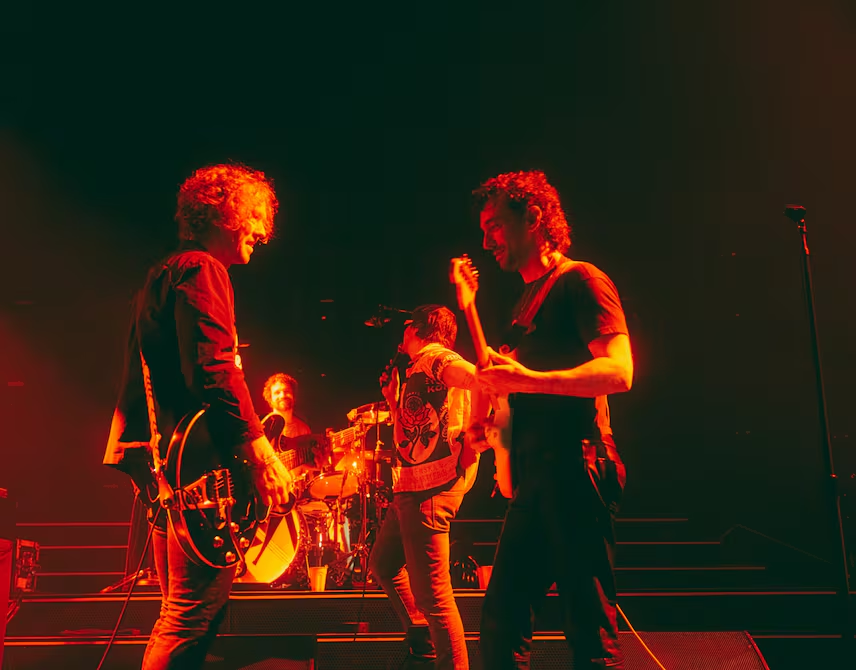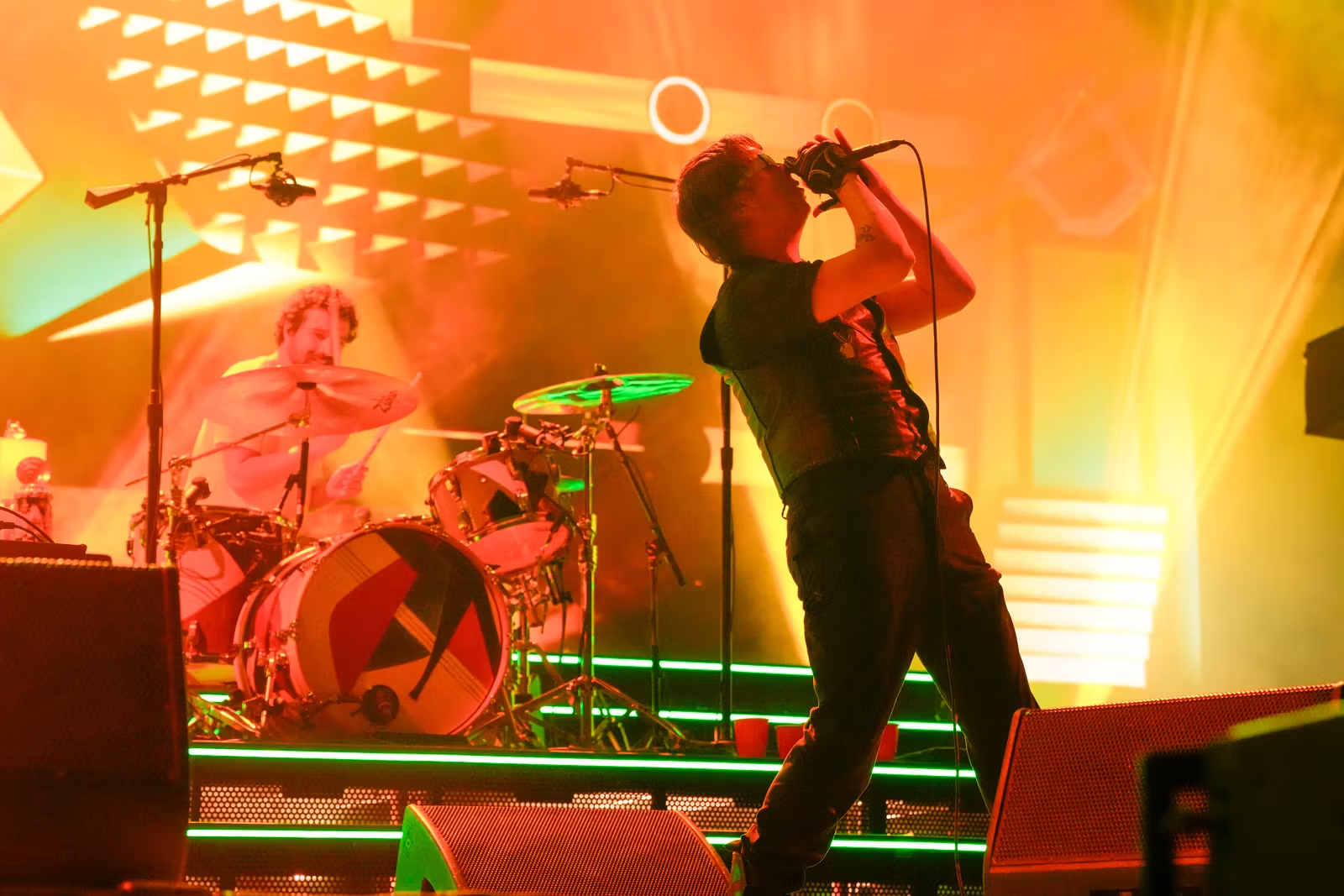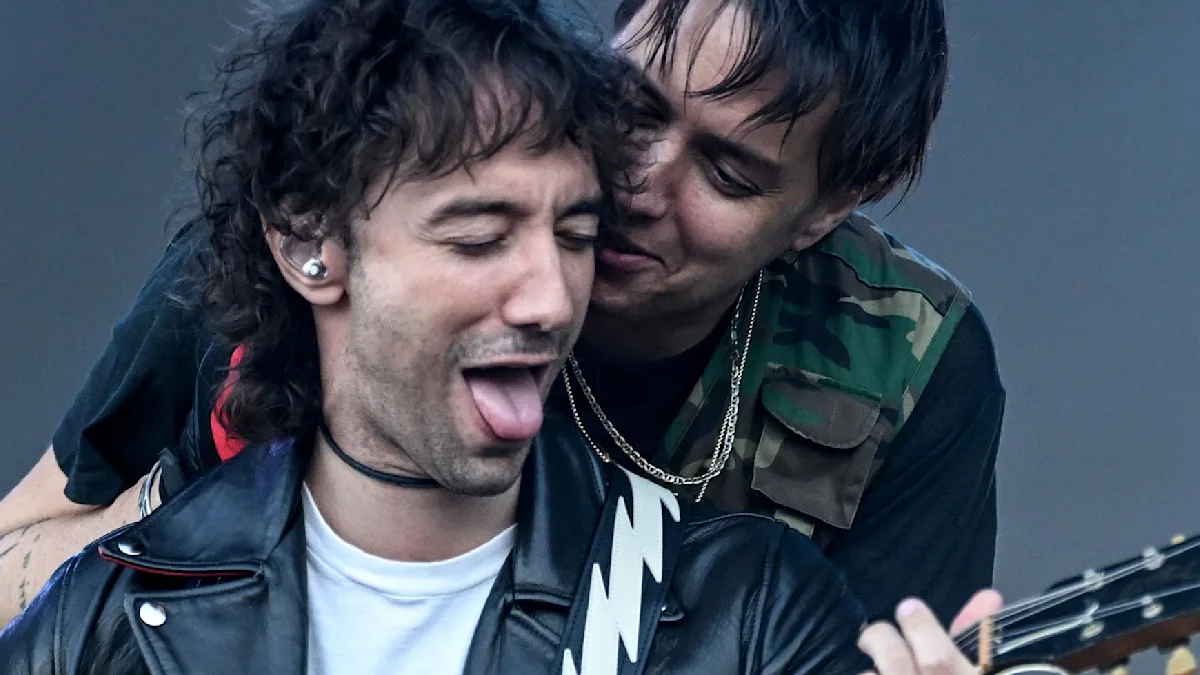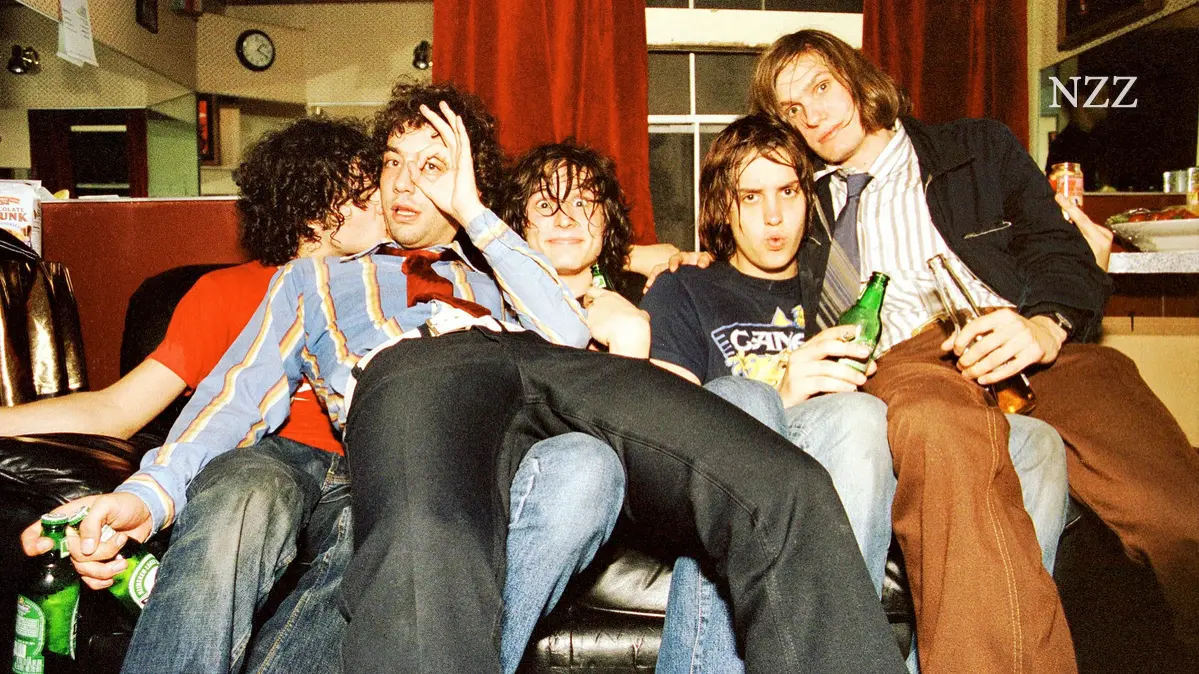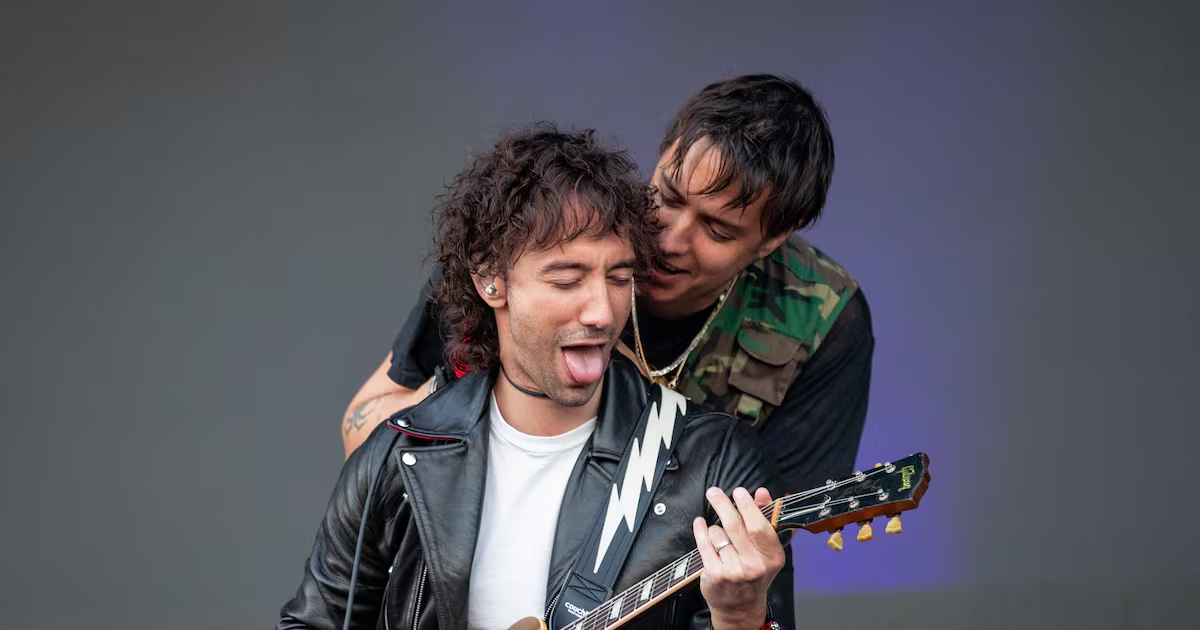
Julian Casablancas was just 22 and not yet a rock star when he led his band on stage at Temple Bar Music Centre, in Dublin, one muggy evening in June 2001. Under the dry ice and amid the coal-bunker gloom of the venue’s modest stage, he was slight and stooped, his face still carrying traces of puppy fat. But his leather jacket was immaculately rumpled, and he had the haircut of a man ready to change the world.It was The Strokes’ first performance in Ireland, and a snapshot of a group slouching their way towards stardom. Feted by the NME as saviours of rock – potentially the biggest earthquake to hit indiedom since Oasis – they hadn’t yet released their debut album, Is This It, and the crowd at the venue (today the Button Factory) had been drawn out of curiosity as much as by excitement for the music.The band seemed to pick up on that ambivalence, sensing that people were there to gawk rather than take their songs at face value. Careful not to wear out their welcome, they clocked through a trim 40-minute set, rarely engaging with the audience and avoiding eye contact both with the crowd and with each other. The impression was of young men who had worked out how the members of an epochal indie band should look and carry themselves – which is to say to come across as if they didn’t care all that much – while still tinkering with the musical part of the equation.Pushed right up the front, I was rendered speechless not so much by their tunes as by their hair: never had I encountered so breathtaking a line-up of mop tops, fringes and statement mullets. They looked as cool as Lou Reed hanging out with David Bowie while having the air of people who’d slept in their clothes and been dragged backwards through a gorse bush. As with many that night, I wasn’t especially bothered about their music, but The Strokes were clearly locked and loaded, primed to set the world alight.That tour, and the release that August of Is This It, marked the beginning of one of 21st-century pop’s great soap operas: a whirlwind of drugs, fights, fantastic hair, the occasional terrible album and the sense that things could fly off the handle at any moment. There were, in fact, many occasions when things did go off the rails, when it seemed that The Strokes, fed up with each other and with their own success, had decided the coolest career move of all would be to implode in a cloud of boredom.The Strokes backstage at The Fillmore, San Francisco, California, October 2001. From left are Fabrizio Moretti, Albert Hammond jnr, Nick Valensi, Julian Casablancas and Nikolai Fraiture. Photograph: Anthony Pidgeon/Redferns The Strokes perform at the Troubadour in Hollywood, August 2001. Photograph: Gina Ferazzi/Los Angeles Times/Getty But they never quite did. And now, 25 years later, here they are again, back with a new album, Reality Awaits, due next week, and ready to argue that music still matters and that an old-fashioned rock band represents the purest expression of that belief. But does it? And are The Strokes the ones to deliver that message?[ The Strokes: ‘There was conflict, fear, and we got through it and made records’Opens in new window ]The music already released from Reality Awaits suggests that this question is very much in the balance. While fans are glad to have the band back, few have been blown away by the singles Going Shopping and Falling Out of Love, bedraggled ditties that rely heavily on the novelty of Casablancas seemingly singing through a vocoder, so that he sounds like a deflated robot wondering about the meaning of it all (a vibe already familiar from The Voidz, his side project).“The song had potential to be a lot better than it is. I think the lyrics are very good,” one fan wrote on Reddit. “Could do without the autotune, and the instrumental sounds a bit Mario Kart.”Such complaints notwithstanding, anticipation for Reality Awaits is considerable, and not just among older fans. “It will be one of the biggest new studio albums of the summer for us,” says Ray O’Brien of the cult record store Music Zone, in Cork, who notes that interest is particularly strong among Gen Z, too young to have seen the band at Temple Bar Music Centre. “It’s hard to know why a band around for nearly 30 years connects so well with a younger audience.”One explanation is that The Strokes, more than any other 21st-century rock band, are committed to the idea of the outsized rock’n’roll lifestyle. From the start they have understood that, for a band to matter, they must be not only talented but also notorious. Just look at how, in their first flush of success, they went on a speed run of rock’n’roll cliches.The Strokes backstage at the Tower Theater in Philadelphia, October 2003. Photograph: Tony Cenicola/The New York Times Talk about young men in a hurry. Casablancas punched a record company executive in France. Their guitarist Nick Valensi blacked out on anti-seizure medication, Klonopin, waking up to discover he had trashed a Las Vegas hotel room, causing $7,000 worth of damage. Albert Hammond jnr, the group’s other guitarist, started hanging out with Ryan Adams, then a self-admitted drug user, and began using heroin. [ The Strokes: The New Abnormal review – Pleasantly disappointingOpens in new window ]On an early press trip to the UK, their publicist described them as a “bunch of Holden Caulfields”, referring to the self-consciously feckless anti-hero of JD Salinger’s novel The Catcher in the Rye.“It was f**king nuts,” Valensi once told me, looking back on the band’s overnight rise. “I could tell you stories that would make you shit your pants.”Their lives had been unusual long before fame arrived. Casablancas’s father, John Casablancas, founded Elite Model Management (clients included Cameron Diaz and Christie Brinkley); his mother, Jeanette Christiansen, is a former Miss Denmark. He met the future Strokes bassist Nikolai Fraiture at a private French-language school in Manhattan, and first crossed paths with Hammond jnr – son of Albert Hammond, who co-wrote the Joe Dolan songs You’re Such a Good Looking Woman and Make Me an Island, among many other hits – at Institut Le Rosey, in Switzerland, which is reportedly the world’s most expensive school.Julian Casablancas performs with The Strokes at Electric Picnic 2019 at Stradbally Hall Estate in Stradbally, Co Laois. Photograph: Debbie Hickey/Getty “I say our childhood was like the movie Kids,” Casablancas once told me, referring to Larry Clark’s 1995 film about jaded teenagers hanging about in a pre-9/11 Manhattan. “It’s New York; we’re kind of roaming around, drinking beer on stoops. You know, some of the people in The Strokes, yeah, their parents had success – but we didn’t live like yuppies. My parents separated when I was eight. I grew up with my mom alone. Starting the band, we didn’t say, ‘Hey, let’s all put on leather jackets and pretend to be cool.’ It was who we were.”Whatever privilege they came up with, they certainly didn’t take success in their stride, and they were veering off course from the start. Valensi didn’t dress it up when I spoke to him in 2011 – at which point The Strokes were still battling demons of various sorts. “We have a couple of guys who are sober and don’t f**k around with stuff,” he said, referring to Casablancas’s decision to stop drinking in 2009 and to Hammond jnr’s stint in rehab. “The key is that whatever we are doing, we have it somewhat under control. The people who couldn’t keep it under control are not doing it any more. I don’t know how it affects songwriting.”Valensi admitted that living life at full throttle came at a price – and that it heightened tensions within The Strokes. “You might have a band member who was either totally f**ked up, at which point you can’t talk to them, or, the next day, totally hungover. At which point you can’t talk to them either,” he said. “Then they segue from hungover to f**ked up again. There is never time to address certain things. That can make communication tough.”[ Julian Casablancas + The Voidz: TyrannyOpens in new window ]That sense of a band fuelled by chaos made life interesting, but also meant there was a danger of everything unravelling.“It’s hard to find an analogy to describe our relationship,” a post-rehab Hammond jnr told me. “We are close, but we’ve fought. We have our own lives. It’s like anything in life: there are many aspects. We go through all sorts of things ... We are trying to figure it out right now. It’s like all relationships, I suppose: it follows an arc. Of course, it gets more extreme with money and success.”The Strokes perform at the Coachella Valley Music and Arts Festival at Empire Polo Club in Indio, California, April 2026. Photograph: Kevin Mazur/Getty Perhaps it’s the contradictions that have kept them going. Hammond jnr seemed to agree. “My response is, wow, I can’t believe I’m still on the roller-coaster,” he said. “You have a sense of being slightly overwhelmed while never thinking the train is out of control.“When I look back at the early years it feels like a movie. But, you know, the past is dangerous. You shouldn’t stare at it too long. You look at it and try to understand it and then apply it to what you are doing now. “Maybe my perspective will be different when I’m 65 and life has slowed down. Right now my stance is, well, if you liked what we did back then, wait until you see this. Let’s just go do it.”The world today is very different from the one in which The Strokes materialised in 2001. Back then, rock’n’roll was still at the approximate heart of youth culture – a position today occupied by TikTok and Instagram. But a cool-looking band projecting drop-dead indifference can still cut through, even now. The question Reality Awaits poses is whether that’s enough – whether The Strokes can make the kids put their phones down and believe in rock’n’roll again.Reality Awaits is released by Cult/RCA Records on Friday, July 24th
Reality check: Can Julian Casablancas and The Strokes really save rock’n’roll?
The Strokes are about to release a new album, Reality Awaits. A lot has changed in the 25 years since the band’s first Irish gig
1,709 words~8 min read