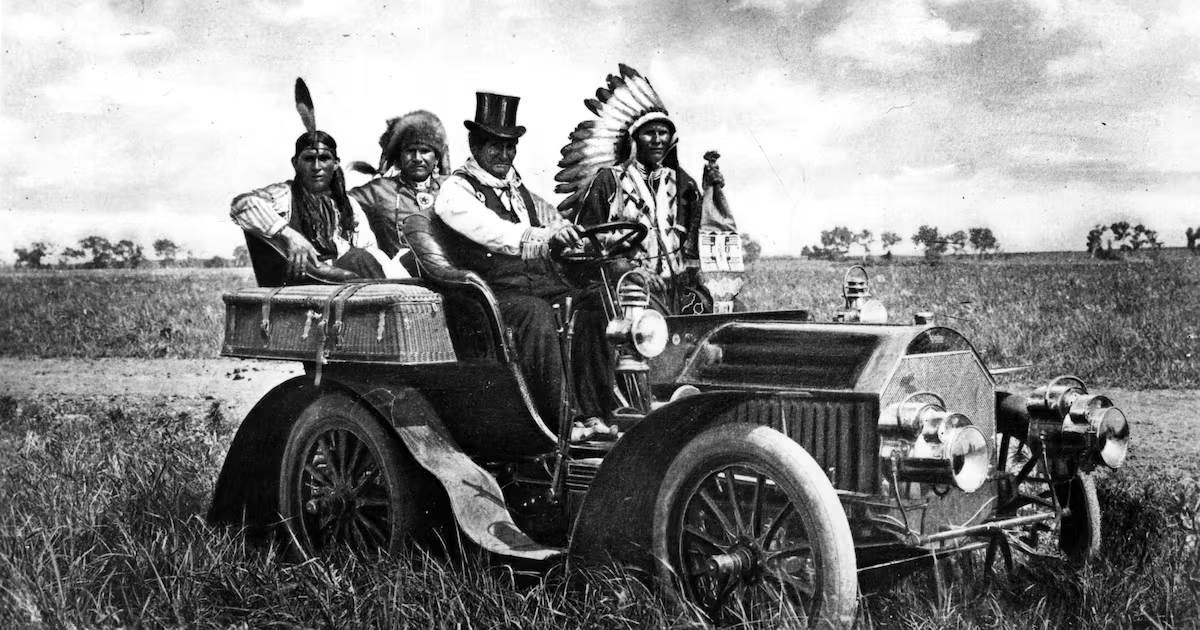
Mexican author Álvaro Enrique writes historical novels that are at once powerfully illuminating and playfully metafictional. His previous novel, You Dreamed of Empires, recast the story of Cortés and his “conquest” of the Aztecs as a tragic comedy of manners, shot through with hallucinatory, visceral violence. Now I Surrender (Harvill, 464pp, £20), translated by Natasha Wimmer, tells the story of the Apachería, a land that once straddled northern Mexico and the southern USA. He conjures this world with an authorial incantation, and we find ourselves in 1836 with Camila, a woman frantically fleeing through the prairie, only to swept up by Mangas Coloradas, who takes her as a captive wife. This is only one strand of a multicoloured tapestry, which also takes in the picaresque attempts of a rag-tag group to rescue her – a cavalry officer, a gun-toting zarzuela singer named Elvira and a pair of Yaqui twins before leaping forward to 1886 to the extermination of the Apache peoples and the surrender of shaman and leader Geronimo and his last years as a prisoner of war. All this is interspersed by discursions, archival material and present-day intrusions by the author as he and his family take a road trip through this vanished land. If this sounds convoluted, it is anything but – Enrique tears up everything we know about the western and, aided by translator Wimmer, who matches every nuance of his linguistic bravura, takes tragedy and fashions a dazzling, baroque epic that is by turns harrowing, hilarious and profoundly human. Brute violence also runs through the stories in Troubled Lands: Stories of Mexico and Cuba (Princeton University Press, 296pp, £22), a collection selected and translated by Langston Hughes, the poet, activist and leader of the Harlem Renaissance. The 33 stories, whose subjects Hughes described as “revolutions and uprisings, sugar cane, Negroes, Indians, corrupt generals, American imperialists”, reflect his politics and his times. Hughes learned Spanish in his teens visiting his estranged father in Mexico and, being a gifted writer, he proves a fine translator. Many of the stories have a power and an energy that blaze on the page. Rafael Felipe Muñoz’s tales of the Mexican revolution alternate between the traumatic tale of women’s resistance in A Shot in the Air to the blistering satire of Biography, in which an idealistic reporter interviews a mercenary “general” and turns his warts-and-all tale of into mendacious propaganda. Cuban stories focus on the aftermath of the brutal Machado dictatorship and the struggles of exploited workers. In Tintorera’s Last Dance, a simple man with “a dried gourd for a head” is forced to dance for his rum and, reeling home drunk, dances a wild last Lucumí as flames burst from his head and set the cane fields ablaze. Perhaps the finest story is The Night the Dead Came Out, Lino Novás Calvo’s eerie allegory of slavery in which Captain Amiana, a people smuggler who charged $300 passage but threw his passengers overboard. When forced to flee, he finds a nameless island and builds an empire, using slavesbought for a dollar a head, until a shaman named Moco frees the dead.The collection, edited by Ricardo A Wilson II, who offers an elegaqnt introduction to the stories, is a valuable document of Hughes and his era and a brilliant snapshot of early 20th-century Hispanic literature.Swell, by the award-winning South Korean writer Son Bo-mi, translated by Janet Hong (Two Lines Press, 240pp, $18), is a series of interconnected stories in which nothing is as it seems, and stories play out differently in parallel universes. In Blanket, a novice writer find success by appropriating the true story of his friend, Han’s boss, Jang, who, to bond with his son, takes him to a concert only for the boy to die in a mass shooting. The outraged, furious Han ends the friendship and, when he dies two years later, the writer is haunted by guilt and forced to confront the real Jang. But in Blimp, the same boy survives the shooting in which his father is injured, grows up to be a translator working on the novel from Blanket. He too is racked by guilt and the sense that he should have died. The stories teem with real people who are startlingly different from how we know them. In this world, Babe Ruth was not a baseball player but a movie star. In The Love of a Scientist, which purports to be Son’s translation of an article from Popular Science, the physicist Gordon Gould does not invent the laser; instead he marries the fictional Vivian Sternwood, inspires Einstein and discovers the Gould Triangle, where gravity ceases to exist. The stories are tenuously connected, major characters have walk-on parts elsewhere, while the strings of the various unreliable narrators – writers, biographers, film students – are pulled by Son herself, who gleefully inserts herself into the stories. Hong’s flawless translation captures the chorus of different voices, and nimbly follows Son as her characters move through fluctuating realities and timelines, without ever losing their intense connection to the fragile humanity.Croatian writer Daša Drndić was one of the greatest chroniclers of the horrors of the 20th century, a champion of the dispossessed and the immigrant. Her novels Trieste and Belladonna explored the lingering trauma of the Holocaust even as they experimented with what literature could be. Dying in Toronto (Istros Books, 200pp, £13.99), translated with verve and intelligence by by Celia Hawkesworth, is different in scope but shares the author’s preoccupation with migration, isolation, language and culture. The autobiographical essays chart Drndić’s first months as a refugee in Canada in 1995, moving through the city, from the Toronto subway to libraries and laundromats, while searching among fellow Croatian immigrants for news of her Istrian home. Her portrait of a city in which 105 minorities all but outnumber the majority is alert to the festering divisions and, having come from the ruins of Yugoslavia, Drndić is aware of where they might lead. In the sprawling city she tries to forge new relationships, while her daughter keeps hamsters – whose caged existence reminds her mother of life in war and peacetime. And all the while, they must navigate the “refugee system”, which ensnares and traps those caught in its web. Drndić brings her dry humour and keen, sometimes caustic wit to everything she observes in these essays, filled with inserts and footnotes, that are funny, moving and sometimes shockingly prescient.Happy the Hours (Hermits United, 270pp, £16.99), translated by Chris Turner, is the 12th volume in a cycle Pascal Quignard began in 1997. These brief pieces – some no more than a few paragraphs – are not essays or pensées but reflections on the world. Memories of a beach at night, of the illustrations in a Book of Hours, are transcendent, even numinous. Musings on the goddess Tellus, or eels in old age as they arrive back from the Sargasso Sea, fork and divide into meditations on music, history and, above all, time. For all his erudition, Quignard writes with a mesmerising sense of awe and wonder that forces the reader to see things anew. Turner’s translation is electrifyingly alive to the limpid prose and each delicately-placed word in these glittering miniatures that transfigure thoughts and memories.Frank Wynne is a translator and critic
Translated literature: From a harsh and hilarious epic set in Apachería to a portrait of Toronto
Álvaro Enrique’s historical novel Now I Surrender tears up everything we know about the western
1,210 words~6 min read