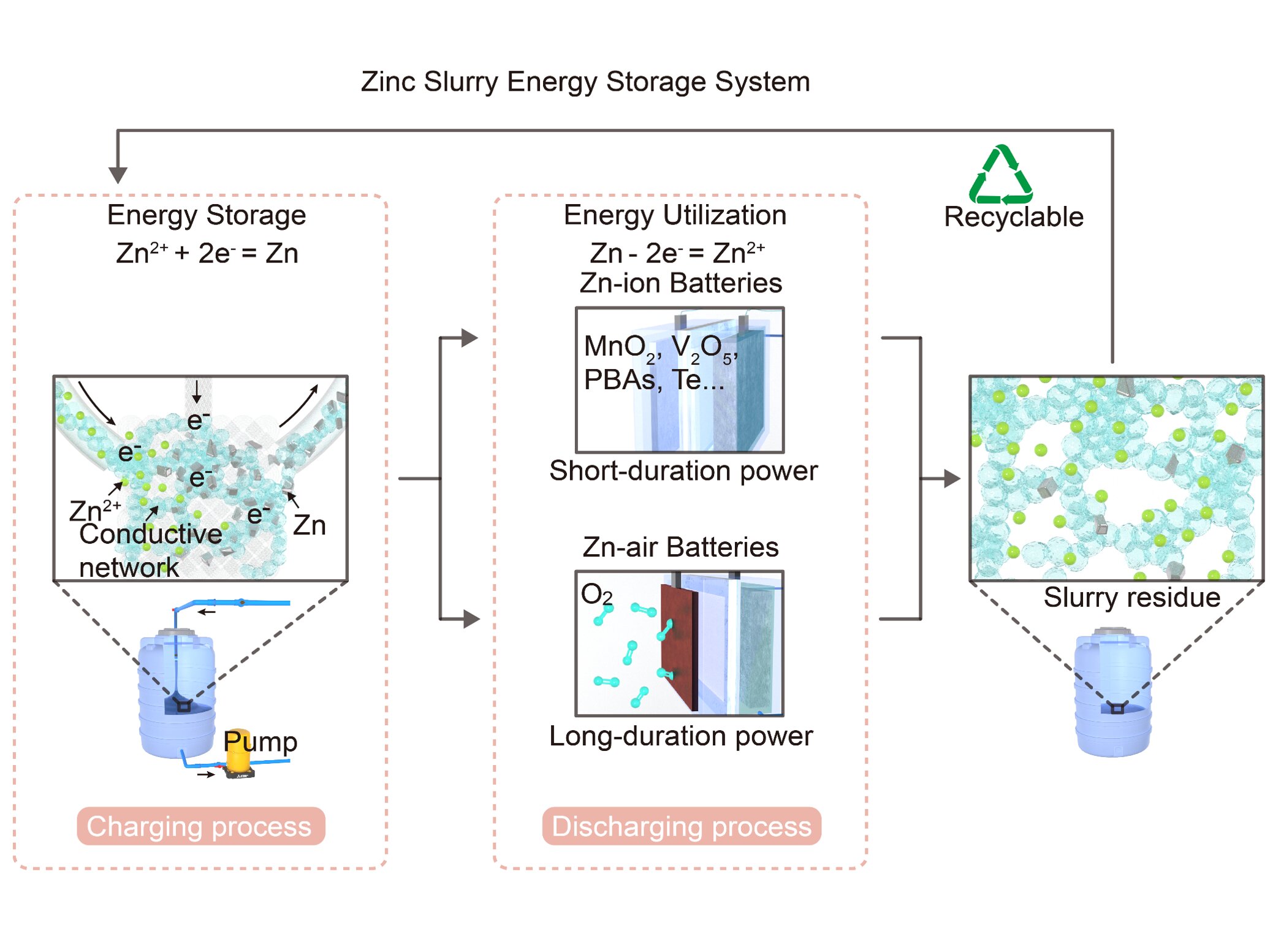
Schematic illustration of a flowing Zn slurry energy-storage system. Credit: Nature Energy (2026). DOI: 10.1038/s41560-026-02091-w
Solar panels, wind turbines and other renewable energy technologies are becoming increasingly widespread worldwide. Most of these technologies generate electricity from natural sources, such as sunlight and wind, which are more abundant on some days, months and seasons.
To facilitate the ongoing transition to renewable energy technologies, many energy engineers have been developing batteries that could store the excess energy produced by solar cells and wind turbines. This energy could be used to provide electricity on days or during periods when sunlight or wind are scarce, without having to rely on fossil fuel-based energy infrastructure.
Researchers at Fudan University and the Chinese Academy of Sciences recently designed a flowing zinc (Zn) slurry battery that could store energy derived from renewable sources for significantly longer periods. The new battery, presented in a paper published in Nature Energy, stores energy using Zn nanoparticles suspended in a conducting liquid.
"Our work emerged from our long-standing interest in improving the reversibility of Zn metal electrodes through electrolyte and interface engineering," Fei Wang, senior author of the paper, told Tech Xplore. "While Zn is an attractive candidate for large-scale energy storage because of its abundance, low cost and high volumetric capacity, conventional Zn electrodes suffer from interfacial degradation during repeated cycling.