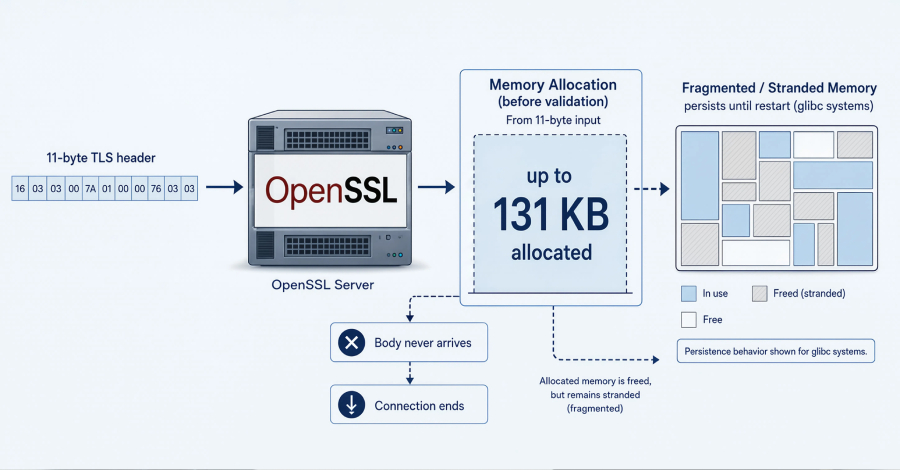
Eleven bytes will make an unpatched OpenSSL server set aside up to 131 KB of memory for a message that never arrives. On the glibc systems Okta tested, that memory is gone until the process restarts.
OpenSSL shipped the HollowByte fix in June with no CVE, no advisory, and no changelog entry pointing at it. Okta's Red Team, which reported the denial-of-service bug and named it, published the details on Thursday.
The fixed releases are OpenSSL 4.0.1, 3.6.3, 3.5.7, 3.4.6, and 3.0.21, all dated June 9. Every release on those branches before the fixed ones has it. Nothing in a normal patch pipeline will point you at them: there is no identifier for a scanner to match and no advisory to read.
The flaw is that OpenSSL took the attacker's word for it. Every TLS handshake message carries a 4-byte header, three bytes of which declare how long the body will be. Older versions grew the receive buffer to that declared size the moment the header landed, before a single byte of the body showed up, and before the handshake's own checks ran.
For an inbound ClientHello the ceiling is 131 KB. Then the worker thread blocks, waiting on a body that never comes. No authentication, no session, no key exchange.