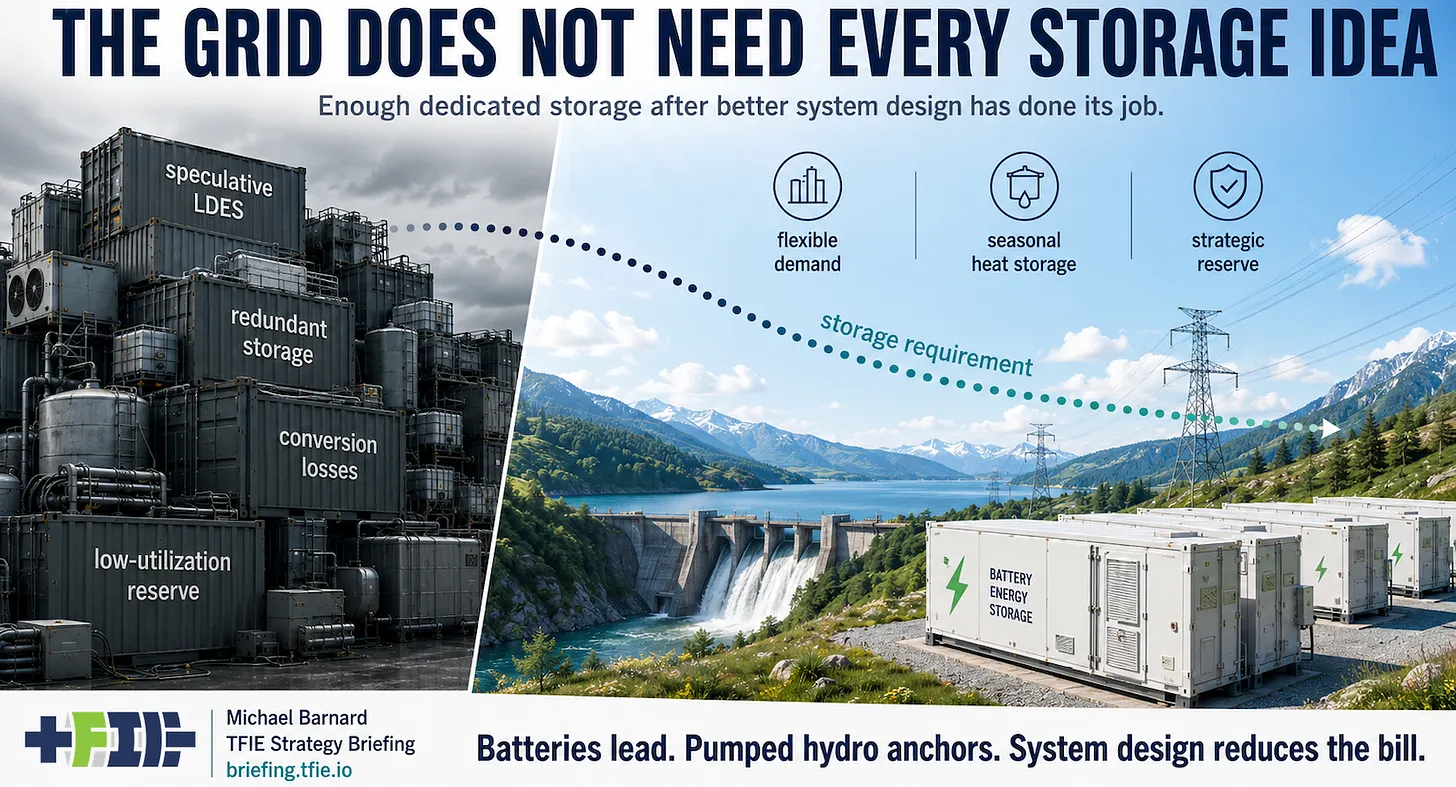
Batteries lead and pumped hydro anchors, while transmission, flexible demand and thermal storage reduce how much dedicated storage the grid must build.
Support CleanTechnica's work through a Substack subscription, on Patreon, or on Stripe. Help us produce all of the high-quality, original content we publish week after week despite the challenges of content-scraping AI, antisocial media, inflation, and other hurdles.
Grid-storage debates are usually framed as a contest among technologies. Lithium-ion batteries compete with flow batteries, compressed air, liquid air, gravity systems, iron-air and whatever new long-duration acronym has arrived with a funding announcement. That framing skips the more important system question: how much dedicated electrical storage is actually required after transmission, flexible demand, thermal storage and strategic reserve have done the jobs they perform more efficiently?
My updated grid-storage scenario through 2100 lands at roughly 108.5 TWh of dedicated electrical storage in a mostly electrified world. That is a scenario anchor, not a prediction or a number copied from another model. It is also substantially lower than my earlier estimate because the boundary has improved. The new model no longer asks electrical storage to solve every seasonal, geographic and rare-event reliability problem.