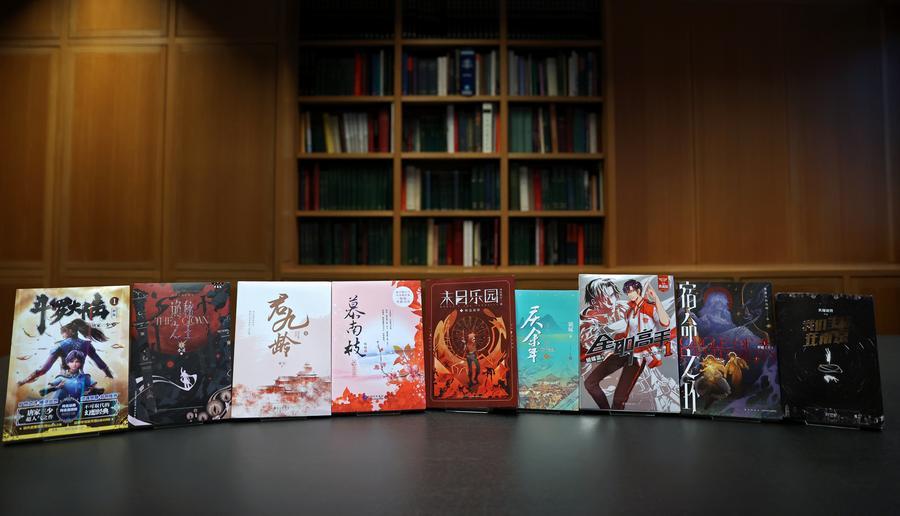
Lyu Shasha did not open Weidu Bookshop in London to make a grand statement about cultural exchange. She was trying to solve a simpler problem: Chinese readers in Britain missed the books they could once find so easily back home.It was a longing she knew well. Since moving to the UK in 2016, Lyu had often returned from trips to China with Chinese books packed into her suitcase. The longer she lived abroad, the more she felt their absence.Britain has no shortage of bookshops, libraries or public reading culture, but for readers seeking carefully selected Chinese-language books — especially contemporary literature and humanities titles — the options are limited.In 2024, while sorting through the books she had brought back from China over the years, Lyu spent more than 10 days going through the shelves in her study. Each time she picked up a volume, she could remember exactly where, when and why she had bought it: a market in Beijing, a bookshop in Nanjing, a trip to Hong Kong.“All those memories just pull me back to China,” she said. “Wherever I am, Chinese books nourish my spirit, but that joy is always shadowed by a sense of lack.”That feeling eventually led Lyu to open Weidu Bookshop, an independent Chinese bookshop in London, in 2024.Before opening the shop, she spent four months selecting every title by hand. She brought in books from major Chinese literary and humanities publishers, including People’s Literature Publishing House, and sourced some titles directly from publishers such as Imaginist rather than relying solely on wholesalers. She deliberately left out market-driven bestsellers, success manuals and feel-good quick fixes.“In an age of AI and information overload, what’s truly scarce is not information but judgment and taste,” Lyu said. “We chose every book by hand. It’s a slow way of doing things, but that’s where the bookshop’s foundation is.”The result was a shop shaped less by size than by intention. Alongside contemporary fiction, essays, poetry, history and social thought, Lyu created a children’s section and launched graded reading boxes for Chinese-language learners. The selections ranged from classical poetry and history books adapted for young readers to the Chinese-language Harry Potter series.After the shop opened, the demand Lyu had sensed became visible. Orders went out across the UK — to cities, villages, university towns and school dormitories.What surprised Lyu was that the shop’s reach extended beyond the Chinese community.She once noticed a British man in his 20s browsing so quietly in the shop that she assumed he could not read Chinese. In fact, he could, and the books he had been looking at were not easy ones. Another customer, a British woman who had lived in Shanghai a decade earlier, came in saying her Chinese was no longer good enough and that she had decided to pick it up again. She and Lyu talked about books and Beijing, where she is heading this September to study at Peking University.Those encounters gradually changed Lyu’s understanding of Weidu Bookshop. She had opened it to serve native Chinese readers living abroad. But over time, the shop also became a place where non-Chinese readers could encounter a China that felt current, literary and alive.“Through a modern Chinese bookshop, British readers can see what China is doing now — not a China trapped in history or imagined from afar,” Lyu said.In 2025, Lyu published her first annual list of the most popular Chinese books among UK readers. Displayed in university libraries and more than 80 venues across the country, the list gave shape to a readership that had often been scattered and quiet.
A quiet bridge of books
THE ARTICLES ON THESE PAGES ARE PRODUCED BY CHINA DAILY, WHICH TAKES SOLE RESPONSIBILITY FOR THE CONTENTS
597 words~3 min read