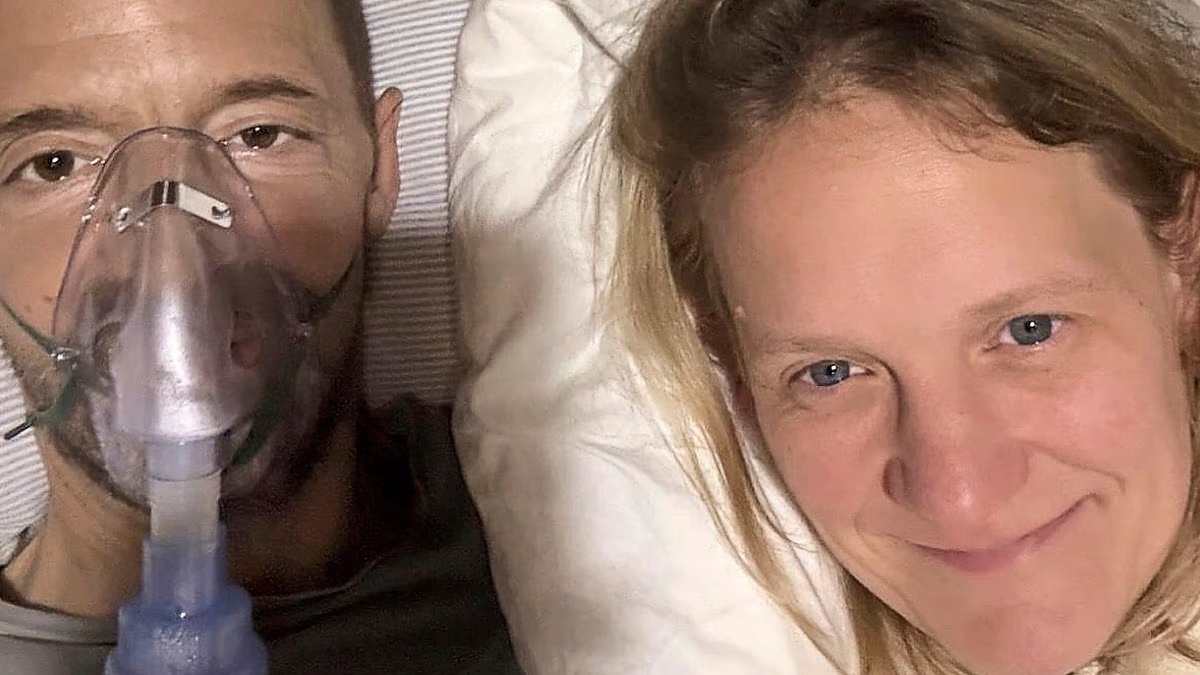
In March 2025, my finger was hovering over a button that said ‘share’. I was about to post on my Instagram grid for the first time in two years and it felt like opening a floodgate. The post was the picture you see below, of myself and my husband Ben lying in bed. He was wearing a nebuliser mask. I was there to tell my 80,000 followers that he had almost died.For the previous five years, I’d considered myself ‘in recovery’ from being an influencer. In 2015, my satirical account Deliciously Stella, which poked fun at clean-eating fads and the wellness industry, brought me fame and fortune. It also destroyed my mental health.To outsiders my dizzying ascent seemed like a Cinderella story. My fans included Davina McCall, Ellie Goulding and Ashton Kutcher. I had a book deal, a sold-out stage show and countless brand deals, but I was the unhappiest I had ever been.In 2016, not long after going viral, I was admitted to The Priory with severe depression and anxiety. I understand now that I was addicted to dopamine.It would take years to finally uncouple myself from my quest for validation, and I eventually posted my final piece of ‘sponsored content’ in 2020. I needed structure, stability and a steady income so I sought out a corporate job in social-media marketing. I would later find out the hard way that stability is an illusion.It was August 2024 when my partner Ben, then aged 47, fell ill in Majorca. My Instagram post of myself and my husband Ben with a nebuliser mask. I was there to tell my 80,000 followers that he had almost diedI was p***** off and tired of looking after our two children, aged five and 20 months, while he went back to bed. He’d been exhausted for weeks and had developed a nasty cough. I put it down to man flu then went for a dip in the pool.‘At least we’re here,’ I thought. ‘Where we’ve always dreamed of.’ We’d moved to Majorca permanently almost a year earlier, looking for sun, sea and a slower pace of life. Ben had been working as a drum ’n’ bass MC for 27 years and needed some time off the road. I now had my steady corporate role. We were relishing our anonymity and new life.One night, the cough intensified and Ben was violently ill. I sent him to the doctor who described his infection markers as ‘concurrent with someone who has sepsis’ and he was told to go straight to A&E.Ben was nonplussed. He didn’t feel that bad. I sobbed while he insisted he cook himself steak and chips before he went, as he might get hungry. I was already deep into Google and knew that the word ‘sepsis’ was never good.Within a week he was admitted to hospital with a chest infection caused by a bacteria called pseudomonas aeruginosa. I became a single mum overnight. The bacteria kept mutating and Ben was placed on stronger and stronger antibiotics. Six weeks later he started coughing up blood and was placed in a medically induced coma.The coma lasted another six weeks, during which time he survived sepsis, multiple organ failure and a heart attack. I breastfed my baby and quietly cried while the doctors told us he was unlikely to survive. My mother-in-law and I took turns to look after my children while keeping vigil by his bedside in the ICU.Every day the odds of Ben’s survival seemed less likely. In our darkest hour, the doctors told us that they had exhausted every antibiotic but one – which was extremely new.Miraculously, it worked. He pulled through. From being unable to eat, drink, talk or move he fought tooth and nail to get out of bed and into a chair. But just as we thought he was turning a corner and only a few days after being moved from ICU to the ward, there was another terrible blow – he was diagnosed with acute myeloid leukaemia.A few months later he was moved to a hospice in the mountains to die. He was having daily blood transfusions and had started to hallucinate. The doctors thought that the leukaemia had reached its final stage, but an MRI scan revealed another life-threatening infection, which led to an emergency operation to remove an abscess from his neck. Against all the odds, he survived and entered remission from the cancer. Bella with Ben and their two children... they got married as soon as they could when he got out of hospitalBen left hospital weighing just over 6st and the first thing we did was get married in the town hall in our village in Majorca. We were given special permission to do it in a matter of weeks and had a little party for 20 people in our tiny garden. Ben was still frail and in pain. My mum cooked and his made flower arrangements from the local market.I’d never imagined myself getting married, and in a way it felt perfect in its absurdity. None of us could believe it was happening when just weeks before our wedding guests had flown out to say their final goodbyes. We weren’t sure when the cancer was going to come back but it’s now been 16 months, and the cancer is nowhere to be seen.Our new problem was finding a way to make a living. I had taken four months off when Ben was ill and when I tried to return to work, I was told the company had restructured and I lost my job. We needed money, fast. I couldn’t get another job in the UK that would let me work from Spain, and my Spanish wasn’t strong enough for a marketing role in Majorca. I also needed flexibility to look after my children while Ben was still in and out of hospital.Could it be safe to go back on social media, where I had made money in the past? Being an influencer is the loneliest job in the world, and it filled me with dread. I started writing about what had happened to Ben on Substack, the longform newsletter app. I slowly climbed to a few thousand subscribers, then some of them started to pay. I realised that I could make money on social media without resorting to being an influencer.When I was at my peak on Instagram a few people had asked me for advice on growing their accounts. There was a proliferation of social media ‘coaches’, spouting tips on how to go viral and ‘make internet money’. Looking at their suggestions, I was horrified. Some coaches encouraged posting three times a day, some aimed to shock or manipulate their audiences, all claimed to make hundreds of thousands of pounds.I knew from experience that anyone following these instructions would end up burnt-out, fed-up or worse. Perhaps, I thought, I could come back to social media to help people navigate it in a more manageable way. I created a website and started consulting my first clients.My main concern was that I didn’t want to encourage the habits that had made me so ill. If I was going to help people grow, mental wellbeing had to be at the forefront of my message. I now help creators and businesses build strong personal brands and grow steadily on social media without risking burnout. I teach them how to work smarter, not harder, and it’s rewarding to help people make sense of a world I know so well.I knew that to attract business, I needed a presence on Instagram. I had to practise what I preached. I pressed ‘share’ on the Instagram post about my husband and the outpouring of love and support from my long-neglected following brought me to tears. In abandoning my account, I had thrown the baby out with the bathwater. There were people on the other side of the app I loathed so much, and those people were my community. I can do this, I thought. I’ve got to do this for my family.And in the process, I have found I am able to be online and at peace. I’m no longer motivated by fame, fortune and followers. My husband has been given a second chance at life, and I have been spared a lifetime of grief. We want to live in a way that feels safe, secure and full of joy. We want to live our lives in Majorca, and if social media can help my family exist comfortably on the island we love, then I’m genuinely happy to be there.@deliciouslystella
I dismissed my husband's cough as man flu and went for a swim
Bella Younger had overcome a breakdown and made her dream move to Mallorca - only for a shock diagnosis to shatter everything
1,427 words~6 min read