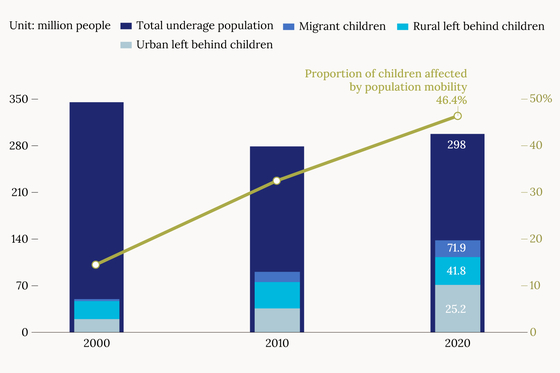
1. Ninth-grader Liu Yu faces a pivotal decision regarding her education due to not having Beijing household registration (hukou). This status restricts her to only attending vocational school in Beijing, unless she moves to another province to pursue a regular high school and prepare for university entrance, effectively pushing her away from the city she grew up in [para. 1][para. 2][para. 3]. Liu’s case illustrates the broader dilemma for many migrant families in China, who must frequently choose between continuing in the city and seeking better educational opportunities elsewhere [para. 3].2. The Liu family considers sending Liu to neighboring Hebei province or returning to their distant hometown in Anhui province as viable options for her further education. Such choices exemplify the challenges faced by migrant families, who often must relocate or separate to secure their children's educational futures [para. 3].3. The predicaments like Liu's are common among the 80 million migrant children in China, representing over 30% of the country's underage population, as cited in the 2023-2024 Development Report on China’s Migrant Children. Each spring, non-local students graduating from junior high in cities like Beijing must decide where they can continue their schooling [para. 4][para. 5].4. Although China has started to improve local access to basic public services for migrant children and gradually loosened restrictions on attending local schools, major barriers persist for high school and college entrance in wealthier cities. Household residency restrictions often force children to return to their hometowns, with over 70% of surveyed migrant parents experiencing enrollment difficulties and over 40% compelled to send their children back for further schooling according to the Beijing Collaborator Social Work Development Center [para. 6][para. 7].5. The central government recognizes this issue and its 2024 work report proposed easing conditions for migrant children’s registration for high school entrance exams; however, these measures depend on “local conditions,” and their interpretation varies greatly. Cities such as Guangzhou and Shenzhen allocate only a small number of high school seats for non-locals, often requiring higher exam scores, creating a two-tiered system with significant pressure on migrant families [para. 8]. Some areas, like Zhejiang province, are experimenting with reforms that tie funding to students regardless of hukou status, potentially providing a path forward [para. 8].6. For many families, strategizing about education involves years of planning and often daunting sacrifices. Some parents manage to secure local residency or work permits that grant their children some schooling rights, but these do not guarantee equal access, particularly to college. Many families contemplate selling homes or living apart for years to navigate these barriers, sometimes relocating specifically to secure better educational prospects for their children [para. 10][para. 11][para. 12][para. 13][para. 14].7. The financial burden is especially severe for low-income migrant families, who often cannot afford to buy property or meet documentation requirements for public schools. Many must pay substantial tuition and ancillary fees for private schools, which can total thousands of yuan per semester [para. 15][para. 16]. With limited resources, some parents opt to leave their children in their hometowns—resulting in nearly 67 million “left behind” children as of the 2020 census. Schools that once served migrant children are also rapidly disappearing, dropping to fewer than 20 in Beijing by the end of 2024 [para. 17][para. 18].8. Zhejiang province provides a potential national model by directly funding districts based on the number of migrant children they serve rather than hukou status. This has led to universal public school access for migrant children with residence permits, and, crucially, the chance to take the university entrance exam if they complete three consecutive years of local high school. These reforms mean that in Zhejiang, the chief limits on a child’s educational future are now primarily family finances and academic ability, rather than policy blocks [para. 21][para. 22][para. 23][para. 24][para. 25].AI generated, for reference only
In Depth: How China’s Migrant Students End Up Locked Out of Local High School
Residency rules force millions of families to make an impossible choice — abandon the cities that have become home or give up on the possibility of a university education for their children
632 words~3 min read