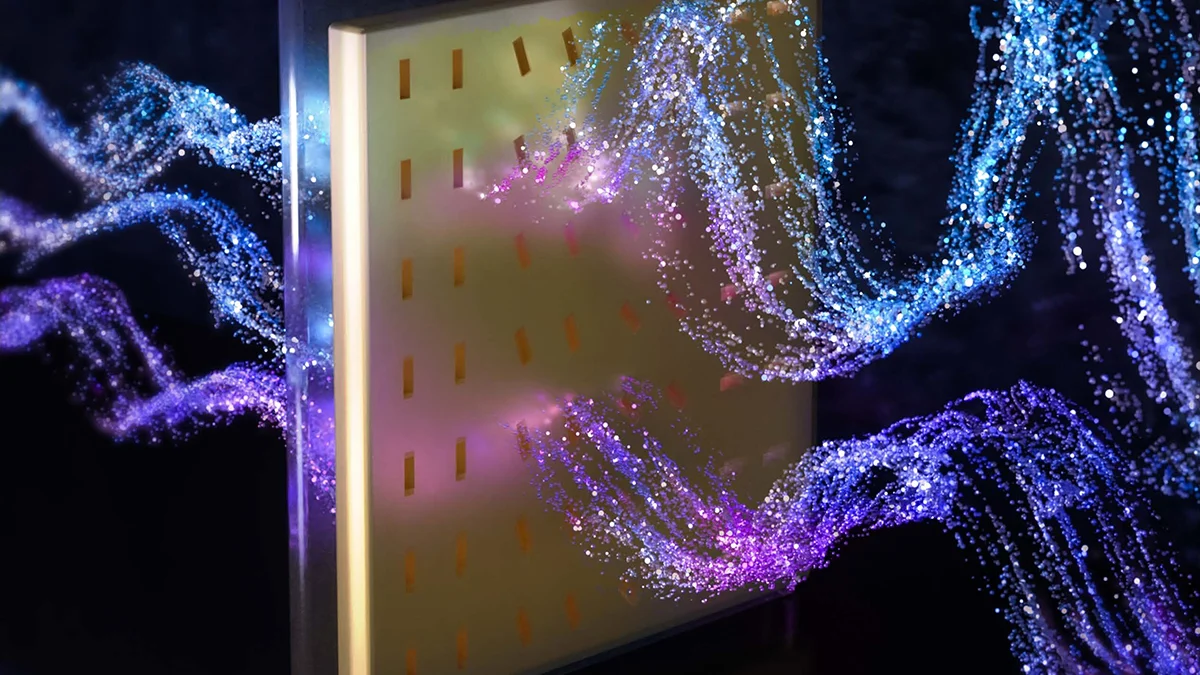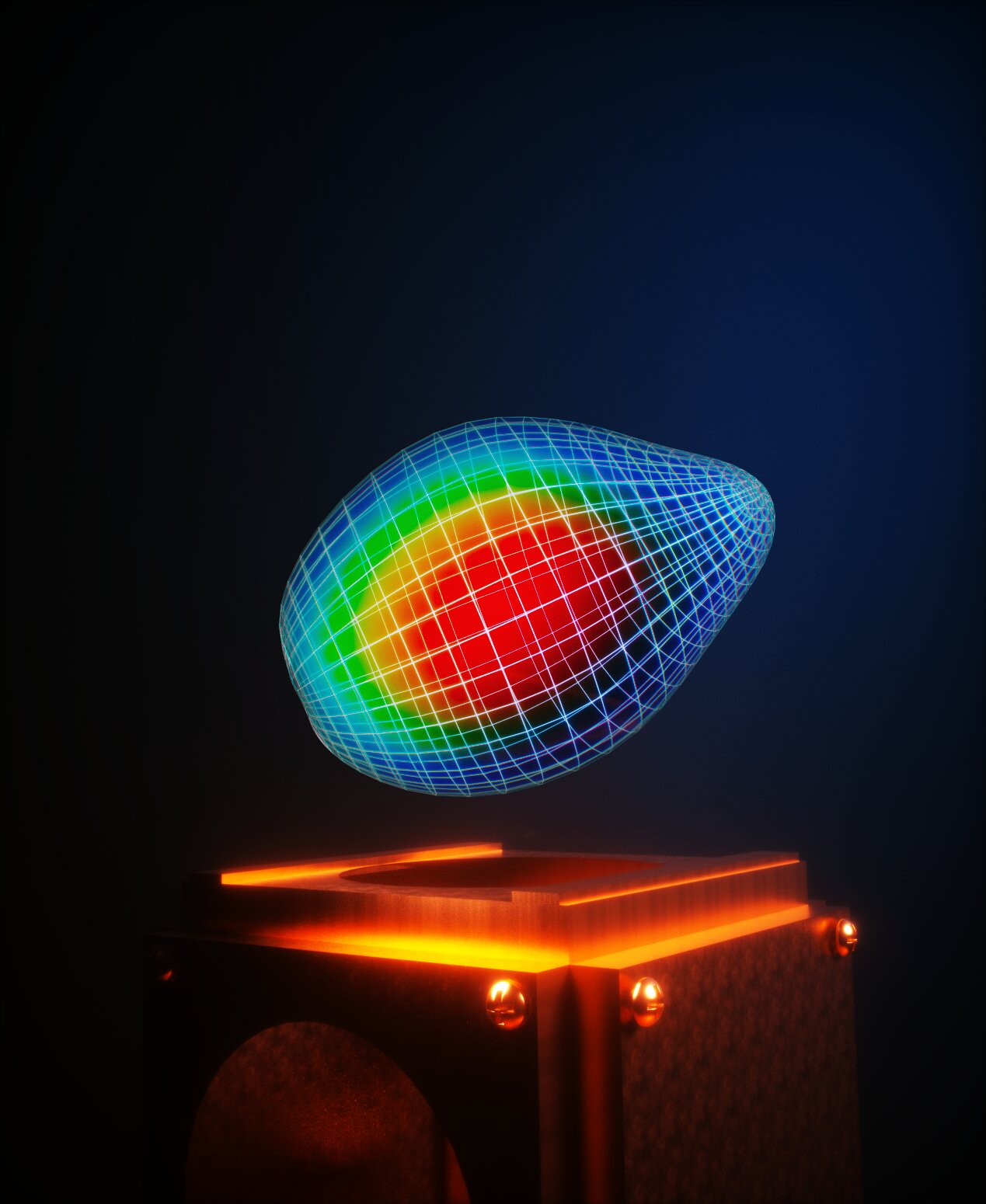
Radium has a pear-shaped nucleus, which enhances its sensitivity to new particles and forces. The copper chamber below depicts a simplified version of the cryogenic cell used by the Hutzler lab to form radium-containing molecules. Credit: Ella Maru Studio
For the first time, researchers have developed a way to create chilled molecules containing the radioactive element radium. The resulting laboratory concoctions, generated in part through steps similar to those used to make candy, are poised to help researchers solve one of the biggest mysteries of our universe: How did matter in the early universe come to dominate over its antimatter counterpart?
Early in the universe, matter and antimatter were created in equal proportions. The negative electron, for example, has an antimatter twin called the positron, which is positively charged. An electron and positron can be created from energy in perfect pairs, yet when the two meet, they annihilate each other back into pure energy. Just what happened to all the antimatter remains one of the biggest mysteries in physics. Some kind of difference, or asymmetry, between matter and antimatter must exist to explain why matter was favored during the creation of our universe.