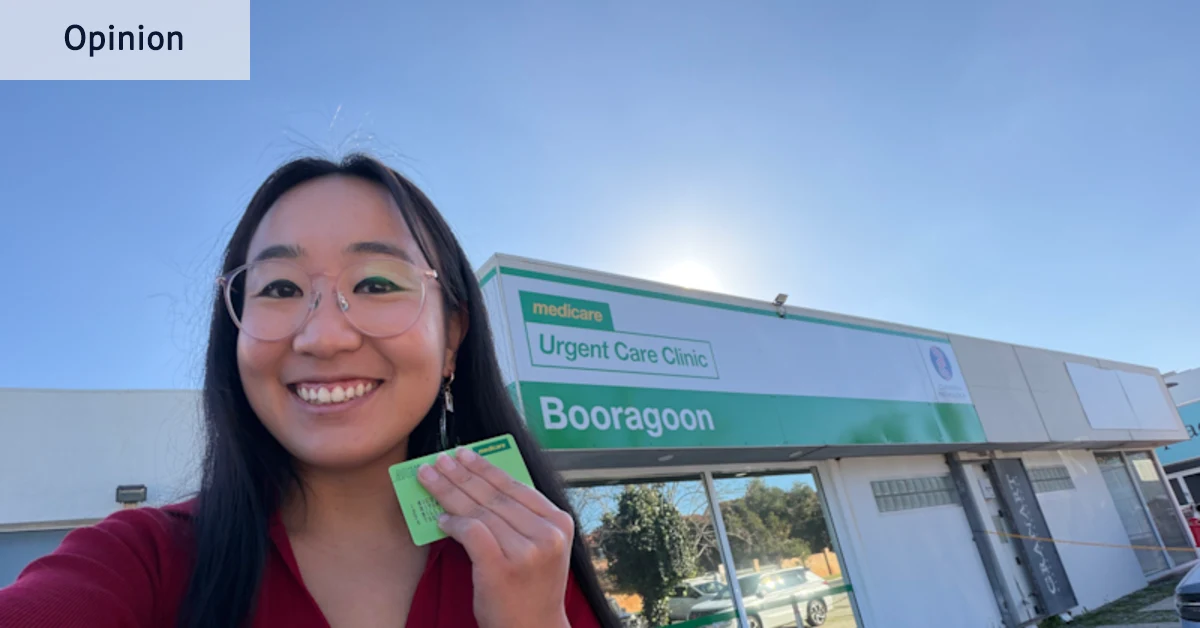
OpinionJuly 17, 2026 — 9:48amIt wasn’t the sharp twist of my ankle or the sudden tripping sensation that spooked me: those feelings I’m quite familiar with as someone with (what my physio has since told me is) a hypermobile ankle. It was the seconds after my ankle gave way — time I usually spend snapping back and continuing on my run — that told me I was in trouble.Hobbling along the home stretch of a 16 kilometre training run, just 300 metres from home, I could feel the probability of a marathon personal best dwindling with every step: this stabbing pain felt worse than any of my previous misadventures.Medicare urgent care clinics are generally open after business hours.Matt DavidsonEven once I’d lain down with my ankle elevated and iced, I could feel the joint angrily protesting in pain. I have a bad habit of letting my mind rule over my body and pushing through the warning signs. I couldn’t get anywhere without someone holding me up.All of this is to say: I ended up at a Medicare urgent care clinic in the Perth suburb of Booragoon the next day. It’s where I saw how the billions of dollars in public spending on a new form of healthcare could meet a need almost all of us have occasionally – at a surprisingly smaller cost to patients and taxpayers.I wasn’t particularly keen to pay for an appointment with a general practitioner after copping a hefty fee to push back my flight home to Sydney. Finding a bulk-billed GP was also tricky: most seemed not to offer the service, and the ones that did only offered it to certain people or were heavily booked. I also knew I would almost certainly be sent elsewhere — and be billed again — for an X-ray.The emergency department would be a one-stop to rule out a fracture or anything more serious than a sprain. But I knew I’d be (rightly) triaged as a low-priority case and be waiting indefinitely — and that it just wasn’t the right place to be for a non-life-threatening condition.It took about 90 minutes to be seen by a nurse at one of the relatively new Medicare urgent care clinics in Booragoon.A quick search told me that a Medicare Urgent Care Clinic would be the best fit for me, treating “minor fractures, sprains and sports injuries” — as well as other non-life-threatening but urgent cases such as minor infections, respiratory illness, minor burns and minor cuts.The initial wait to see a nurse was about 90 minutes. During that time, an interesting array of people walked in: plenty with lingering coughs, a woman with chest pain who was gently told she was better off going to ED because the clinic wasn’t equipped to rule out cardiac problems, a mother with a baby who had a fever and wasn’t eating, and a man who’d fallen off a motorbike and sprained his wrist but didn’t have Medicare so was told he’d be better off going to a GP.The urgent care clinic was 750 metres away from an imaging facility.After getting assessed by a nurse, my case was run by a doctor who gave me a referral for an X-Ray at a clinic just 750 metres down the road. There, some invisible beams were shot through my foot, and an hour later, the doctor back at the urgent care clinic gave me my result: “good news, no fracture!”Many urgent care clinics are also equipped with diagnostic tools in-house such as X-Ray machines, which would allow patients to bypass the back-and-forth to a separate X-Ray facility.The entire process from stepping into the clinic to getting my diagnosis, being bandaged up and given a treatment plan, took about four hours: a long time but undoubtedly faster — and less costly to the taxpayer — than going to an ED.I’m fortunate in that if I needed to, I probably could have dug into my savings to see a GP and get a scan.And according to an interim report published last year by the Department of Health, the cost of each presentation to an urgent care clinic costs taxpayers between $206 for clinics opened before September 2024, and $246 for newer ones opened more recently which are expected to see average costs decrease as they become more established.The latter figure is one the Royal Australian College of General Practitioners has said is five times higher than a standard GP consult which sets taxpayers back about $42 on average. It’s worth noting, though, that GPs may not love the Urgent Care Clinics because these clinics are, in economic terms, at an “unfair” government subsidised advantage.Basically, I might have saved taxpayers about $200 if I’d sucked it up and gone to a GP instead, although I would borne that cost myself (the gap fee might have been about $44 according to some estimates, though a five-minute GP appointment set me back more than $100 recently). There is, of course, a good chance I would have written off professional medical attention completely and just hoped for the best.The reality, though, is that for many Australians, going to a GP is a substantial cost. That might mean they choose to delay or not seek any medical attention at all, meaning their conditions may worsen or not fully heal. Or, they end up at their closest ED where they may have to wait a long time, but will eventually be seen without having to pay.Both of these alternatives come at potentially higher costs. That includes loss in quality of life (for example, if a condition becomes chronic or is never treated), needing more invasive or costly intervention down the line because a person decides not to seek help and the condition worsens, or the higher cost attached to an emergency department presentation.The latter is easier to put a number on. The Health Department’s most recent report indicated the average funding needed for patients who went to an urgent care clinic, but would otherwise have gone to an ED or called an ambulance, was $236 (compared with $220 for all other cases).Had the same people gone to the hospital instead, it would have cost taxpayers closer to $617, saving about $381. That’s because regardless of who is being treated, hospitals must have emergency physicians rostered on and specialised equipment such as advanced life support ready to go, which come at a steep cost. An urgent care clinic doesn’t require the same level of staffing or equipment on hand.One criticism of urgent care clinics is that they may be used by people who have the money to see a GP but choose to go to a clinic for free treatment instead, putting unnecessary pressure on government finances and take up public medical resources which could otherwise be used to treat those who have no alternative.While that’s probably true (I could have gone to a GP, for example), that limitation is almost certainly outweighed by the societal and individual patient benefits: late-night accessibility, early intervention and reduced wait times as fewer people sit at EDs.Couldn’t we just pay existing GPs to stay open longer? We could, but GPs generally don’t have access to the imaging tools the urgent care clinics do, and some will not be able to immediately stitch up a deep cut or do a blood test. There’s also the issue of affordability at GPs that don’t bulk-bill.And nearly half of patients who went to an urgent care clinic reported they would have gone to an emergency department or called an ambulance if the clinic was not available, meaning pressure is almost certainly being taken off hospitals.Urgent care clinics, typically open between 8am and 10pm daily, are essentially a middle-ground between GPs and emergency departments, able to specialise and therefore save money — and provide more targeted or immediate care for urgent matters.These clinics, of which there are more than 130 now, were first opened in 2023 and have seen nearly 3 million cases over the past three years, with roughly four out of five Australians living within a 20-minute drive from one.They’re not perfect. Urgent care clinics could prevent more emergency department presentations if they were open longer. The bulk billing system at GPs needs to be improved. And there’s no doubt there are some cases which would be better served by a GP and cost the public less.But these clinics also undoubtedly improve access to healthcare, especially for those who are most vulnerable, and ensure many Australians get on the front foot with their injury or illness, leading to savings we may not necessarily see directly.I’m optimistic that my trip to the urgent care clinic, which was surprisingly pleasant all round — with empathetic, efficient and friendly staff — will have me back on my feet faster than if I’d left it untreated.“It’ll take six weeks to heal fully, and you’ll need to get into physio quickly from here,” the doctor told me at the end. Seeing my panicked face, she reassured me: “you can start getting in some movement over the next few weeks. Otherwise, you’ll go mad.”That might be the most accurate prognosis yet.The Business Briefing newsletter delivers major stories, exclusive coverage and expert opinion. Sign up to get it every weekday morning.Millie Muroi is the economics writer at The Sydney Morning Herald and The Age covering workplace and economics. She was formerly an economics correspondent based in Canberra’s Press Gallery and the banking writer based in Sydney.Connect via X or email.From our partners
I ended up in a Medicare urgent care clinic … and I liked it
A badly rolled ankle landed Millie Muroi at a new urgent care clinic in Perth. Four hours later, she hobbled away with an unexpected prognosis.
1,582 words~7 min read