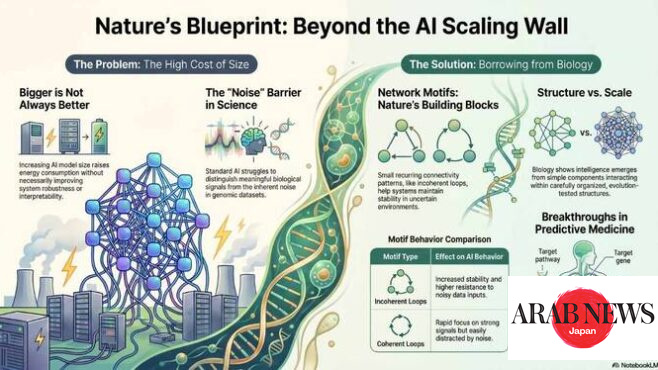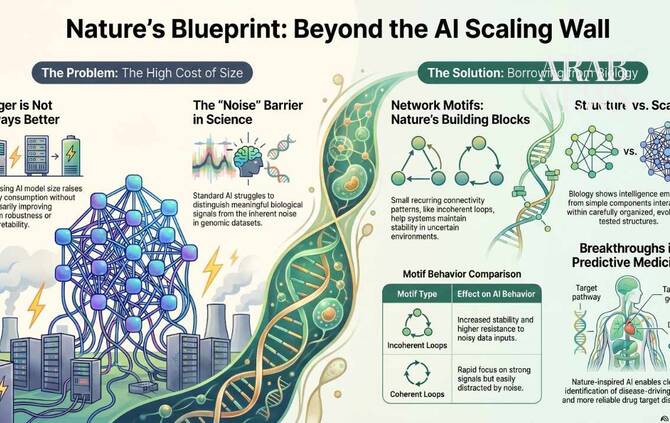
RIYADH: For years, the race in artificial intelligence has been driven by scale, with companies building ever-larger models trained on vast datasets. But researchers at King Abdullah University of Science and Technology believe the next leap forward may come not from making AI bigger, but from learning how nature processes information.
At KAUST, scientists are investigating how biological networks can help AI handle the rapidly expanding volume of life sciences data more efficiently.
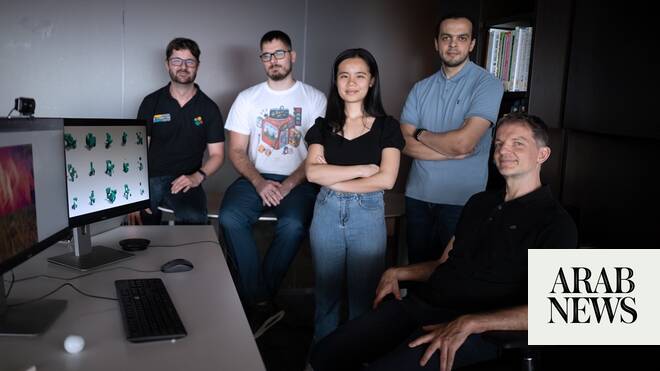
“Nature has spent billions of years solving information-processing problems,” Jesper Tegner, professor of bioscience and associate dean of students in the Division for Biomedical Sciences at KAUST, told Arab News.
“The human brain, genetic regulatory networks, immune systems, and ecosystems are all examples of highly efficient, adaptive systems operating in noisy, uncertain environments.”
While recent advances in AI have largely come from increasing model size, data and computing power, Tegner argues that scale alone is not enough.