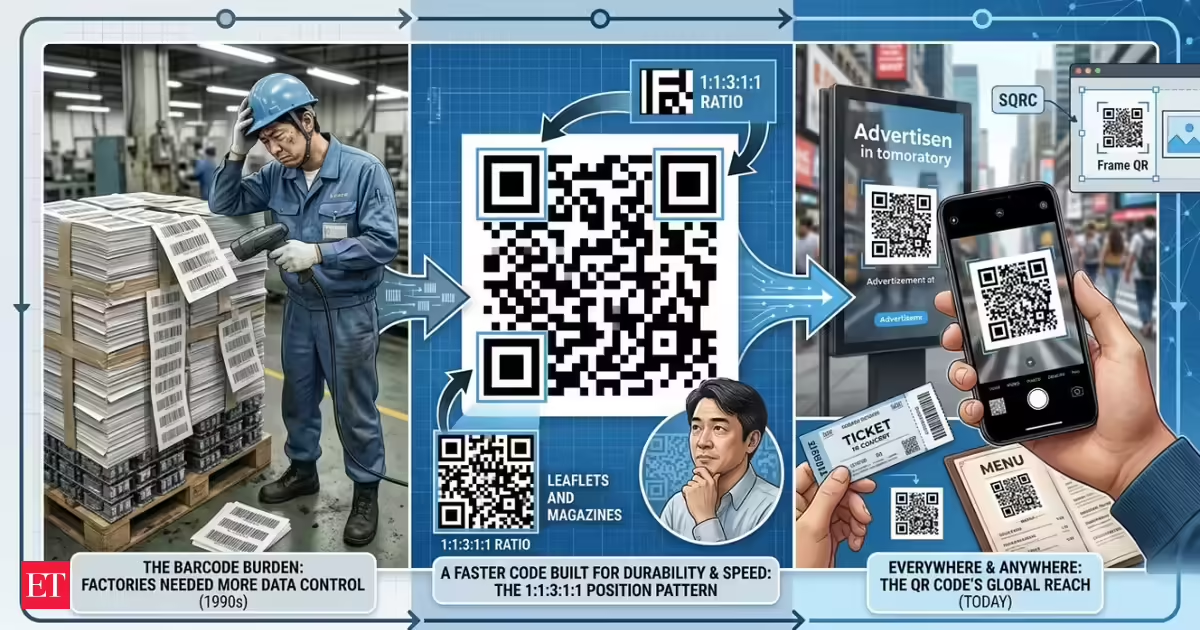
QR code invention story: Today, QR codes are everywhere. You see them on tickets, advertisements and countless other things. But the technology began with a much more specific problem inside manufacturing plants.In the early 1990s, workers were dealing with a barcode system that was becoming increasingly difficult to use. As production became more flexible and products became smaller, factories needed to manage more information. The existing barcode system simply could not keep up.That problem eventually led to the development of the QR Code system by engineers at DENSO WAVE, as per a report.Why existing barcodes were becoming a problemBy the 1980s, barcodes were already widely used in manufacturing, distribution and retail.But by the 1990s, manufacturing sites were moving away from mass-producing one type of product and needed more detailed production control. That created a demand for barcodes capable of storing more information.You Might Also Like:Each barcode could hold only around 20 alphabetic characters. To make up for that limitation, workers sometimes had to use multiple barcodes at once. In some cases, they were required to scan around 1,000 barcodes a day.The system was becoming inefficient. Masahiro Hara, who was working on barcode scanners and optical character recognition devices at DENSO, was asked in 1992 to help develop scanners that could read barcodes more quickly, as per a DENSO WAVE report.But he soon realized that simply improving the scanners would not solve the larger problem.You Might Also Like:The idea that led to the QR CodeHara decided to develop a compact code that could store much more information, including Kanji and Kana characters, while also being read at a much higher speed, as per the report.Unlike traditional barcodes, which store information in one direction, a two-dimensional code can store information both horizontally and vertically.The development team began working on the new code with just two members.Their biggest challenge was speed. A scanner could easily identify the position of a traditional barcode, but recognizing the location of a two-dimensional code was more difficult.You Might Also Like:Then Hara came up with an idea: add a pattern to the code that would tell the scanner where the code was located, as per the DENSO WAVE report.The unusual pattern hidden in QR codesThe team eventually created position detection patterns at three corners of the code.But finding the right shape was not easy. If a similar pattern appeared nearby, the scanner could mistake it for the code.To solve the problem, the team studied black-and-white patterns found in printed materials, including leaflets, magazines and corrugated cartons.After examining countless examples, they identified a black-and-white ratio that appeared least often: 1:1:3:1:1, according to the report. That ratio became the basis of the position detection pattern, helping scanners recognize QR codes quickly, regardless of the scanning angle.A faster code built for the factory floorAfter a year and a half of development and repeated trial and error, the QR Code system was completed.The new code could store approximately 7,000 figures, could encode Kanji characters and could be read at more than 10 times the speed of other codes, according to DENSO WAVE's account of its development.It also offered another advantage for manufacturing environments: durability.Why QR codes worked where barcodes struggledFactories can be dirty environments, with oil and other substances potentially affecting printed codes.QR codes included an error correction function, meaning they could still be read even when part of the code was stained or damaged.The three position detection patterns also helped scanners identify the code accurately, whether it was being scanned manually with a mobile scanner or mechanically on a production line.How a factory solution spread far beyond factoriesThe QR Code system was launched in 1994, initially to solve problems in manufacturing.But its use eventually expanded far beyond the factory floor. QR codes began appearing on tickets, advertisements and in many other applications.DENSO WAVE also continued developing the technology, including the SQRC, which adds a data-reading restriction function, and Frame QR, which includes a canvas area within the code for design purposes, as per the DENSO WAVE report.
One engineer solved a small factory problem, the whole world benefited - here's the story behind QR codes
QR code invention story: Discover the fascinating story of QR codes, originating from a manufacturing challenge to becoming an essential part of modern life. Learn how one engineer's innovation transformed technology and usability in various industries.
666 words~3 min read